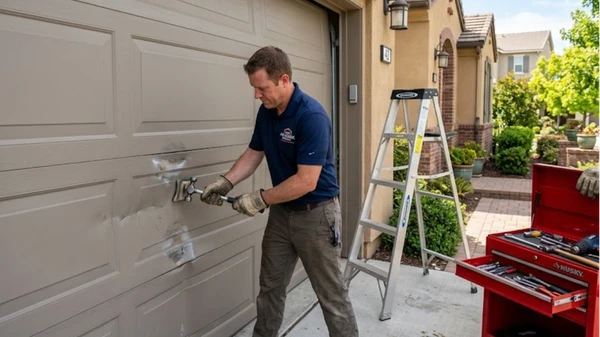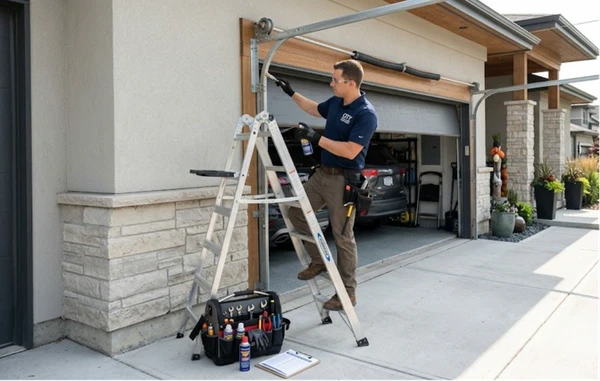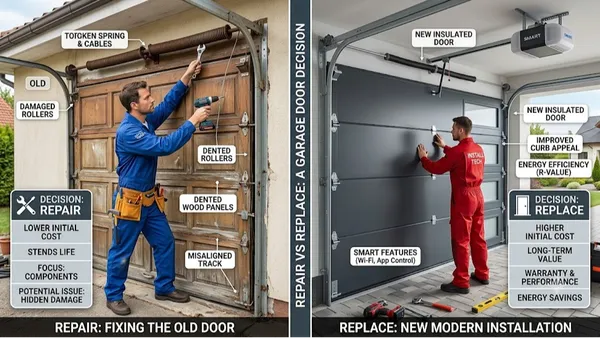
The repair guy shows up, looks at the door for ten minutes, and tells you it needs a new torsion spring. That's $250. But the door is fourteen years old, one panel is dented from a backup three years ago, and the opener has been grinding for a while. Do you fix the spring and move on, or does this become the moment you just replace the whole thing?
This decision comes up constantly. And the honest answer isn't always obvious from the outside.
Here's the framework that actually helps.
Start With the Age of the Door
Not because old automatically means replace - plenty of 20-year-old doors are worth repairing - but because age tells you something important about what's coming next.
A well-maintained steel garage door lasts 20–30 years. Wood runs 15–20 years before maintenance costs start adding up seriously. Aluminum sits in the middle, roughly 20–25 years.
If your door is under 10 years old and the problem is a single component - spring, cable, panel, opener - repair almost always makes financial sense. The door itself has a lot of useful life left, and you're just replacing what broke.
If the door is 15–20 years old and you're looking at a repair, ask yourself this: is this the first thing that's gone wrong, or the third? A 17-year-old door needing its second spring replacement and a panel swap is telling you something. You're spending money on a door that's heading toward the end of its useful life anyway, and each repair buys you less future than the one before.
The Repair Cost Rule of Thumb
There's a rule used in the appliance world that translates well to garage doors: if the repair costs more than 50% of the replacement cost, replace.
A basic single-car door replacement runs $800–$1,500 installed. A double-car door, $1,200–$3,000. So the rough threshold is:
- Single door: repairs over $600–$750 → replacement worth serious consideration
- Double door: repairs over $800–$1,200 → same
These aren't hard lines. A $700 repair on a 5-year-old door is almost certainly worth doing. A $500 repair on an 18-year-old door with other problems brewing might not be.
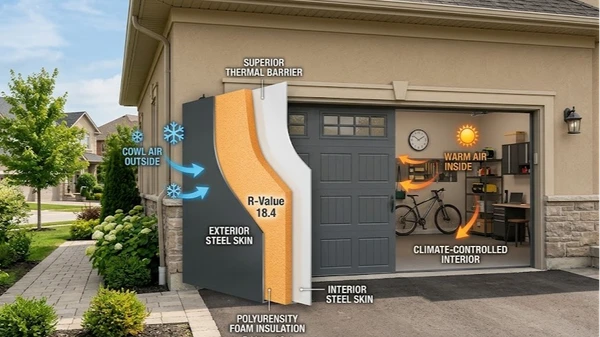
The calculation changes when you factor in what you're getting with a new door - better insulation, quieter operation, updated aesthetics, a fresh warranty. If the old door is costing you on energy bills or just looks rough, the calculus shifts toward replacement even at lower repair costs.
Damage That Almost Always Means Replace
Structural frame damage. If the door frame - the wood or steel surrounding the opening - is rotted, warped, or damaged from impact, you're not just replacing a door. The opening itself needs work, and whatever caused the frame damage (moisture, impact, settling) needs to be addressed too. This is a replacement situation, not a repair.
Multiple bent or bowed panels on a sectional door. A single dented panel can usually be replaced at $200–$500 for the section. Two or three panels that are bowed, dented, or misaligned means the door took a significant impact or has been running wrong for a long time. At that point, panel-by-panel replacement costs more than a new door.
Severely bent tracks. Tracks that are slightly out of alignment can be adjusted. Tracks that are visibly bent or warped from impact - usually from a car hitting the door while it was closed - often can't be straightened reliably. The door that rides on warped tracks will never operate smoothly and will wear rollers and hardware faster. Replace the door and tracks together.
Water or rot damage on a wood door. A little rot at the bottom corners of a wood panel can be cut out and filled with epoxy. Rot that's spread into multiple panels, or that's compromising the structural sections, means the wood itself is failing. No amount of filler makes a structurally rotted panel worth keeping.
Damage That's Almost Always Worth Repairing
A broken torsion spring. This is the most common "scary" repair that's almost always just a repair. Springs have a rated cycle life - usually 10,000 cycles for standard springs, 20,000–100,000 for high-cycle springs - and when they reach it, they break. A spring replacement on a door that's otherwise in good shape costs $200–$350 and makes complete sense. If you're replacing springs on a door that's less than 15 years old with no other significant issues, repair it.
A single damaged panel. One dented or cracked panel on a door that's otherwise sound is a repair situation. The challenge is matching the panel - color, style, and texture - which gets harder the older the door is. Manufacturers discontinue panel styles. But if you can get a match, a single panel replacement at $150–$500 is clearly better than a full door.
A broken cable. Cables fray and snap. It happens. A cable replacement costs $150–$250 and takes a technician an hour. Unless the rest of the door is problematic, this is always a repair.
Worn rollers. Grinding, squeaking, visible cracking on the wheels. Replace the rollers ($100–$300 including labor), keep the door. Easy call.
A malfunctioning opener. Openers fail independently of the door. If the door itself is in good shape and the opener is the problem, fix or replace just the opener ($200–$500 installed). The door's fine - the box on the ceiling isn't.
The Middle Ground: When It's Genuinely 50/50
Some situations don't have a clean answer.
A door in the 12–17 year range with moderate wear, needing a spring and a panel. The door works, doesn't look terrible, but it's clearly not new. A repair keeps it going - probably for another 3–5 years before the next issue. A replacement costs more now but starts the clock over with a warranty and modern performance.
In this situation, ask the technician to do a full condition assessment while they're there - springs, cables, rollers, hinges, panels, opener. Not to upsell you, but to understand what else is near the end of its life. If only one thing needs fixing and everything else looks reasonable, repair. If the assessment turns up multiple items that are worn or borderline, you might be stacking repair costs over the next few years that would have paid for a new door.
Also factor in energy costs. An old uninsulated door on an attached garage is costing you money on heating and cooling every month. A new insulated door pays back part of its cost over time. That's not a reason to replace a door that's otherwise fine - but it's a factor when the door is marginal anyway.
What Good Technicians Do That Bad Ones Don't
A technician who looks at a damaged door and immediately recommends full replacement without considering repair options isn't necessarily wrong - but they should be able to explain why.
Ask specifically: "What would a proper repair look like, how long would it realistically last, and what's the cost comparison?" A straight answer to that question tells you a lot about whether you're getting honest advice.
The reverse is also true. A technician who patches everything and never mentions that the door is getting close to the end of its useful life isn't doing you any favors either. The best advice acknowledges both options with their real costs and honest timelines.
DoorFixy will assess your door and give you a straight comparison - repair cost and realistic lifespan estimate versus replacement cost and what you'd gain. No pressure either direction. Call or message us to arrange an assessment.