The basketball hit it. The car got a little too close. A hailstorm rolled through and left its mark.
However it happened - now you've got a dented garage door panel and zero idea what it'll cost to fix it.
Good news: most dents don't cost nearly as much as people assume. Here's the real breakdown.
It Depends on How Bad the Damage Actually Is
Not all dents are created equal. A shallow scuff from a bike handlebar is a completely different job than a deep crease from a car bumper.
Here's how most garage door dent repair jobs break down by severity:
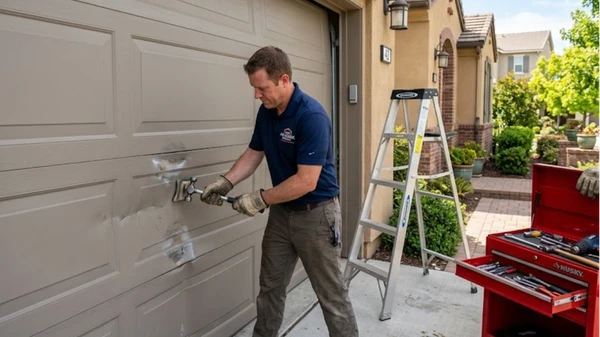
Minor dents - small, surface-level damage with no paint cracking These are the easiest and cheapest to deal with. Minor dents from things like sports equipment typically cost $100 to $300 to repair. A technician accesses the back of the panel and massages the metal back into shape - no repainting needed.
Moderate dents - deeper damage where paint has cracked or the panel is visibly warped More extensive panel repair runs $250 to $400and involves a bit more work - filling, sanding, and color-matching the finish.
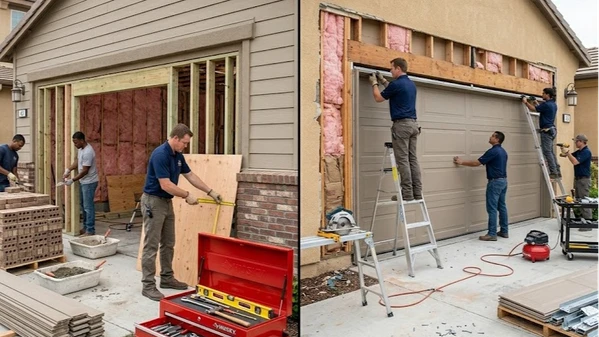
Severe dents or structural damage - the panel is crushed, bent out of track, or multiple panels are hit At this point, repair often gives way to replacement. Replacing a single damaged panel costs $300 to $900+.If several panels are affected, full door replacement - which runs $700 to $3,500 - often makes more financial sense than patching each one individually.
Your Door's Material Changes Everything
The same size dent costs very differently depending on what your door is made of.
Steel doors are the most common and the most forgiving. Dents in metal garage doors are generally easier to repair than wood or composite, so they tend to be more affordable.
Aluminum doors are lightweight and flexible - dents pop out more easily, but the material is also more prone to denting again in the same spot.
Wood doors are the expensive one. Wood is the most expensive garage door material to repair. Dents, splitting, and cracks are hard to fix and are more likely to require full replacement over repair.
Fiberglass and composite doors sit in a middle ground. They're durable, won't split, and repairs average around $100 to $200 in most cases.
Should You Try to Fix It Yourself?
There are a few DIY tricks that actually work on shallow dents - the heat-and-cold method, a rubber mallet with a wood block, or a suction cup puller. For a tiny ding with no paint damage, these can genuinely do the job.
But here's the honest truth about going further than that.
Deeper dents are tricky. Push too hard in the wrong spot and you buckle the panel worse than before. Paint matching is harder than it looks. And if the dent has shifted the panel enough to affect how the door sits in its track - that's a safety issue, not just a cosmetic one.
Attempting self-repair on more serious damage often compounds the problem and can void manufacturer warranties. For anything beyond a surface scuff, a professional call is usually the smarter move.
When Repair Stops Making Sense
There's a point where patching a dent costs more than it's worth. A few signs you're there:
- The door is already 10+ years old and showing wear elsewhere
- More than one panel is damaged
- The dent is deep enough that the door no longer sits level or closes smoothly
- You can't find a matching replacement panel for your door model
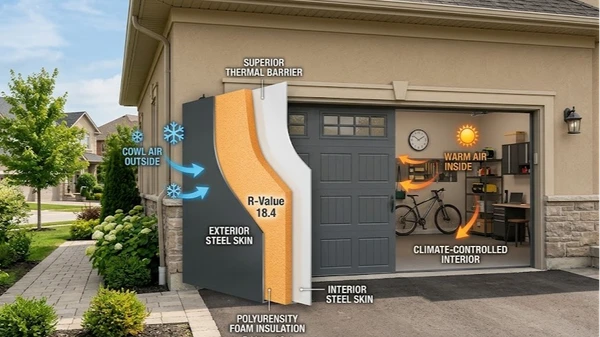
If your door is nearing the end of its lifespan or showing wear beyond the dent, replacement is often more cost-effective long-term - and gives you the chance to upgrade to a more energy-efficient, better-insulated door.
The Bottom Line
A small dent? Probably a quick, affordable fix. A caved-in panel on a 15-year-old door? That math might push you toward replacement.
Either way - don't ignore it. Letting dents sit can strain tracks and hinges over time, turning a simple cosmetic fix into a much more expensive repair.
Get a technician to look at it, get the number, then decide. Most of the time, it's far less dramatic than you'd expect.
/