Most people ignore their garage door until it stops working.
Then comes the emergency call, the repair bill, the whole headache - and somewhere in the middle of it, the technician mentions that regular tune-ups would've caught the problem six months ago.
So. Is that true? And is a yearly tune-up actually worth paying for?
Short answer: usually yes. Here's the full picture.
What a Tune-Up Runs These Days
A standard garage door tune-up costs $100 to $150. Premium packages - which include more thorough diagnostics, better parts, and extended service guarantees - typically run $150 to $250.
Most of that is labor. The job itself takes an hour, sometimes less on a door that's been maintained before. On a door that hasn't been touched in five years, expect the technician to spend more time - and possibly find things that add to the bill.
That's not a scare tactic. Springs wear down. Rollers crack. Cables fray. A tune-up surfaces all of it.
What They Actually Do When They Show Up
Not just a visual check and a handshake.
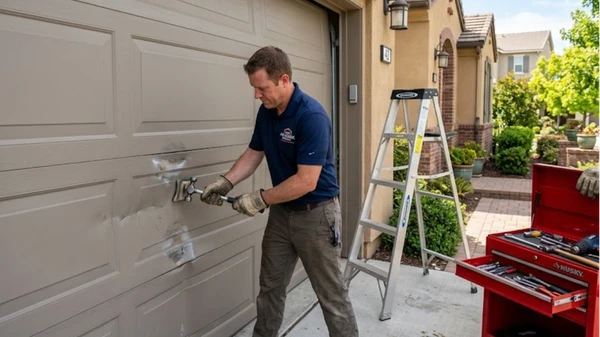
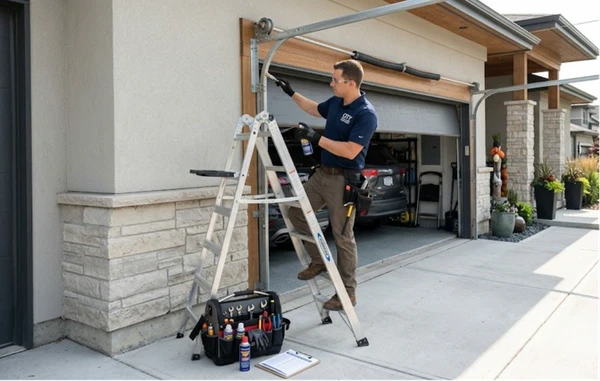
A proper tune-up covers the hardware inspection first - bolts, hinges, brackets, anything that vibrates loose over time. Then lubrication on every moving part: rollers, hinges, the torsion spring bar, the rail. They'll also adjust the opener's tension and alignment, test the auto-reverse mechanism, and check that the door is level.
That auto-reverse test is the one most homeowners never do on their own. It's the safety feature that stops the door from closing on something - or someone - in its path. Over time it drifts. A tune-up recalibrates it.
Then there's the balance check. Technician disconnects the opener, lifts the door manually to about waist height, lets go. A balanced door stays put. One with worn springs either drops or climbs. Most homeowners have no idea their door is out of balance until the opener motor starts struggling - and by then, the motor is already taking damage.
The Actual Math on "Is It Worth It"
A yearly tune-up runs $100 to $300. An emergency repair - the kind that happens when something actually breaks - costs $400 to $1,200. A full door replacement starts around $3,000.
One skipped tune-up that leads to a snapped spring costs more than two or three years of maintenance visits combined.
That's not a hypothetical. Springs don't snap randomly. They give warnings first - tension changes, balance shifts, small sounds that a trained eye catches on a routine visit. Most homeowners miss those signs entirely because they're not looking for them.
A tune-up is basically paying someone to look.
When You Can Go Every Two Years Instead
Not every door needs annual professional service. Some genuinely don't.
Push the schedule out if your door is under 5 years old, used lightly, and you're doing basic upkeep yourself. A newer door on a light cycle - opened maybe once or twice a day - isn't accumulating wear fast enough to justify a yearly visit.
If your garage is the primary entry point to your home or you're not sure when the last tune-up happened, stick to annual service.Same goes for any door over 8 years old. Older systems have parts that are already close to their service life. Finding that out during a $150 maintenance visit beats finding it out on a cold morning when the door won't open.
Three Things You Can Do Yourself
Between professional visits, a few basic tasks cost almost nothing:
Lubricate the rollers and hinges every 3 to 6 months. Use an actual garage door lubricant spray - not WD-40. WD-40 cleans, it doesn't lubricate, and it pulls in dust and debris over time.
Test the auto-reverse yourself. Put a flat piece of wood on the ground under the door and hit close. The door should bounce back the moment it touches the wood. If it doesn't, stop using the automatic opener until a tech can look at it.
Listen. Grinding, squealing, a new thunk when the door hits the bottom - those sounds mean something changed. Catching it early is almost always cheaper than waiting.
Basic DIY maintenance - lubricant, simple tools - costs around $20 to $50 a year.Combined with a professional visit every year or two, that's a system that should run cleanly for the long haul.
So - Worth It?
A garage door is a 400-pound machine that moves multiple times a day, every day, mostly without anyone paying any attention to it.
A hundred and fifty dollars once a year to keep that machine in safe working order is genuinely cheap insurance. The people who disagree with that usually come around after their first emergency repair bill.