My neighbor replaced his garage door two winters ago. Nothing fancy - just a mid-range insulated steel door. He told me his heating bill dropped noticeably that first season. I thought he was exaggerating.
He wasn't.
If you've got an older garage door - especially the thin, rattling kind - you might be losing more heat than you realize. And if the garage is attached to your house? That heat loss is your problem, not just your garage's.
Let's get into the actual numbers.
What Does an Insulated Garage Door Cost in 2026?
Prices depend on three things: the size of your door, what material it's made from, and what type of insulation is inside it.
Here's a realistic range for most homeowners:
|
Door Type |
Installed Cost |
|
Steel door with polystyrene insulation |
$800 – $1,200 |
|
Steel door with polyurethane foam |
$1,200 – $2,000 |
|
Premium or custom double-car door |
$2,000 – $4,000+ |
|
Labor - single door |
$150 – $500 |
|
Labor - double door |
$300 – $700 |
Most people land somewhere between $1,200 and $2,500 for a standard double-car door, installed. That's the realistic middle ground - not the cheapest, not the most expensive.
Add windows, unusual sizing, or a wood-look finish and it goes up. Sometimes quite a bit.
Not ready for a full swap? A DIY insulation kit costs $50–$200 and clips onto your existing door panels. It's not a perfect solution, but it knocks the edge off - especially if your door is otherwise still working fine.
The ROI Question - Honestly
People love to throw around big ROI numbers with garage doors. Some reports claim 193%. Others say 95%. The truth? It depends on your door, your market, and what you're comparing it against.
What's consistently true: garage door replacement ranks among the highest-ROI home improvements you can make. It beats kitchen remodels. It beats bathroom updates. Partly because the cost is relatively contained, and partly because curb appeal is genuinely what buyers notice first.
A solid insulated door signals a maintained home. That matters more than most sellers expect.
Energy Savings - What's Realistic?
Here's where people sometimes get disappointed - because the savings look different depending on your setup.
Attached garage, shared walls, or room above: This is the scenario where insulation really delivers. Homeowners in this situation typically save $100 to $200 a year on heating and cooling. At that rate, a $1,500 door pays itself off in roughly 3 to 5 years - and keeps saving money for the 15 to 25 years after that.
Detached garage you don't heat: Savings drop to maybe $20–$40 a year. The payback period stretches out to 10+ years. Still worth it for comfort and protecting what's stored inside - just don't expect dramatic utility bill changes.
Extreme climates - very hot or very cold: Savings climb. An uninsulated door bleeds heat at a dramatically higher rate than an insulated one. Your HVAC runs less. You notice it.
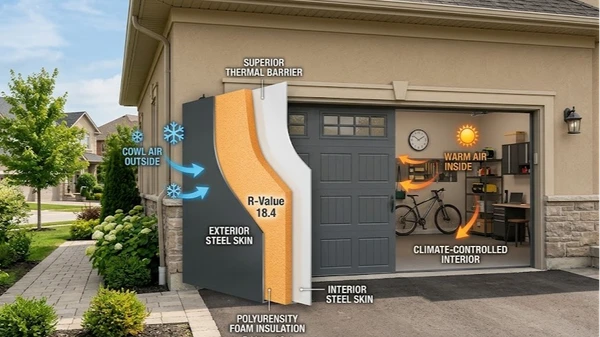
A good insulated door keeps garage temps roughly 12°F warmer in winter and 25°F cooler in summer. If your household spends $1,200 a year on energy, you're looking at saving somewhere around $120 to $240 annually. Not life-changing on its own - but over a decade, that adds up to real money.
Other Stuff People Don't Talk About Enough
Energy savings get all the attention. But homeowners who've actually upgraded mention these things just as often:
The noise difference is significant. Foam-core doors open and close quietly. That hollow banging sound from a cheap single-panel door? Gone. If you have a bedroom above the garage or a baby who naps during the day, this alone might justify the cost.
They hold up better. The multi-layer construction resists dents in a way single-panel doors simply don't. A stray ball, a bike handle, a backing-in moment - a good insulated door shrugs it off. A cheap door crumples.
Your garage actually becomes usable space. This surprises people. Once temperatures stabilize, the garage stops being an unusable freezer in January and a sauna in July. People actually spend time in there - working on cars, working out, doing projects.
Stored items last longer. Paint separates in extreme cold. Car batteries drain faster. Electronics degrade. A more stable garage temperature is genuinely better for everything stored in it.
Is It Worth It For Your Situation?
Few honest checkpoints:
- Attached garage with shared walls? Yes - strong case, good payback timeline.
- Room above the garage? Even stronger case. Heat loss through the door directly affects that room.
- Using garage as a workspace or gym? Comfort alone justifies it.
- Detached garage, mild climate, no plans to sell? Maybe try a kit first.
- Current door works fine and you're not selling soon? Wait, or add weatherstripping for now.
One thing worth saying: the door is part of a system. If your garage walls have no insulation and the weatherstripping is cracked and pulling away, a new door helps - but it won't fix everything. The whole envelope needs to work together.
How to Pay Less Without Sacrificing Much
You don't need to spend $3,500 to get a good insulated door. A few things that actually help:
Stick with standard sizes. A 16×7 double-car or 9×7 single-car door is the most widely available size - which means more competition among suppliers and lower prices. Unusual sizes push costs up fast.
Get three quotes, minimum. Installation prices vary more than most people expect. Two installers can quote the same door hundreds of dollars apart. Shop around.
Choose steel. Wood doors look great. Glass doors look stunning. But steel with polyurethane foam gives you the best insulation performance per dollar spent - and it lasts.
Combine projects. If you're also getting a new opener, weatherstripping, or springs replaced - do it all at once. Trip charges are real, and bundling saves money.
The Bottom Line
An insulated garage door isn't the most glamorous upgrade. But it's one of the few that genuinely delivers on multiple fronts - lower bills, better comfort, less noise, and solid resale value.
For attached garages especially, the numbers make sense. The door pays itself back, and then keeps working in your favor for years.
If you're ready to stop guessing and start getting real answers - DoorFixy is here to help. We'll walk you through the options, give you honest recommendations, and handle the installation right. Reach out for a free quote today.