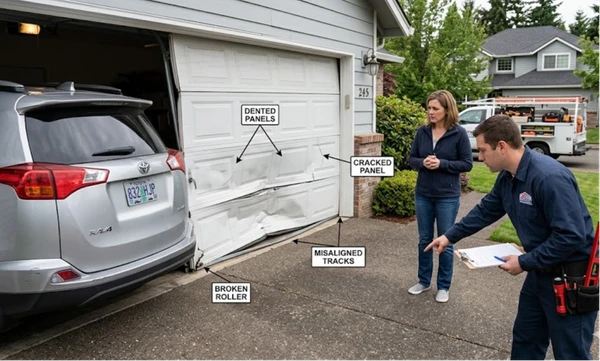
It was a Tuesday morning. My wife was running late, put the car in reverse a few seconds before the door had finished opening, and heard the sound you don't want to hear - a dull impact, then the door moving in a way it wasn't supposed to move.
She called me at work. First question: "Is it going to fall?" Second question: "What did we just break?" Third question, after a pause: "Do I have to tell the insurance company?"
These are the right questions, asked in roughly the right order. The door stayed up. What was broken was one panel, a bent track on the left side, and the rollers on the section that took the hit. What it cost was $580 for a same-day repair - one panel swap and track realignment. No replacement needed. Insurance wouldn't have been worth calling for an amount that small relative to our deductible.
That story ends well. Others don't, and the difference is usually what the homeowner does - or doesn't do - in the first thirty minutes after impact.
The first thing to do before anything else
Stop the car and leave it where it is if the door is resting against any part of the vehicle. Moving the car when the door is partially engaged with it can cause the door to drop suddenly, which creates a different and potentially worse damage scenario than the initial impact.
Look at the door from outside before touching anything. What you're assessing:
Is the door still in the tracks? A door that's been hit at one side can pull the panel assembly out of one track while staying in the other. This looks like a diagonal tilt across the door face - one corner lower than the other, visible gap between the rollers and the track wall. Don't operate the opener on a door that's off-track. It won't fix the problem and will very likely make it worse by running the opener motor against a door that can't travel correctly.
Is the panel visibly buckled or the track visibly bent? Bends in the vertical track create a point where the rollers will jam on every subsequent cycle. Operating the door repeatedly over a bent section adds secondary damage that compounds the original.
Is the spring or cable hardware at the top of the door still intact? Impact damage that's concentrated enough occasionally affects the spring system - visible broken spring, cable that's come off its drum, or the bottom bracket on the side that was hit. These require the door to be immobilized in the closed position until a professional can assess it. Do not operate the opener if you can see damaged spring or cable hardware.
If the door is intact and the damage appears confined to a panel dent, it's usually safe to manually test whether it travels smoothly. Disconnect the opener by pulling the emergency release cord, then manually lift the door a foot. Does it move evenly, stay level, and not catch anywhere? If yes, you can typically use the door cautiously while arranging repairs. If it catches, grinds, or tilts - stop, leave it down, and call someone.
What actually breaks in a typical impact
Vehicles hit garage doors in two main ways: backing into the door while it's closed or mostly closed, and pulling forward into the door before it finishes opening. The damage pattern differs.
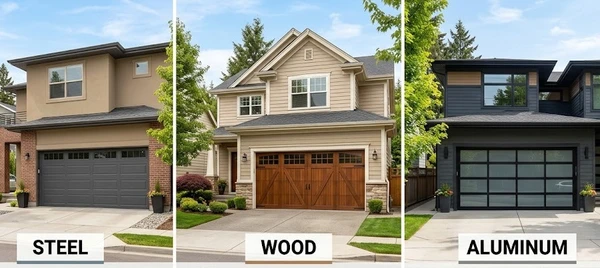
Backing into a closed door usually concentrates the impact on one or two panels in the lower section. The bumper hits the exterior panel face and transmits force to the panel itself. Steel panels dent. Aluminum panels dent and may crack. Wood panels can crack or break outright. If the force was significant, the panel edges press against the track and the rollers at the affected section may be pushed out of alignment or damaged.
Driving forward into a door that's partially open is a different scenario. The car meets the bottom panel, which is rising. Depending on where in the travel cycle the door was, you might contact the door edge-on, which can pry the bottom section outward from the opening and transfer force to the hinges and cables. This type of impact is more likely to damage the cable system and the bottom bracket - the hardware under spring tension - than a direct-face hit.
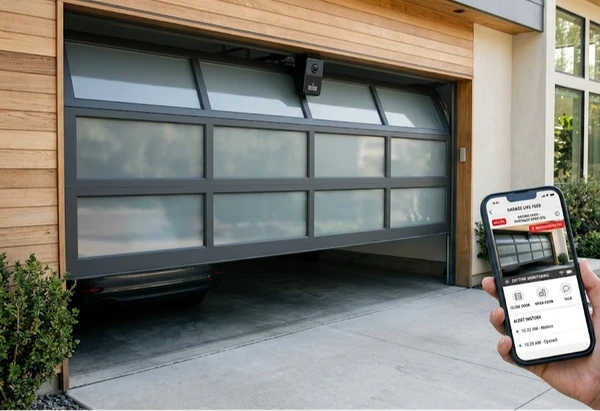
The opener and operator hardware can also sustain damage if the impact is at the top of the door near the opener attachment point, or if the force is severe enough to transmit up the door assembly. Check whether the opener motor continues to cycle smoothly - a door that's visibly damaged but still travels evenly suggests the opener wasn't directly affected. Grinding, resistance, or unusual sounds from the motor suggest it's working against something that's now wrong with the door geometry.
Damage assessment: panel vs. track vs. full door
The repair decision breaks down into three categories that have very different cost implications.
Panel damage only - a dent or bend confined to one or two panels, no track involvement, and the door still travels correctly. Panel replacement for a standard steel section runs $350 to $700 depending on door style, color, and panel availability. The tricky variable: if your door is more than eight to ten years old, the exact panel profile or color may no longer be in production. You can repair the functionality with a close match, but matching the appearance may require replacing more panels or the full door. Cosmetically mismatched panels bother some homeowners significantly and others not at all - worth knowing your own tolerance for this before deciding.
Track damage - a bent section of vertical track, a displaced bracket, a track that's shifted out of plumb. Track realignment on one side runs $100 to $175. Track section replacement runs $250 to $350. Combined panel and track damage is the most common scenario in a vehicle impact and typically runs $500 to $900 total for a standard repair.
Full door damage - a severe enough impact that multiple panels are damaged and the structural integrity of the door assembly is compromised. Or a situation where panel replacement isn't feasible due to discontinued product lines and a patchwork repair would look worse than a clean replacement. Full door replacement for a standard steel residential door runs $800 to $2,000 installed depending on style, insulation, and brand. The silver lining, such as it is: it's an opportunity to upgrade what was there.
Spring and cable damage - this is the scenario worth paying professional attention to immediately. A damaged or displaced spring or cable is a safety issue that takes priority over assessing anything else. Call a professional the same day. Do not attempt to diagnose or repair cable or spring damage yourself.
The insurance question - usually worth a call but not always
Homeowner's insurance typically covers vehicle-impact damage to the garage door under the dwelling coverage portion of your policy, subject to your deductible. That qualifier matters more than it sounds.
If the repair cost is $600 and your deductible is $500, making a claim saves you $100. Whether that's worth having a claim on your record - which can affect your premium at renewal - is a calculation that varies by insurer, by your history, and by how long you've been with the company. For repairs under about $1,000, it's often worth getting the estimate first and then deciding whether to involve insurance based on the actual number.
If the repair runs $2,000 or more, insurance becomes worth calling without question. Document the damage with photos before any repair work begins. Get the estimate in writing. Call your insurer and let them walk you through the claim process - some companies want to send their own adjuster; others will work from your documentation.
One note: if the vehicle that caused the damage was someone else's, their auto liability coverage may be relevant. If it was your car, auto insurance typically doesn't cover damage to your own property - homeowner's insurance is the correct policy.
What not to do
Don't try to "push out" the dent from behind the panel. Steel panels have a formed profile that gives them rigidity - pushing or hammering from behind distorts that profile in ways that make the panel look worse and can transfer stress to adjacent sections.
Don't run the opener repeatedly to see if the door will work itself out. If something is misaligned, repeated mechanical cycling adds wear to the opener motor, stresses the tracks at the damage point, and can turn a single-panel repair into a multi-panel problem.
Don't wait several weeks to address it if the door is running crookedly or the track is visibly bent. My father-in-law's story - from earlier in this blog series - applies here too. A bent track left in service compounds into more expensive damage over hundreds of cycles. The repair that costs $300 now might cost $600 in two months.
Typical repair costs at a glance
|
Type of damage |
Typical repair cost |
|
Single panel dent, steel door |
$350 – $700 |
|
Two-panel replacement |
$600 – $1,200 |
|
Track realignment, one side |
$100 – $175 |
|
Panel + track combined |
$500 – $900 |
|
Roller replacement |
$110 – $230 |
|
Full door replacement |
$800 – $2,000+ |
|
Spring/cable damage (professional repair) |
$300 – $800 |
These are 2026 figures for standard residential doors. Custom sizes, premium materials, and discontinued panel profiles all push the numbers up.
The honest bottom line
Most vehicle impacts to garage doors are fixable without replacing the whole door, at a cost that's below most homeowners' deductibles. The key is getting a professional assessment before deciding anything, because the visible panel damage is often less consequential than the track, roller, and hardware damage that the same impact caused but that isn't visible from the outside.
The instinct to wait and see if the door still works is understandable. It's also the instinct that turns a $500 repair into a $1,200 one.
DoorFixy offers same-day impact damage assessment and repair - including the full system check that makes sure you're fixing everything the impact affected, not just what's visible on the panel face.