Last spring my neighbor had his truck broken into. Not stolen - just gone through. It was parked in his garage. Door closed, opener in the car, motion light on the exterior. His wife's car sat two feet away, completely untouched.
He had no idea how they got in until I showed him the YouTube video. Takes about fifteen seconds. A thin wire or hook slipped through the gap at the top corner of the door catches the emergency release cord - the red cord hanging from the opener carriage - pulls it, and the door lifts manually without any key, any code, any forced entry at all. The door looked completely fine afterward. No broken locks, no pried panels. Just a truck that had been rifled through and a garage owner who had no idea his security setup had a gaping hole in it.
I'm starting with this because most garage door security content goes straight to lock comparisons, and that's the wrong first move. There's a vulnerability baked into nearly every residential garage door opener that a lock does nothing to address, and until you close it, your other security upgrades are working around a hole they can't see.
Fix this before you buy any lock
The emergency release cord is there for legitimate reasons. Power outage, failed opener motor - you need a way to disconnect the door and lift it manually. But from outside, that cord is reachable through the gap that exists between the top of a sectional door and the frame above it. The gap exists in almost every residential installation.
Two solutions, both cheap. One is a zip tie through the hole in the release lever - limits how far the lever travels so a hook can't trip it from outside, but still breaks or stretches with enough intentional force in a real emergency. Costs nothing if you have zip ties. Two is a dedicated release shield, a plastic cover that physically blocks hook access to the lever. Both cost under $10. Both take under five minutes.
Do that today. Then think about locks.
What's actually available, and who it's for
There is no single right answer here because people use their garages differently and face different threat levels. Someone in a quiet rural neighborhood who mainly worries about opportunistic theft has different needs than someone in a dense urban area who uses the garage as the primary house entrance. What follows is honest - including the parts where each option falls short.
Slide bolts are the most basic option and, in some ways, the most effective one. A steel bolt mounted on the inside of the door slides horizontally into the door track when the door is closed. Zero external access. Can't be picked from outside, can't be reached with a hook, can't be bumped or defeated with a code. When it's engaged, the door simply doesn't move.
The problem is exactly what you'd expect. It has to be manually engaged every time, and manually disengaged before you use the opener. Most people are consistent about this for about two weeks and then start forgetting. It ends up being the vacation lock - something you set when you're leaving for a week, then ignore the rest of the year. Some households are disciplined enough to use it nightly. Most aren't. Know yourself before buying this.
T-handle keyed locks are the external cylinder lock you see on most metal and steel sectional doors - the T-shaped piece in the center. The cylinder rotates when you insert the key and drives a horizontal bar into the tracks on both sides. Real two-point engagement. When locked, the bar prevents lifting even if the opener is completely disengaged.
Standard T-handle cylinders are decent but not impressive from a pick-resistance standpoint. A bump key or basic lock pick tools can open most of them in under a minute. This matters if you're in an area with any organized theft - opportunists who've bothered to learn basic lock bypass techniques. The fix is a high-security cylinder replacement. Medeco, Mul-T-Lock, and Abloy make cylinders that fit standard T-handle housings and are genuinely difficult to bypass. The housing is $20. The cylinder upgrade is $40 to $80. The combination is substantially more secure than either the original or the housing alone.
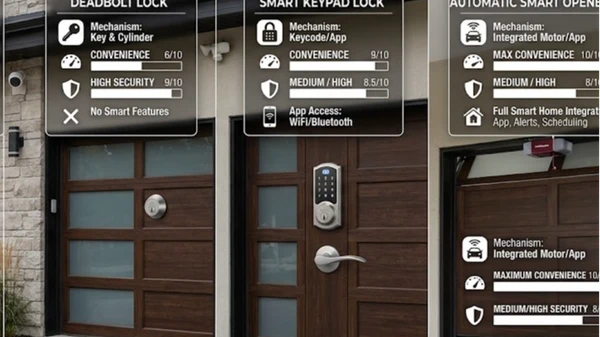
Deadbolt add-on locks step up from the T-handle in throw length and cylinder quality. Brands like Elocksys design these specifically for garage doors - longer bolt throw into the track, drill-resistant cylinder, heavier housing. If you want the best mechanical external lock without going electronic, this is it. More expensive than a T-handle, more effective, and visually intimidating enough that a lot of people will just move to the next house.
Brand-integrated locks from Clopay, Wayne Dalton, Amarr and similar manufacturers are deadbolt-style hardware built into the door panel itself, not retrofitted. They're aesthetically cleaner and typically better engineered than aftermarket hardware. The limitation is obvious - they're door-specific. If you're replacing your door anyway, it's worth asking about integrated lock options at the time of purchase. Retrofitting them onto an existing door usually isn't possible.
Electronic and smart locks are two different things that often get conflated. An electronic deadbolt motorizes the lock engagement - the bolt extends and retracts automatically based on door position, a code, or a smartphone app. Some connect to myQ or Z-Wave systems and can be controlled remotely or set to auto-lock after a specified period. Genuine security upgrade for households that are bad at remembering to lock things manually.
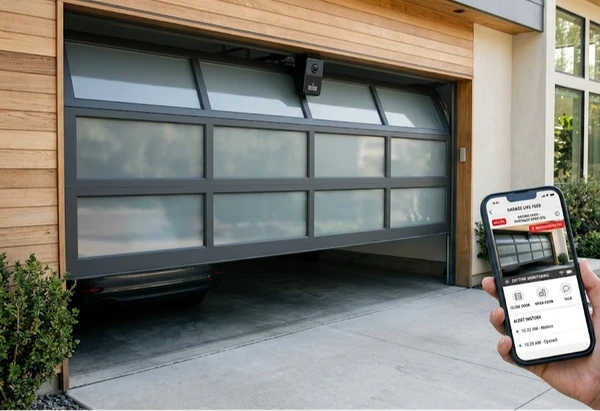
Smart monitors are different - they track door position and send alerts when the door opens, closes, or stays open too long. Not a lock, but functionally important for people who leave on a commute and then spend the rest of the day not entirely sure whether they closed the garage. The auto-close feature alone has saved a lot of people from coming home to an open door they didn't realize they'd left.
Electronic systems have one weakness that mechanical locks don't: they sit on your home network. An outdated firmware version, a weak Wi-Fi password, a router that hasn't been updated - these create potential remote attack surfaces. This isn't a reason to avoid them. It's a reason to use them carefully: unique strong password, two-factor authentication on the app account, firmware updates when prompted.
Padlocking the track is the last option and the most absolute one. A padlock through pre-drilled or existing holes in the vertical track physically prevents the door from rising. Nothing to pick from outside, nothing to bypass remotely. The door simply cannot open while the padlock is there. Useful for vacation, extended absence, or situations where the garage isn't being used for weeks at a time. Not a daily-use option for most people - it's inaccessible from outside and inconvenient to manage even from inside.
The door everyone forgets about
Almost every guide on garage door security ends at the garage door. This one isn't going to.
The door between your garage and your house - typically the one from the garage into the kitchen or mudroom - is often the worst-secured door in the building. Front door has a deadbolt. Back door has a deadbolt. Garage-to-house door has a passage handle, sometimes no lock at all, and is almost always hollow-core if the house was built in the last forty years.
If someone gets through your garage door - by any method - and your interior garage door has a cheap lever handle and a hollow core, they're inside your house with about one firm kick. The garage door was the hard part. The interior door wasn't the hard part at all.
Treat that door like an exterior door. Solid core, keyed deadbolt, security strike plate with three-inch screws that reach the structural framing. This is a $200 to $500 job depending on whether you're replacing the door itself or just upgrading the hardware. It's the most underrated garage security upgrade most homeowners aren't making.
How to think about layering this
No lock solves every problem. The goal is to make entry hard enough that someone moves on to an easier target - which, honestly, is how residential security mostly works.
Start with the zip tie on the emergency release cord. That's today, costs nothing, takes five minutes.
Then add a T-handle lock or deadbolt add-on for external keyed security. If you want to spend an extra $60 on the cylinder upgrade, do it.
If you travel or work long hours with variable schedules, add a smart monitor with auto-close. The peace-of-mind value is real.
Upgrade the interior door hardware if it's currently just a passage handle. This is the most impactful step most people skip.
Use the slide bolt when you're going on vacation or leaving the house empty for more than a day.
None of these individually transforms a vulnerable garage into a vault. All of them together make your garage door a substantially harder target than your neighbor's - and that's all it actually needs to be.