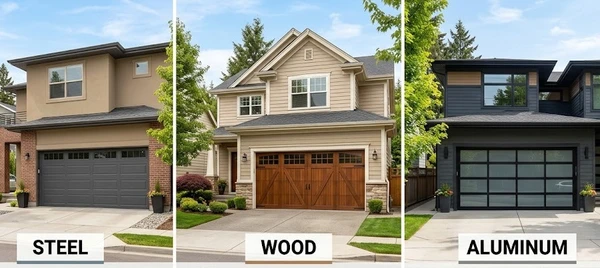
Three materials. Wildly different personalities. And a price gap that looks straightforward until you factor in what each one costs you five years from now.
Most comparison articles treat this like a simple checklist. It isn't. The right answer depends on where you live, how much you actually use the garage, and - honestly - how realistic you're willing to be about your own maintenance habits.
Let's go through each one without the sales pitch.
What You're Actually Paying: Real Numbers First
|
Material |
Single Door (Installed) |
Double Door (Installed) |
Lifespan |
|
Steel |
$600 – $2,000 |
$1,200 – $4,000 |
20 – 30 yrs |
|
Wood |
$1,400 – $3,500 |
$2,500 – $5,000+ |
15 – 20 yrs |
|
Aluminum |
$800 – $1,800 |
$1,500 – $2,500 |
20 – 25 yrs |
These are installed costs - door, hardware, labor. What they don't show is ongoing maintenance. That's where the real story is, especially for wood.
Steel: The One Most People Should Buy
Steel is the right call for most homeowners. Not because it's the flashiest option - it isn't - but because it does everything reasonably well without demanding much back from you.
The cheapest steel doors are single-layer, no insulation, around $600–$900 installed. Fine for a detached workshop you never heat. For an attached garage sharing walls with your living space, you want insulation. Double or triple-layer insulated steel runs $1,200–$2,500 for a single door. That's the sweet spot where most families land.
Insulated steel doors hit R-6 to R-14 depending on the foam type. Polyurethane-injected doors - the kind where foam is shot directly into the panel cavity - outperform polystyrene-backed ones by a noticeable margin. Worth asking specifically which you're getting when comparing quotes.
Styles are wider than most people expect. Carriage house, raised panel, flush modern, and wood-grain embossed options all exist in steel. The embossed wood-grain ones look surprisingly convincing from the street. Up close, less so - but for curb appeal purposes they work.
The part steel owners don't love: it dents. Back a bumper into it, drop a bike against it, let a kid practice soccer near it - dents happen and they stay. Thicker gauge steel resists this better. Budget doors use 25 or 26-gauge. Spend a bit more and you get 24-gauge, which is meaningfully tougher.
Also rust. Not immediately, and not if you take care of chips when they happen. But scratch through the protective coating and leave it, especially anywhere near coastal air, and rust will find that spot eventually. Annual inspection, touch up anything that got dinged - takes twenty minutes and prevents a much bigger problem.
Day-to-day maintenance is genuinely minimal. Soap and water a couple times a year. Lubricate the hardware. That's it. No painting schedule. No refinishing. Just the occasional wash and you're done.
Wood: Gorgeous. Demanding. Often Misunderstood.
Nobody buys a wood garage door because it's practical. They buy it because it looks incredible on the right house - and it does. A well-finished cedar or mahogany door on a craftsman or colonial home is something steel can't replicate, regardless of what the embossing looks like.
Here's what that actually costs.
Basic pine or fir single-car doors start around $1,400 installed. Cedar runs $2,000–$3,500 for a single door. Premium hardwoods - mahogany, redwood, teak - on a double door can push $4,500–$5,000 and beyond. Custom carriage-house designs with decorative hardware go higher still.
That's just the door. Now add the maintenance.
Wood needs to be refinished - sanded, stained or painted, sealed - every two to three years. This isn't optional. Skip it and moisture gets into the grain, the finish cracks, the wood warps. Eventually panels split or rot from the bottom up, especially in climates with real winters or serious humidity. A refinishing job costs $150–$300 each time depending on door size and who does it.
Run the numbers over twenty years: that's somewhere between $1,500 and $6,000 in maintenance on top of whatever you paid for the door. One homeowner in Denver bought a $3,200 cedar door that genuinely transformed her house's curb appeal. Two winters later she got a $600 refinishing bill she hadn't planned for. "Nobody explained the lifetime cost upfront," she said. It's one of the most consistent complaints we hear about wood.
None of this means don't buy wood. For the right house and the right person, it's worth every dollar. But "the right person" means someone who will genuinely follow the maintenance schedule - not someone who intends to and then gets busy. Be honest with yourself about which one you actually are before spending $3,000 on a door.
Wood does insulate naturally, by the way. Not as well as polyurethane-injected steel at similar price points, but reasonably well - R-values roughly in the R-2 to R-6 range depending on thickness. It's a real benefit, just not the main reason people choose wood.
Aluminum: The Underrated One
Aluminum doesn't get enough credit in most comparisons. It gets lumped in as "lightweight but dents easily" and left there. That's not wrong, but it misses the bigger picture.
If you live near the coast - within a few miles of salt air - aluminum is probably your best option and nobody tells you that loudly enough. Steel rusts. Not immediately, and not without cause, but salt air accelerates every form of corrosion and it will find the steel in your door eventually, coatings or not. Aluminum doesn't rust. Full stop. For coastal homeowners, that changes the calculation significantly.
Aluminum is also the material that makes full-view glass doors possible at a reasonable cost. The modern aesthetic - aluminum frames, glass panels, clean lines - looks fantastic on contemporary homes and is genuinely hard to replicate in steel at the same quality level. If that's the look you want, aluminum is the path there.
Prices: basic aluminum single-car doors run $800–$1,500 installed. The full-view glass style, which is what aluminum is usually chosen for, jumps to $1,500–$2,500 for a single door and can push $3,500–$4,000 for a large double. The glass sections and thicker aluminum profiles drive that cost up.
What to know going in: aluminum dents more easily than steel and the damage is harder to repair cleanly. Unlike a steel dent that can sometimes be pushed or filled, aluminum tends to crease in ways that are visible and permanent. High-traffic driveways, kids, and parking near the limit of your space all increase the chances of this.
Insulation is also not aluminum's strength. It conducts heat and cold more freely than steel, so even insulated aluminum doors don't hit the R-values that insulated steel achieves at the same price. Fine for coastal or mild climates. Worth thinking about if you're in Minnesota.
Maintenance is low - similar to steel. Wash it periodically, keep the hardware lubricated, check the weatherstripping. No rust to worry about, no finish to refinish.
How to Actually Decide
Forget the feature comparison for a second. Here's how to think through it:
Attached garage, four-season climate, no strong preference on look: Insulated steel. Mid-grade, 24-gauge, polyurethane foam. You'll never regret it.
Within five miles of the coast: Aluminum, or at minimum an aluminum-framed door. Salt air will eventually win against steel no matter how diligent you are.
Strong architectural character on the house - craftsman, colonial, farmhouse, Tudor: Wood might genuinely be worth it. But only if you'll actually maintain it. If you're not sure, buy embossed steel in a woodtone finish. From the street, most people won't know the difference.
Modern house, want glass panels: Aluminum full-view. Steel can't match the look at the same quality level.
Selling in the next two years: Mid-range insulated steel, carriage-house style. Photographs well, broad buyer appeal, strong ROI, and you won't be around long enough to feel the maintenance difference between materials.
The Faux-Wood Option (Worth Knowing About)
Steel doors with realistic wood-grain embossing and woodtone finishes have gotten genuinely good. Standing on the street, many of them are hard to tell from the real thing. They cost more than plain steel - roughly $1,200–$2,500 for a double door installed - but less than real wood, and they need the same minimal upkeep as any steel door.
If the reason you're considering wood is the look rather than some principled attachment to the material itself, look at these before committing. Plenty of homeowners who thought they wanted wood ended up here and were happy with the decision.
Still figuring out which way to go? DoorFixy installs all three and will tell you straight which makes sense for your specific house, climate, and how you actually use the space. No upselling toward the most expensive option - just an honest assessment. Reach out for a quote.