I had a package stolen off my driveway last November. Broad daylight, between 2 and 4 PM - I know because that's the delivery window - and I have no idea who took it because I had zero coverage on that side of the house. No camera, nothing. Just a doorbell camera pointing at my front porch that caught approximately nothing useful.
That was the push I needed to finally look seriously at what smart garage door systems can actually do in 2026. What I found was considerably more impressive than I expected - and a lot of people are still working with a setup that was considered advanced five years ago.
What "smart garage door with camera" actually means
There's some confusion about this category because the products aren't all the same.
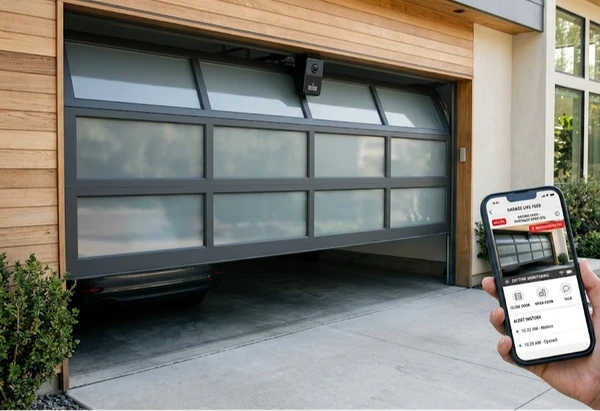
Some are smart openers with cameras built directly into the opener unit itself - meaning one device handles motor control, app connectivity, and video monitoring simultaneously. The Chamberlain Group's latest LiftMaster and Chamberlain lines launched in October 2025 set a new standard here, making built-in cameras a baseline feature across their whole residential lineup rather than a premium upgrade. That's a significant shift.
Others are smart openers paired with a separate camera - the opener talks to the camera through an app like myQ, giving you a unified control interface without the camera being physically part of the opener.
Both work. The integrated version is cleaner - one installation, one device, one subscription - but the paired approach lets you position the camera separately, which matters if your opener is positioned where it would give you a poor viewing angle.
What they share: 1080p or better video, motion detection, smartphone alerts, and the ability to watch live video from anywhere. The better systems distinguish between a person, a vehicle, and a pet - so you get relevant alerts rather than a notification every time a squirrel crosses the driveway.
Why the garage specifically
This is worth pausing on because a lot of people treat garage cameras as a bonus, not a priority.
The garage door is the biggest entry point in your home. Not the front door, not a window - the 16-foot-wide panel that faces the street. And unlike the front door, which most people have a camera on now, the garage is often either uncovered or covered by a wide-angle camera that captures more sky than garage.
More practically: the garage is frequently used as the primary entrance for a lot of households. Keys go in the car, the car goes in the garage, the garage door to the house goes unlocked. If someone gets through the garage door - whether by hacking an older rolling-code system, tailgating a vehicle, or physically forcing entry - they're essentially inside your house with no visible break-in.
A smart garage door opener with camera and activity logging closes a lot of that gap. Every opening and closing is timestamped and logged. You get a video record of every entry event. And if the door is left open - which happens more often than people want to admit - you get an alert and can close it remotely from your phone.
One family I came across in reading about this used their smart garage system to monitor their teenager's driving habits. Whether that sounds helpful or invasive probably depends on which end of that relationship you're on.
What to actually look for when buying
There are several things worth spending money on and a few where the base version is fine.
Video resolution - 1080p is the floor. It's enough to identify a vehicle or read a plate in decent lighting. 2K and 4K options exist and are better, particularly for darker environments or if you need to catch fine detail. Don't go below 1080p in 2026.
Night vision - Non-negotiable if your garage faces a low-light area at night, which most do. Infrared night vision is standard on most models. Some higher-end systems use color night vision, which is noticeably better for identifying what's actually happening in low light.
AI-based motion detection - The difference between a camera that alerts you every time a branch moves and one that only pings you when a person or vehicle enters the frame is substantial. If you want to use alerts functionally rather than just turning them off after three days of false positives, pay for this feature.
App ecosystem and smart home compatibility - myQ is the dominant platform right now. It integrates with Amazon Key (in-garage delivery), Google Home, and several security systems. If you're already in a specific smart home ecosystem, check compatibility before buying. Some systems work beautifully together; others technically integrate but feel clunky.
Battery backup - Power outages happen. A garage door that won't open manually when the power is out is an annoyance. One that doesn't work during a storm when you need to get in or out is worse. Battery backup is standard on the newer LiftMaster and Chamberlain lines and worth prioritizing.
Rolling code or Security+ 3.0 - Older garage door openers used fixed codes that could be intercepted and replayed by people with the right equipment. Current systems generate a new encrypted code every single time the remote is used. Make sure whatever you're buying uses modern encryption, not legacy fixed-code technology.
The part nobody leads with: the security risks
Here's something that deserves more airtime than it gets.
In early 2026, security researchers documented a pattern of burglars specifically targeting smart home devices - including garage door cameras - to surveil homes before breaking in. Not hacking for data. Hacking to watch when people leave, when they come back, and when the house is empty long enough to enter.
This isn't a reason to avoid smart garage technology. It's a reason to set it up correctly.
Use a strong, unique password on your myQ or app account - not the one you use for email. Enable two-factor authentication. Keep the firmware updated - manufacturers push security patches and most people never install them. Use a separate IoT network if your router supports it, so that even if a smart device is compromised, it can't reach your computers or phones.
Done right, a smart garage system is meaningfully more secure than a dumb one. Done sloppily, it creates a window that didn't exist before.
What it actually costs
Rough numbers for 2026:
|
System Type |
Price Range |
|
Smart opener (no camera) |
$180 – $350 |
|
Smart opener with built-in camera |
$280 – $500 |
|
Smart opener + separate camera |
$250 – $600 combined |
|
Professional installation |
$100 – $250 |
|
myQ video storage subscription |
$3 – $10/month |
Most of the name-brand smart openers with cameras land between $300 and $450 for the unit itself. Installation runs $100 to $250 if you go professional, less if you're comfortable with DIY. The subscription for cloud video storage is optional on most systems - you get live view and basic alerts free, recorded clip history costs a few dollars per month.
For most homeowners replacing an aging opener anyway, upgrading to a camera-equipped smart system adds maybe $100 to $150 over what a basic smart opener would cost. That's a small premium for a meaningful security upgrade.
Is it worth it
For an attached garage that doubles as your main entry point? Yes, clearly. The combination of remote monitoring, activity logging, auto-close functionality, and visual verification of entry events closes a genuine security gap at a reasonable cost.
For a detached storage garage with no living space connection? The security case is softer. A standalone camera and a basic smart opener may serve you just as well for less money.
The thing that pushed me over the line personally wasn't the burglary protection angle - it was the auto-close feature. My garage had been left open overnight three times in the previous year. Each time I found out the next morning with that specific mix of embarrassment and relief that nothing happened. An opener that sends an alert at 11 PM and asks if you want to close the door removes that problem entirely.
Looking to upgrade your garage door opener to a smart system with camera monitoring? DoorFixy can help you choose the right setup for your home and get it installed and configured properly.
More on the DoorFixy blog - smart garage technology, door brands, installation guides, and real advice without the sales pitch.