Here's something most homeowners don't know: in a hurricane or severe storm, the garage door is usually the first thing that fails. It's the largest opening in the house. When it fails - when wind gets under it or through it - the resulting pressure change can take the roof with it.
That's not an exaggeration. It's why building codes in hurricane zones specifically regulate garage door construction. And it's why preparing the door before storm season matters more than most people bother with.
This guide covers what to check, what to fix, and what to do if you're caught unprepared.
Start With an Honest Inspection
Before buying anything or calling anyone, spend twenty minutes looking at your door carefully. Most storm failures aren't surprises - the warning signs were there beforehand.
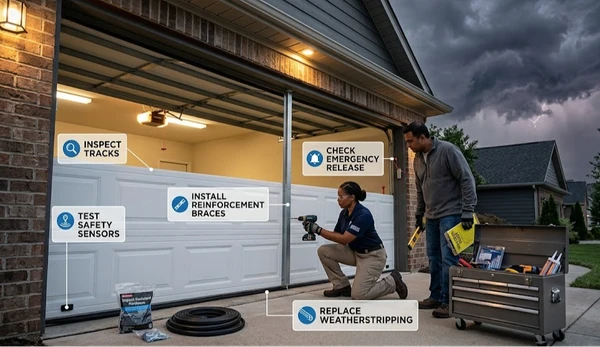
Check the panels. Look for cracks, dents, or sections that are visibly bowed. A panel that's already weakened won't hold up in wind. Run your hand along the panel surface and feel for flex - a structurally sound panel should feel rigid. Any panel that moves noticeably under light hand pressure is compromised.
Check the bottom seal. Get down and look at it across its whole length. It should contact the ground evenly. Gaps, tears, or sections that have hardened and pulled away from the concrete mean water and wind get in at the bottom. This is one of the first things storm wind exploits.
Check the weatherstripping on the sides and top. Same logic - gaps are entry points. Squeeze the seal between two fingers. If it's stiff, brittle, or crumbling, it's done. New weatherstripping runs $20–$60 and takes an hour.
Check the hardware. Hinges, rollers, tracks, the cable drums. Look for rust, loose bolts, worn rollers, fraying at the cable ends. In a strong storm, the door cycles through forces it never sees on a regular day. Hardware that's marginal normally can fail under that load.
Test the balance. Disconnect the opener by pulling the red cord, then manually lift the door to waist height and let go. It should stay put - or drift very slowly. If it falls or shoots up, the springs are out of balance. An unbalanced door won't track reliably in high wind conditions.
What Needs Fixing Before Storm Season
Weatherstripping and bottom seal: Do these first. Cheap, fast, and they prevent water infiltration that causes long-term damage regardless of storms.
Loose hardware: Tighten every bolt you can see on hinges and track brackets. Use a wrench, not just a screwdriver - you want those torqued down properly, not just snugged.
Spring balance: If the balance test showed the door doesn't stay put, call a technician. Springs are under serious tension and aren't a DIY job. An out-of-balance door is both a storm risk and a daily safety hazard.
Damaged panels: A cracked or severely dented panel should be replaced before storm season, not after. Patching a damaged panel with sealant buys time but doesn't restore structural integrity.
Lubrication: Springs, rollers, hinges, and the track - all of it should be lubricated with silicone spray or garage door lubricant before heavy weather season. A door that operates smoothly handles wind loading better than one with friction throughout the system.
Does Your Door Meet Wind Load Requirements?
If you live in a hurricane zone - Florida, the Gulf Coast, the Carolinas, anywhere with a significant storm season - this is worth knowing.
Since 2002, most of these areas have required new garage doors to meet specific wind load ratings. A door rated for 130 mph wind is built and braced very differently from a standard residential door.
Older homes, or homes where the original door has been replaced with a non-rated door, may not meet current code. This matters for insurance reasons as much as safety ones - some insurers in hurricane zones require documentation that your door meets wind load ratings.
If you're not sure what your door is rated for, the sticker on the inside of the door near the top usually has this information. If there's no sticker or it's unreadable, a garage door professional can assess it.
Retrofitting for wind resistance: If your existing door doesn't meet wind load requirements, adding horizontal bracing struts can help - these are metal bars that span the door horizontally and stiffen the panels significantly. Cost runs $100–$400 depending on how many are needed. Not as good as a purpose-built wind-rated door, but meaningfully better than nothing.
A wind-rated replacement door runs $1,200–$3,000 installed depending on size and rating. In hurricane-prone areas, many homeowners treat this as a necessary upgrade rather than an optional one - especially given what happens to homes when the garage door fails.
A Storm Is Coming Tomorrow. What Now?
If you've got 24 hours or less and the door isn't prepped, here's what actually helps:
Don't try to "brace" the door with lumber. This is a common instinct and it doesn't work the way people think. Horizontal 2x4s leaning against the door panels don't provide the kind of distributed support the door structure needs. In a serious storm they can actually concentrate stress in specific spots and cause panel failure at those points.
Lock it properly. Make sure the manual lock bar is engaged if your door has one. The opener alone isn't enough - the carriage can separate from the door under high wind load. Slide the lock bar across before a major storm.
Secure the opener disconnect. When the opener is in manual mode (red cord pulled), the door can be pushed open from outside more easily than people realize. If you're evacuating, re-engage the opener before you leave, or manually lock the door from inside.
If you have a wind-rated door, trust it. Wind-rated doors are designed to flex and absorb pressure rather than rigidly resist it. A door that seems to bow under wind load during a storm isn't failing - it's doing what it's designed to do.
If you don't have a wind-rated door and you're in a high-risk zone: board up isn't really an option for a garage door the way it is for windows. The realistic answer is either a hurricane screen (fabric-based protective cover, $300–$800, installed ahead of storm season) or evacuation.
After the Storm
Wait until the storm has fully passed before opening the door. Wind pressure can change rapidly as a storm moves through, and opening the door during a lull only to have it catch a gust is how doors get damaged or people get hurt.
Once it's safe, inspect the door before operating it normally. Check that the panels haven't bowed or cracked, the tracks are still straight, and nothing has come loose. If anything looks off - operate it manually first, slowly, and watch how it moves. A door that tracks wrong or feels uneven needs a technician before it goes back into regular use.
Water under the door and in the garage is normal after a heavy storm even with good seals. The volume matters - a little seepage through weatherstripping is different from flooding through a bottom seal that's pulled away from the ground.
The best time to deal with all of this is before you need to. A door that's been inspected, lubricated, and properly sealed going into storm season handles a lot more than one that's been ignored for three years.
DoorFixy does full storm-prep inspections - springs, hardware, seals, balance, and wind load assessment. Worth doing before the season starts, not during it. Get in touch and we'll take a look.