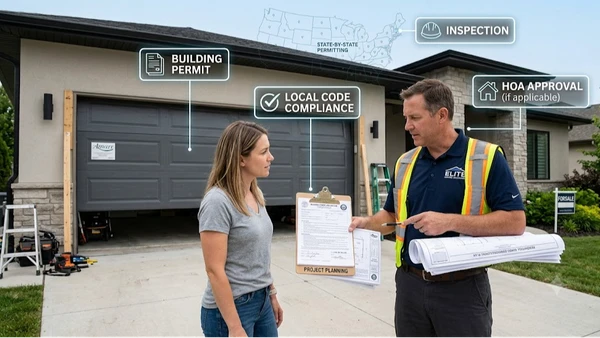
The first thing to understand about garage door replacement permits is that there is no single national answer. There's no federal standard that says "you do or don't need a permit to replace a residential garage door." The rules are set at the state level, and then often amended further at the county or city level. In the same metropolitan area, two homeowners might get different answers to the exact same question based on which side of a jurisdictional boundary they're on.
The second thing to understand is that the most common scenario - a like-for-like garage door replacement, same size, same type, no structural changes - is exempt from permit requirements in most U.S. states. The reason is that most state building codes classify this type of replacement as routine maintenance rather than construction. You're not modifying the structure; you're replacing a door.
The third thing is that there are specific situations where a permit is required regardless of how routine the replacement feels. Knowing those situations, and recognizing when you're in one, is more useful than trying to memorize a state-by-state list that may be superseded by local amendments anyway.
The situations where a permit is almost always required
Before getting into state specifics, these situations consistently require permits across most jurisdictions:
Changing the size of the opening. The moment you modify the structural framing around the garage door - widening it, making it taller, or changing from a single opening to a double - you're doing structural work. The header that spans the top of the opening is a load-bearing element. Replacing or modifying it requires a permit and an inspection regardless of state. There are no exceptions here worth mentioning.
Adding electrical work. Installing a new garage door opener where there was previously no dedicated circuit, or running new wiring for a smart opener or exterior keypad, typically requires an electrical permit. Replacing an existing opener on an existing outlet is often exempt. Adding new electrical is not.
Fire-rated door replacement in an attached garage. The door from the garage interior to the living space is required by code to be fire-rated in most jurisdictions. Replacing it with a door that meets the same rating standard is usually maintenance-category work. Replacing it with a non-rated door - or any situation where the fire separation between garage and house is being modified - triggers permit requirements.
Hurricane-rated doors in Florida. This is worth its own mention because Florida is uniquely specific about this. In Florida, garage door replacement permits are required across the state regardless of whether the door is like-for-like, because every new installation must comply with the Florida Building Code's wind resistance requirements, and the permit process is the mechanism for verifying that compliance. The Fort Walton Beach code office confirms this directly: a permit is required to verify the manufacturer's installation procedures are followed and comply with the Florida Building Code. This is not negotiable anywhere in Florida.
How individual states approach this
Florida - Permit required for all garage door replacements, full stop. The Florida Building Code is the strictest residential construction standard in the continental U.S., specifically because of hurricane and wind load requirements. Every replaced garage door needs to meet the wind load rating for its location, and the permit process is how that's verified. This applies in every county, though in Miami-Dade and Broward you also need the door to carry a Miami-Dade NOA and the requirements are stricter still.
Texas - No statewide standard. Texas has always given building regulation authority to local jurisdictions, and the result is significant variation. Houston and Dallas have their own codes. The 14 Gulf Coast counties under the Texas Windstorm Insurance Association (TWIA) zone have specific requirements for wind-storm compliance that affect garage doors. In TWIA counties, getting the wind storm certificate that insurance requires means a licensed inspector verifies compliance - which functions like a permit even if it's technically a certification. Outside the TWIA zone in inland Texas, many cities exempt like-for-like residential garage door replacement from permit requirements, but you have to check with your specific city.
California - Generally exempt for like-for-like replacement in most jurisdictions, with the specific caveat that Wildland-Urban Interface zones add requirements that can change this. California's WUI zone classification has expanded significantly in recent years - homeowners in areas that weren't classified as WUI five years ago may be now. If you're in a fire-risk zone, the applicable code may require fire-resistant construction standards for garage doors, which triggers a permit requirement. Check with your county building department specifically if you're in or near a designated WUI zone.
Virginia - Under the Virginia Uniform Statewide Building Code (USBC), a like-for-like replacement is classified as an "ordinary repair" under Section 108.2 and is generally permit-exempt for residential single-family homes and townhomes (Groups R-3, R-5). The framed opening must remain unchanged. If the door size changes, it becomes construction rather than repair. Local enforcement varies - Fairfax County and Manassas enforce these rules at the local level, so checking with the county inspections office is worth doing.
North Carolina - The state code exempts garage door replacement permits for projects under $40,000 in combined labor and materials that don't involve structural changes. Since standard residential door replacements are well below that threshold and don't modify the load-bearing header, most replacements are permit-exempt. The exception is any structural work to the framing, the header, or the surrounding studs - that triggers a permit regardless of cost.
Michigan - No statewide uniform rule on this. City-by-city variation is significant. Detroit requires a permit for garage door replacement. Sterling Heights requires a permit for every new installation. Grand Rapids is more permissive for residential work. Homeowners in Michigan genuinely need to check with their specific municipality rather than relying on a state-level answer.
Illinois - The state adopted mandatory baseline standards tied to the International Residential Code effective January 2025, requiring all municipalities to meet at least that standard. Under the IRC, like-for-like residential door replacement is generally maintenance-category work not requiring a permit. But Illinois local amendments have historically been significant - Chicago in particular maintains its own comprehensive building code that differs from the IRC in meaningful ways. Check with your municipality.
Most other states following the IRC - The International Residential Code, adopted in some form by most states, generally classifies like-for-like residential garage door replacement as maintenance work that doesn't require a permit. States that have adopted the IRC with minimal amendment - much of the Midwest, Mountain West, and mid-Atlantic outside of specific localities - typically fall into the "no permit for standard replacement" category.
The HOA layer - separate from building permits
It's worth being clear that HOA rules and building permits are entirely separate systems. A building permit comes from a government authority and relates to building codes and safety. HOA approval comes from your homeowners association and relates to aesthetic standards, approved materials, approved colors, and approved door styles.
Both can apply simultaneously. Getting a building permit doesn't mean your HOA has approved the door. Getting HOA approval doesn't mean you don't need a permit. In many subdivisions and communities, especially newer ones, HOA garage door requirements include approved door styles, approved manufacturers, and sometimes approved colors. You need written HOA approval before installation, not after - a door that violates the CC&Rs may need to come down regardless of whether it passed inspection.
If you're in an HOA, check both systems independently. The building department handles one; the HOA management handles the other.
What happens if you don't pull a permit when you should have
The consequences of skipping a required garage door installation permit tend to surface at two specific moments: when you sell the house, and when you file an insurance claim.
On the sale side: the buyer's inspector will often flag unpermitted work during the home inspection process. An unpermitted garage door in a jurisdiction that requires permits creates a disclosure issue and a potential renegotiation point. In Florida specifically, where permits are required universally, an unpermitted door is a deficiency that carries real weight in a real estate transaction.
On the insurance side: if your garage door is damaged in a storm and you file a homeowner's claim, and the adjuster discovers the door was installed without the required permit, the claim can be complicated or denied. In Florida, where wind mitigation is already a central insurance issue, an unpermitted non-compliant door is a significant problem.
The third consequence that homeowners don't think about until it's too late: if a component of a non-permitted installation fails and causes injury or property damage, the absence of a permit can affect liability coverage. It's a small risk in most situations, but it's not zero.
The fastest way to get the actual answer for your address
Call your local building department. Not your county. Not your state. Your local building department - city or municipality - and describe the project: residential garage door replacement, same size as existing, like-for-like. They will tell you in about three minutes whether you need a permit, how much it costs, and what the inspection process involves.
This phone call is not a commitment to anything. Building departments field this question constantly and most of them are genuinely helpful about it. Getting the answer from the actual authority takes less time than reading anything on the internet about it, including this article.
Your installer can also do this on your behalf - any established garage door installation company is familiar with the permit requirements in the areas they serve and should be able to tell you without you having to make the call.
DoorFixy handles permitting research and compliance as part of the installation process in the areas we serve - so you don't have to figure out what your jurisdiction requires before booking a job.
More on the DoorFixy blog - garage door installation, codes and permits, buying guides, and practical information for homeowners navigating the replacement process.