A homeowner in Palm Beach County called a garage door company last spring because her opener had finally died after twelve years. She wanted a replacement door - something nicer, better insulated. The installer showed up, looked at the existing door, and told her the current door didn't have a Florida Product Approval number. It had never been a hurricane-rated garage door at all. The previous owner had installed a standard residential door, and it had been there since the house was built in 1998.
She'd been paying hurricane insurance premiums for twelve years without the opening-protection discount her county's wind mitigation program would have given her if the door had been properly rated. The discount she'd been leaving on the table was roughly $280 per year. Twelve years. She was not having a great afternoon.
This isn't an unusual story. A lot of Florida and Texas homeowners - especially in homes built before stricter wind codes took effect - are running doors that don't meet current requirements and don't know it. Some are out of code. Some are losing insurance money. Some are both.
Here's what actually applies, by location.
The two different things a hurricane garage door has to resist
This distinction matters and most homeowners don't know it exists.
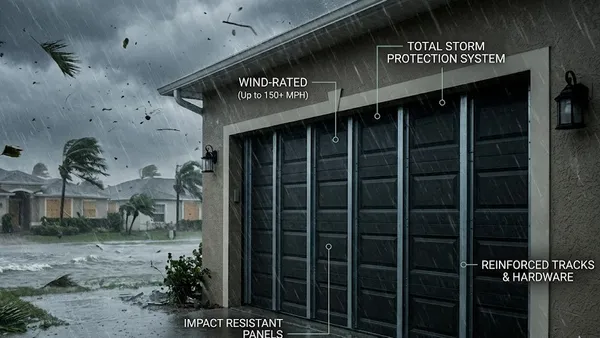
Wind pressure is the force of sustained hurricane winds pushing against the door face. A wind-rated garage door is tested to specific positive and negative pressure loads - positive pressure pushing inward, negative pressure (suction) pulling outward - in pounds per square foot. The rating tells you the maximum design wind speed the door can withstand without structural failure. Wind pressure ratings are required throughout Florida's coastal areas and much of the Texas Gulf Coast.
Impact resistance is different. Debris carried at hurricane wind speeds is what breaks through garage doors and allows pressure equalization to destroy the house from the inside. The large-missile impact test shoots a nine-pound 2x4 at the door at 34 mph. If the door panel is breached, wind enters the structure, pressurizes it, and the roof goes. Impact resistance is required in the most vulnerable zones - primarily the High Velocity Hurricane Zone in Miami-Dade and Broward counties - but strongly recommended anywhere within the Wind-Borne Debris Region, which covers most of coastal Florida.
A door can be wind-rated without being impact-rated. In Miami-Dade and Broward, you need both. In the rest of coastal Florida, you need wind-rated and you're advised (though not always required) to get impact-rated. Understanding which standard applies to your specific address is not something you should guess at.
Florida: what the code actually requires by zone
Florida has the strictest hurricane garage door code in the United States, updated repeatedly since Hurricane Andrew in 1992 demonstrated in catastrophic detail what happens when residential construction isn't built for the conditions.
High Velocity Hurricane Zone (HVHZ) - Miami-Dade and Broward counties. Every garage door must carry a Miami-Dade NOA (Notice of Acceptance). The NOA means the door was tested to TAS 202 (uniform static pressure) and TAS 203 (cyclic pressure test simulating storm duration wind loads) and passed both. In the HVHZ, impact certification is also mandatory - the door has to survive the large-missile impact test. A Florida Product Approval number alone is not sufficient inside Miami-Dade and Broward. Only an NOA qualifies.
Wind-Borne Debris Region (WBDR) - Most of coastal Florida, including Palm Beach, Broward (outside of HVHZ proper), Sarasota, Collier, Lee, Charlotte, and other counties. Wind-load rating is required. Florida Product Approval (the FL number system) is the certification required. Impact rating is not always mandatory but is strongly recommended given the debris environment in a major storm.
Inland Florida - Base wind code still applies, but requirements are less stringent than the coastal zones. Wind-rated doors are still required for new construction and replacement in many areas; check with your specific county building department.
The critical thing to understand: a door without a Florida Product Approval number or a Miami-Dade NOA cannot legally be installed as a hurricane-rated door in any Florida county. The approval number is the proof of testing - not the brand name, not the salesperson's claim, not the fact that it's a heavy steel door. The number is what matters at inspection.
Texas: different code, different zone system
Texas uses the International Residential Code with local amendments, and the specific requirements depend on which coastal county you're in. The Texas Department of Insurance has wind-storm zones that affect insurance requirements as well as building codes.
The Texas Windstorm Insurance Association (TWIA) zone - covering all or parts of fourteen Gulf Coast counties including Galveston, Cameron, Nueces, Jefferson, and others - has specific requirements for opening protection including garage doors. In these counties, a windstorm certificate from a Texas Department of Insurance inspector is required for insurance coverage, and that certificate requires the garage door to meet the wind pressure rating for the applicable design wind speed.
Houston and Harris County are partially in the TWIA zone depending on specific location. Homeowners in the Houston metro area who aren't sure whether their address is in a rated zone should look up their property on the TWIA website before assuming they're either in or out.
Outside the TWIA zone but in inland Texas, the standard IRC wind code applies. This is a lower bar than Florida's coastal requirements but still requires that doors in areas with design wind speeds above certain thresholds be rated accordingly.
The Texas distinction from Florida: Texas doesn't have a statewide testing approval system equivalent to Florida Product Approval. The TWIA inspection process is the practical mechanism for wind-storm compliance, and a door that passes the inspector's requirements - typically a door with a wind-load rating matching the county's design wind speed - gets the windstorm certificate.
What a hurricane-rated garage door actually costs
The price range is real and wide. A hurricane impact garage door for a standard two-car opening in South Florida runs $1,500 to $5,000 installed, depending on:
Material and gauge - 24-gauge steel is standard in hurricane applications; 20-gauge and heavier provides more impact resistance but adds cost and weight. The heavier the door, the more attention the spring system needs.
Whether impact certification is included - wind-rated-only doors are less expensive than fully impact-rated doors with the large-missile certification. In Miami-Dade and Broward, impact is required. In other counties, homeowners often choose impact-rated anyway for the additional protection.
Insulation - hurricane garage door insulation (R-12 to R-18 in polyurethane or polystyrene) adds cost but provides meaningful comfort benefit in Florida and Texas heat. An uninsulated hurricane door is code-compliant but turns the garage into an oven.
Track and hardware system - heavy-duty tracks and reinforced bottom brackets are part of what makes a wind-rated garage door perform under hurricane-force wind load. Don't let an installer use standard residential tracks on a hurricane-rated door.
Professional installation - this is one application where DIY is not a real option. Hurricane-rated garage doors in Florida must be installed by a licensed professional to maintain code compliance. The installation itself - track placement, anchoring to the structural frame, hardware torque specifications - is part of what the product approval certifies. Get it wrong and the approval doesn't apply.
The insurance angle - why this matters even without a storm
Here's what the homeowner in Palm Beach County learned the hard way.
Florida's wind mitigation inspection program allows insurance carriers to discount premiums based on the wind-resistance features of a home. Opening protection - which includes garage doors - is one of the highest-value categories in the wind mitigation report. A home with impact-rated garage doors and windows gets a better classification than one with wind-rated doors and shutters, which gets a better classification than one with standard doors.
The discount varies by carrier and by how many features the home has, but premium reductions of $200 to $600 per year from a properly rated garage door are common in high-risk South Florida counties. A hurricane-rated garage door that costs $3,000 installed, earning a $350 annual discount, pays for itself in under ten years in reduced premiums. The protection it provides in an actual hurricane is separate from the financial calculation entirely.
If you're in Florida and you don't have a current wind mitigation report, getting one costs $150 to $200 from a licensed inspector. If your current garage door is limiting your insurance classification, the report will make that specific and concrete. Then the question is just the math.
How to find out if your current door is rated
The quickest check: look on the inside face of the door - either on the top panel or on one of the end stiles - for a label with an FL number or an NOA number. If you can find the number, you can look it up in Florida's product approval database or the Miami-Dade online approval search. If there's no number, or the door predates 1994, it's almost certainly not rated.
Your county building department can tell you what's required for your specific address. Your insurance agent can tell you whether your current door affects your wind mitigation classification. A licensed garage door installer can assess the door directly and confirm whether what's there meets current code.
All three of those conversations take twenty minutes. Any of them gives you the information you need to decide whether a hurricane garage door replacement makes sense for your situation.
DoorFixy installs hurricane-rated and impact-rated garage doors with proper Florida Product Approval and Miami-Dade NOA certification - and can help you understand what your specific county and insurance situation actually requires.
More on the DoorFixy blog - hurricane preparation, garage door codes, buying guides, and practical information for Florida and Texas homeowners.