My opener burned out last year after six years of service. The technician who replaced it asked me how often the door had felt heavy or required a second button press to open. I said occasionally. He looked at the spring for about four seconds and told me it had lost meaningful tension - probably two or three years earlier. The opener had been compensating for an under-powered spring system for years, running against more resistance than it was designed for, on a timetable that ended with the motor wearing out.
"If you'd run a balance test a couple of years ago you would have caught the spring before it took the opener with it," he said.
This stuck with me. The garage door spring balance test takes less than two minutes and requires no tools at all. It would have told me the springs needed service before the opener had to tell me, more expensively, that they did.
Here's how to do it.
Why spring balance matters - and what it's actually measuring
The torsion spring mounted above your garage door, or the extension springs running alongside the horizontal tracks in older systems, does one specific job: it counterbalances the door's weight so that the opener only has to manage a small fraction of the actual load. A correctly tensioned spring makes a 200 or 300-pound door feel essentially weightless - the springs carry the mass, the opener guides the motion.
When the springs are properly balanced, that counterbalance is precise across the full range of the door's travel. The door floats. Lift it to knee height and let go: it stays. Lift it to shoulder height and let go: it stays. That's a balanced garage door - stable at any position because the spring force exactly offsets gravity at every point in the arc.
When the springs have lost tension through age and fatigue cycles - or when one spring in a dual-spring system has weakened more than the other - the counterbalance is off. The door is heavy. The opener has to do work that the springs were supposed to do. Over time, the opener's motor, drive gears, and the cables and rollers all absorb that extra load. None of them were sized for it.
Running the garage door balance test twice a year takes two minutes. Catching a spring that's losing tension before it takes other components with it costs roughly $150 for an adjustment. Catching it after the opener has compensated for years and burned out costs $400 to $600 for the opener replacement plus whatever spring work is needed. That gap - between catching the balance issue and not catching it - is what this test is for.
The test: exactly how to run it
Before you start: children and pets need to be out of the garage. An unbalanced door can drop quickly when released. This is a safety precaution that matters, not a formality.
Step 1: Close the garage door fully.
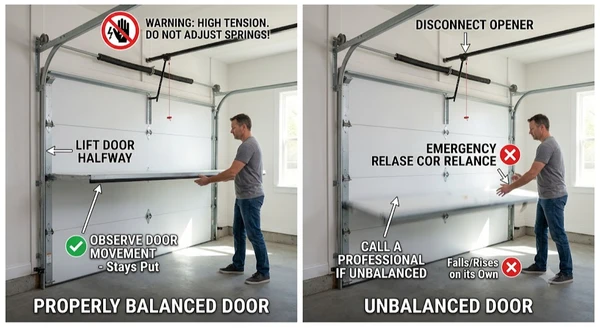
Step 2: Pull the emergency release cord - the red handle hanging from the opener carriage rail. You'll feel or hear a click as the trolley disconnects from the carriage. The door is now disconnected from the opener and moves freely by hand. You're testing the door and spring system, not the opener.
Step 3: Grip the door at the bottom center with both hands and lift it smoothly to approximately waist height - three to four feet off the floor, roughly halfway through its travel. Pay attention to how it feels as you lift. A door with properly tensioned garage door springs should feel noticeably light - much lighter than a 200-plus pound door should feel. If it feels genuinely heavy as you lift, the springs are under-providing lift and the balance test hasn't even started yet.
Step 4: Release the door completely. Step back and watch.
That's the whole test. Three outcomes:
A balanced garage door stays within a few inches of where you released it. It may drift slightly in either direction - that's within normal range. It doesn't move on its own in any meaningful way.
If the door slides downward on its own after release, the springs have insufficient tension to support the door's weight. The most common cause is spring fatigue - springs lose tension gradually over thousands of cycles. On a dual-spring system, it can also happen when one spring has partially or fully broken while the other is intact, leaving the remaining spring to handle all the counterbalancing alone.
If the door rises toward the open position on its own, the springs are over-tensioned. This is less common than under-tension and typically occurs after a spring replacement where the tension calculation was off, or after the door's weight changed (window inserts were removed, insulation panels added, a panel was replaced with a lighter one).
Run the test three times to confirm the result. A door that holds on the first release and drifts slightly on subsequent releases is probably fine. A door that consistently drops or rises every time you release it at the halfway point has a spring tension issue that needs addressing.
The additional test position worth checking
Most guides describe the halfway test and stop. A more thorough garage door balance check includes two additional position tests.
After confirming the halfway result, lift the door manually to the nearly-open position - three-quarters to fully open - and release it there. A balanced door holds in this position too. If it drops from the fully open position, the door is heavy throughout the upper range of travel, which suggests insufficient spring tension.
Then lower the door manually to just above closed - about eight to twelve inches off the floor - and release. A balanced door holds here as well. If it drops to the floor from this position, the door is heavy at the bottom of its travel, which can suggest different things: sometimes spring tension overall, sometimes cable drum wrap that's inconsistent between the two sides causing the door to behave differently at different heights.
The halfway test is the primary diagnostic. The additional positions add useful information if the halfway result is ambiguous - a door that holds at halfway but drops from the fully-open position has a tension profile that's right in the middle but insufficient at the top, which can indicate spring fatigue that's advanced past the point where the midpoint test catches it cleanly.
What friction masquerading as balance problems looks like
One thing worth checking before concluding the springs need adjustment: friction in the system can mimic balance problems.
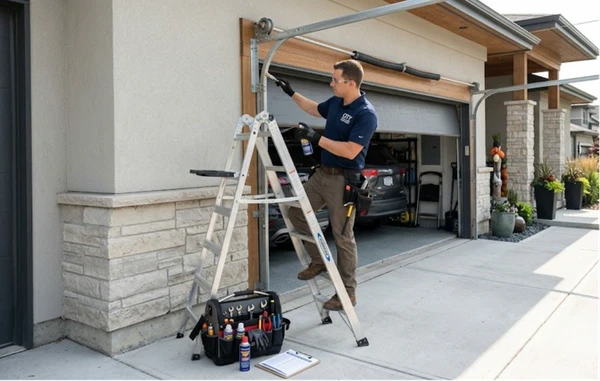
Dry rollers, stiff hinges, and dirty tracks add mechanical resistance to the door's movement. This resistance makes the door feel heavier than its actual weight, which makes the balance test look like the springs are under-tensioned when the actual problem is that the door isn't moving freely. Lubricate the hinges, rollers, and springs with appropriate products (silicone spray for hinges and rollers, white lithium grease for springs), run the door through several manual cycles to distribute the lubricant, and then run the balance test again.
If the balance test results improve noticeably after lubrication, friction was contributing to the apparent balance problem. If the door still drops or rises consistently after fresh lubrication on all the right components, the spring tension is the issue.
The clear line between this test and what comes next
Running the balance test is something every homeowner should do. It's safe, it's fast, and it catches meaningful information about the state of the spring system before that state becomes a problem.
Correcting spring tension is a different category of task entirely. Torsion springs store hundreds of pounds of rotational force in the wound coil. A standard residential torsion spring on a double-car door holds somewhere around 800 pounds of stored energy when properly tensioned. Adjusting that tension requires specific 18-inch steel winding bars that seat fully into the winding cone holes - not screwdrivers, not hex keys, not any other improvised tool that fits approximately. The winding bars have to seat completely because they're the only thing between you and hundreds of pounds of stored energy if the spring or cone shifts.
More than 2,000 people per year are injured attempting spring repair or adjustment without proper training and tools. The injuries include broken bones, lacerations, and worse. This is a documented pattern, not a precautionary exaggeration.
Spring adjustment or replacement runs $100 to $300 as a professional service. The value isn't just the repair itself - it's that the tension calculation for the specific door weight and lift height is done correctly, the tools are appropriate to the task, and the result is tested before the technician leaves.
The balance test: do it yourself, twice a year. The fix for a failed balance test: call someone.
Extension springs: a slightly different picture
Older garage door systems use extension springs - long coil springs mounted parallel to the horizontal tracks that stretch and contract as the door moves, rather than rotating. They're under significantly less stored energy than torsion springs and the balance test works the same way.
Minor extension spring tension adjustment is more accessible for DIY than torsion spring adjustment. The S-hooks or attachment points at the track anchor can be repositioned to higher or lower holes to increase or decrease spring tension, and this can be done when the door is in the fully open (relaxed spring) position. If the balance test shows the door is slightly heavy with extension springs and you're comfortable with the mechanical process, adjusting the S-hook position is within what a careful, mechanically experienced homeowner can do.
Extension spring replacement is a different matter. Replacing an extension spring requires removing the old spring under tension - even though extension springs store less energy than torsion springs, "less dangerous" is not the same as "safe." Professional replacement is still the recommended call.
How often to run the test
Twice a year is the standard recommendation - spring and fall, bookending the seasons that put the most stress on the spring system (summer heat, winter cold). For doors seeing heavy daily use - six or more cycles per day - quarterly testing is worth the additional two minutes.
Run the test any time the door starts behaving differently: heavier than it used to feel when lifting manually, the opener sounds like it's working harder, the door stops holding its open position when it used to. These are the behavioral changes that often precede a spring failure. The balance test, run at the first sign of any of these, catches the problem while it's still a $150 spring adjustment rather than a spring failure plus consequential opener damage.
DoorFixy handles spring tension adjustment, spring replacement, and full balance verification - including the calculation side that determines the correct tension for your door's specific weight.