A structural engineer I've read extensively on residential hurricane damage makes a point that took me a while to fully appreciate: the garage door isn't just the most vulnerable point on the house during a major storm - it's the point whose failure causes everything else to fail.
Here's the physics. A standard residential garage door is a large, lightweight panel with minimal ability to resist lateral wind pressure. When hurricane-force winds hit it, the door deflects inward, then fails. The moment the garage door goes, the interior of the house is open to full wind pressure. That pressure differential - outside atmospheric, inside now pressurized - acts on the ceiling, the roof deck, the walls. Roofs don't blow away from the top. They blow away from the inside out. The garage door failing is often what starts that sequence.
FEMA has documented this in post-hurricane damage surveys repeatedly. The garage door is the weak link that breaks the chain.
Knowing this changes how you think about preparation. It's not about protecting the stuff in the garage. It's about protecting the structural integrity of the whole house.
What you're actually up against
Standard residential garage doors are typically rated to handle wind loads in the 25–50 mph range. Category 1 hurricanes start at 74 mph. Category 3 starts at 111 mph. A door that's not reinforced or wind-rated isn't going to hold against a real hurricane - it's going to deflect, buckle, and eventually come through.
The failure mode matters here. When a garage door panel bows inward under wind pressure, the door is no longer a flat surface resisting force - it becomes a curved surface that's shedding the force to its edges. The edges transfer to the tracks. The tracks transfer to the wall anchors. At some point one of those connections lets go, and when one side releases, the door typically tears off in a violent event rather than a slow fold.
Negative pressure complicates this further. When wind accelerates across an object, it creates lower pressure on the trailing side - the same effect that generates lift on an airplane wing. Your garage door faces this suction effect as wind passes across it, which can pull the door outward. A properly braced door resists this. An unbraced door, even one that's survived inward pressure, can be pulled out of the tracks.
The options, from least to most expensive
There's a spectrum here from things you can do the morning a storm is forecast to things you need to have done months ago.
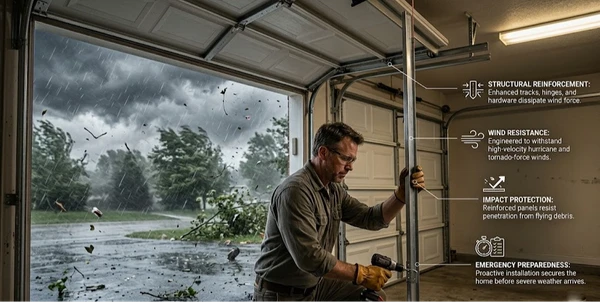
Bracing kits are the most practical solution for homeowners who don't have wind-rated doors but want meaningful protection before a storm. These are vertical steel or aluminum posts that install across the interior face of the door - they anchor to the floor with concrete screws and attach to the door at the hinge points and header above. The posts transfer wind load from the flexible door panels to the solid floor and header structure, dramatically increasing the door's resistance to bowing and collapse.
Several commercial kits exist for this - Secure Door Braces, CHI Overhead Door's hurricane kit options, and others. They're rated to specific wind pressures and come with installation instructions. A kit for a standard 16-foot double door runs $150 to $400. They're removable - you install them before a storm, pull them after. Keep them stored near the door so installation takes twenty minutes rather than a frantic search through the garage the night before landfall.
One thing worth knowing: these kits have to be sized for your specific door height. A kit for a 7-foot door won't work on an 8-foot door. Buy the right size before hurricane season, not during it.
Horizontal struts are different from the vertical bracing approach above. Steel struts bolted horizontally across each panel add rigidity to the panel itself, reducing how much it can bow. Some doors come from the factory with struts already installed; others don't. You can add them. They're not as effective as a full bracing kit but they're a permanent improvement that doesn't require any pre-storm installation. If you're adding struts for other reasons - an older door that bows under opener load - they provide secondary storm benefit as well.
Wind-rated doors are the permanent solution. A hurricane-rated garage door is engineered and tested to specific wind loads - typically 110 mph, 130 mph, or 150 mph depending on the certification, with impact-rated variants that also resist flying debris penetration. In Florida and coastal Texas, many jurisdictions require hurricane-rated doors for any new construction or door replacement. Miami-Dade County has some of the strictest impact-resistance standards in the country; a door with Miami-Dade NOA (Notice of Acceptance) approval has passed the most rigorous publicly-documented testing available.
These doors cost $2,000 to $5,000 installed for most residential applications. They look exactly like standard residential doors in most styles and colors. The cost is real - but it's substantially less than the deductible and out-of-pocket expenses on a major storm-damage claim. Some homeowners' insurance carriers reduce premiums for wind-rated doors, particularly in coastal Florida and the Gulf states. Worth asking your insurer.
What doesn't work
Parking your car inside the garage does not reinforce the door. The car is not in contact with the door panels and provides no structural support against inward deflection. This misconception comes up every hurricane season. It's wrong.
Locking the door - any lock - does not meaningfully increase wind resistance. Locks engage at a few discrete points. Wind pressure acts across the entire 16-foot face of the door. The math doesn't work in the lock's favor.
Leaning lumber against the door from the inside is improvised bracing that varies wildly in effectiveness depending on how it's done. Wood 2x4s run vertically from floor to door can help, but they have to be anchored at the floor (not just resting on it) and need to transfer load to a structural element at the top. Properly executed DIY bracing with 2x4s can provide meaningful resistance; boards leaned casually against the panels provide very little. If you're doing DIY bracing, follow a detailed guide with proper anchoring - don't improvise.
The timing question - when to act
The day before a storm is forecasted to make landfall is when most homeowners start thinking about this. That's late. Here's why.
If you're in a mandatory evacuation zone and you leave, you're leaving the door unprotected. A bracing kit installed in the twenty minutes before you leave is twenty minutes well spent - it's there working while you're not.
If you're sheltering in place, the hours before a storm makes landfall are the window for anything that requires going outside or working in the garage. Once winds reach tropical storm force - 39 mph - working outside becomes dangerous. Once they exceed 55 to 60 mph, working outside in any meaningful way is not advisable. Everything structural has to be done before that threshold.
The preparation that happens before hurricane season - a bracing kit purchased and stored in the garage, a wind-rated door already installed, struts already on the door - requires no decision-making or frantic last-minute trips to a hardware store that's already been cleaned out. This is the actual recommendation. Not "prepare before the storm" in the abstract, but "have the materials in hand before June 1st and know how to install them."
Tornadoes are a different problem
Tornado warning systems give you minutes, not hours. The preparation window is short enough that "act before the storm" means something different than it does with a hurricane.
A bracing kit that takes twenty minutes to install is not a tornado-preparation tool. By the time a tornado warning is issued for your specific area, you have time to get to shelter - basement, interior room, lowest floor away from windows - and that's where you should be. Not in the garage installing braces.
The practical tornado preparation for a garage door is the permanent option: a door that's already wind-rated and strut-reinforced before tornado season. In the Midwest and southern plains, doors rated to 130 mph or higher are the relevant target. A door that survives the wind load doesn't become the catastrophic entry point that starts the roof-loss sequence.
If you're in a tornado-prone area with an unrated door and tornado season is underway, a set of horizontal struts installed on the door now - today, not when the sirens go off - is the only meaningful preparation you can execute on a tornado's timeline.
One thing worth doing before this season ends
Pull up your garage door's product information - the label on the inside face of the top section, or the documentation that came with the door when it was installed - and find out whether it has a wind load rating. If it's a standard residential door with no wind rating listed, you have a door that's likely to fail in any storm above Category 1 intensity.
Decide whether a bracing kit or a door replacement makes more sense for your situation. Buy the bracing kit before June if you're in hurricane territory, before April if you're in tornado country. Keep it in the garage where you can find it. That's the difference between being prepared and being someone who searches "how to secure garage door" the night before a storm makes landfall.
DoorFixy installs wind-rated doors, hurricane bracing systems, and strut reinforcement - and can advise on what your specific door and location actually need.
More on the DoorFixy blog - garage door safety, storm preparation, maintenance, and honest advice for homeowners.