Most homeowners never think about garage door balance until something goes wrong. The opener starts straining. The door hesitates on the way up. A spring breaks earlier than it should. All of these trace back to the same root cause - the door isn't balanced, and the spring system is compensating in ways it wasn't designed to.
The good news: checking your door's balance takes about sixty seconds and requires no tools. The disconnect test is one of those things that's so simple it almost seems like it can't tell you much. It tells you quite a lot.
What "Balance" Actually Means
A properly balanced garage door is one where the spring tension exactly offsets the door's weight. The springs do the lifting - the opener just guides the movement and provides a small amount of additional force at the start and end of travel.
When the balance is right, the door should feel nearly weightless when you move it manually. Open it halfway, let go, and it stays there. The opener runs quietly and efficiently because it's not fighting gravity.
When the balance is off - springs too loose or too tight - something else carries the load. Usually that's the opener motor. Over time, an opener working against an unbalanced door wears significantly faster. Springs also wear unevenly when tension is wrong, shortening their cycle life.
The Disconnect Test: Step by Step
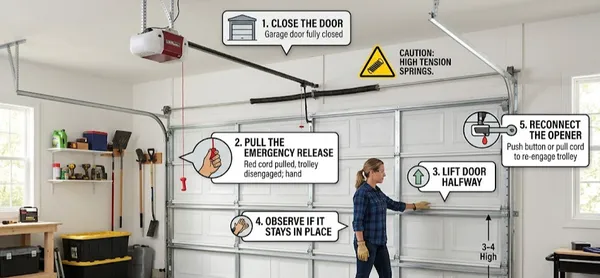
Step 1: Close the door completely. Start with the door fully closed. This is important - doing the test with the door partially open changes the spring load and gives you misleading results.
Step 2: Pull the red cord. The red emergency release cord hangs from the opener carriage on the ceiling track. Pulling it disengages the door from the opener, putting the door into manual mode. You'll hear a click or feel the carriage release.
Step 3: Lift the door manually to waist height. Grab the door at the bottom or sides and lift it to roughly hip or waist height - approximately 3 to 4 feet off the ground. You don't need to lift it all the way up. Use both hands, lift slowly, and note how much effort it takes.
A balanced door should feel noticeably lighter than you'd expect for its size and weight. If it feels like you're lifting the full weight of the door, the springs aren't doing their job.
Step 4: Let go. Release the door and step back immediately. Watch what happens.
- Door stays put, or drifts very slowly: The door is balanced. Springs are correctly tensioned.
- Door falls to the floor: Springs are under-tensioned. The spring system isn't carrying the door's weight.
- Door shoots upward: Springs are over-tensioned. More spring force than needed for the door weight.
That's the test. Sixty seconds, no tools, clear result.
What Each Result Actually Means
Balanced (door holds position): You're in good shape. Check again in six months or if you notice any change in how the opener sounds or how the door moves.
Door falls (under-tensioned springs): The springs need more tension - either they've lost tension over time, one has broken and been removed without compensating the other, or the door was replaced with a heavier one without adjusting the spring system.
Under-tensioned springs mean the opener is doing work it shouldn't. Left long enough, this kills openers ahead of schedule. It also puts uneven stress on the door panels because the opener is pulling on the carriage while gravity is pulling the door down.
Door rises (over-tensioned springs): Less common, but it happens - usually after a DIY spring replacement where too many turns were added, or if the door was replaced with a lighter model without rebalancing the springs.
An over-tensioned spring creates its own problems. The door is harder to pull down manually, which is a safety issue if the opener fails. The spring itself is under more stress than it's rated for, which accelerates wear and increases the chance of breakage.
What You Should Not Do With This Information
Check the balance: yes. Adjust the springs yourself: no.
Torsion springs - the horizontal springs above the door opening - need to be adjusted by adding or removing turns using winding bars. The process requires specific tools, knowledge of how many turns correspond to your door's weight, and physical positioning that keeps you clear of the spring if something goes wrong.
The amount of stored energy in a wound torsion spring is not trivial. A standard double-car door spring holds enough tension that a sudden release can cause serious injury. This isn't overcaution - it's the reason spring-related injuries show up in emergency rooms regularly enough that most experienced technicians have a story about it.
Extension springs - the ones that run parallel to the horizontal tracks on either side - are more accessible but carry their own risks if adjusted without proper technique or if the safety cable isn't correctly installed.
The disconnect test tells you whether adjustment is needed. A trained technician is how you get that adjustment done safely.
How Often to Check Balance
Once a year is a reasonable schedule for most homeowners. A good time is before heavy-use seasons - late fall before winter in cold climates, or early spring when the door starts getting more daily use.
Also check after any spring replacement, after a significant impact to the door, or if you notice any of these signs between scheduled checks:
The opener sounds like it's working harder than usual. The door moves slower in one direction than the other. The door doesn't sit fully closed - there's a small gap at the bottom on one side. The door hesitates or jerks during travel.
Any of these warrants a disconnect test before the next scheduled one.
One More Thing: The Full Manual Operation Check
While you have the door in manual mode, take thirty extra seconds to check something else.
With the door disconnected from the opener, operate it manually through its full range - floor to fully open and back. It should move smoothly with consistent resistance throughout. No binding, no scraping, no points where it catches and then releases.
Binding at a specific point usually means a roller is worn, a track section is slightly out of alignment, or a hinge is stiffening up. Catching-and-releasing is often a roller that's cracked or flat-spotted. None of these are urgent emergencies, but they're useful to catch before they become one.
Reconnect the opener by pulling the cord again or by operating the opener - most systems re-engage automatically when the opener runs.
DoorFixy handles spring balancing and adjustment for all residential garage door types. If your disconnect test showed the door isn't holding position, get in touch - we'll assess the spring tension and make the adjustment correctly. Same-day availability in most areas.