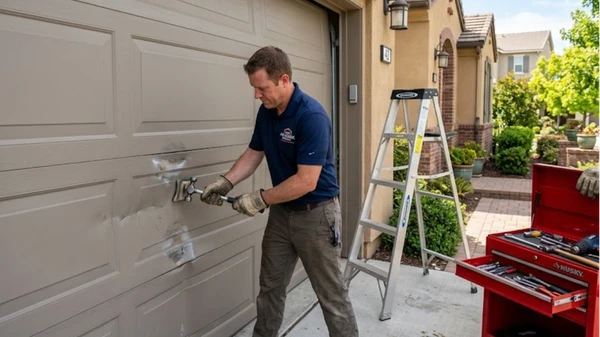
I asked a garage door technician this question directly a few years ago, after he'd come out to fix a broken cable on my neighbor's door. My neighbor hadn't had any service on the door in the seven years since it was installed. "What would have caught this?" I asked him.
He thought for about two seconds. "An annual tune-up. We would have seen the fraying on the cable last year and replaced it for about sixty bucks. The emergency call today is three hundred."
That's the summary of the garage door service frequency question, honestly. The cost difference between catching things preventively and dealing with them after failure is real, consistent, and not particularly subtle.
The follow-up question - how often specifically - has an answer that depends on a few things about how your door is used and where it lives. Here's how to think through it.
The baseline: once a year for most homeowners
The consistent recommendation from garage door manufacturers, the Door and Access Systems Manufacturers Association (DASMA), and most experienced installers is professional garage door service once per year. Annual inspection and tune-up.
That recommendation is built around a typical household that uses the garage door four to eight times per day and lives somewhere with normal seasonal variation. At that usage rate, a standard residential torsion spring completes roughly 1,500 cycles per year - springs are typically rated for 10,000 cycles, meaning a seven-year service life under normal use. Annual inspection catches spring fatigue developing before the spring fails, which is significantly preferable to a spring failing at the end of its cycle life without warning.
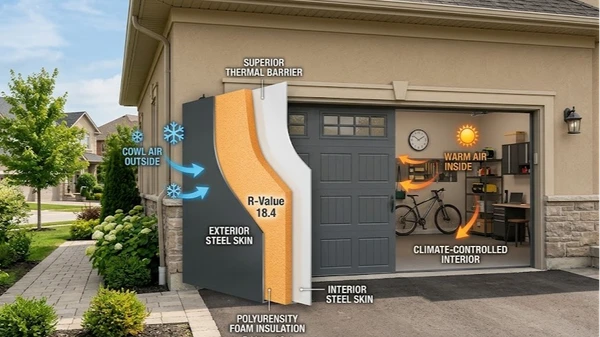
The annual visit also catches the less dramatic things that accumulate over a year of use: rollers that have developed flat spots, cables with early fraying, mounting brackets that have worked loose from vibration, weatherstripping that's cracked enough to leak air and water but not yet enough that you'd notice just using the door.
When once a year isn't enough
Annual service is a baseline, not a ceiling. Several situations genuinely push the recommendation toward twice a year or more.
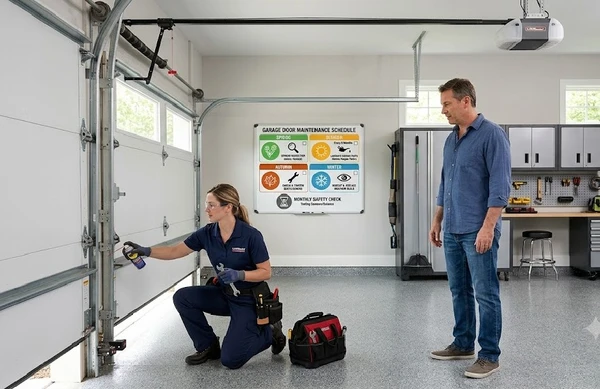
Heavy daily use. A household where four people with four cars are all using the same garage door in the morning and evening - eight to sixteen cycles per day - is completing 3,000 to 6,000 cycles per year. That's two to four times the typical load. Components wear proportionally faster. The same spring that might last seven years at light use might last three years at heavy use. For households in this category, garage door service twice a year - spring and fall - is the sensible schedule. You're inspecting after each high-stress period before the next one begins.
Coastal and humid climates. Salt air accelerates corrosion on steel components - springs, roller stems, cable hardware, tracks - at rates that aren't comparable to dry inland environments. A torsion spring that shows minimal surface rust after five years in Denver might show heavy pitting after three years in a coastal Florida garage. If your garage is in a high-humidity or salt-air environment, an annual inspection and lubrication schedule gives you the opportunity to catch corrosion before it becomes structural. Twice a year is worth considering in genuinely harsh coastal environments.
Extreme temperature climates. A garage door system working through -20°F winters in Minneapolis or 115°F summers in Phoenix is experiencing thermal cycling that wears hardware differently than a temperate climate. Lubricants thin and evaporate faster in heat, thicken and lose effectiveness in cold. Rubber seals crack faster at temperature extremes. Metal fatigue accumulates differently. Most installers in extreme climate areas recommend seasonal garage door service - specifically checking the system before and after the most stressful season.
Old doors and aging hardware. A garage door system that's fifteen years or older is operating on components that have been through a lot. Springs rated for 10,000 cycles may have 8,000 to 9,000 cycles on them. Rollers are worn. Cables have accumulated micro-fatigue. The closer a system is to its end of life, the more valuable frequent inspection becomes - because the cost of catching a spring before it breaks is $150; the cost of dealing with a broken spring and whatever secondary damage the sudden door drop caused is substantially more. For doors over fifteen years old, twice-yearly inspection is reasonable.
Garage as primary home entry. A lot of households use the garage as the main way in and out of the house - the front door gets unlocked once a week for Amazon deliveries and that's it. If your garage door cycles ten or more times a day because it's the primary entry for the household, you're in the heavy-use category and should schedule accordingly.
What the professional service visit actually covers
Understanding what happens during a professional garage door tune-up helps calibrate how much value you're getting from the annual recommendation.
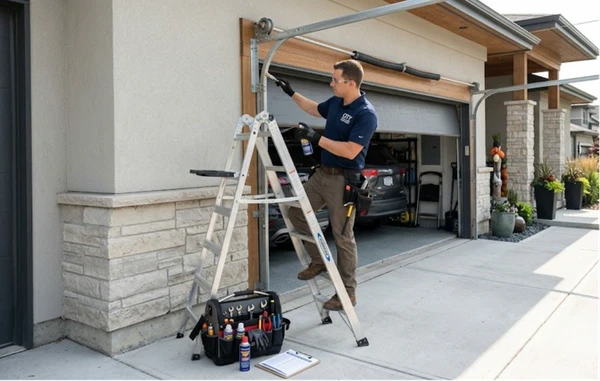
Spring inspection and tension verification is the highest-value item. The technician checks the spring against the door's current weight, verifies tension is within spec, looks for corrosion in the coil valleys, and identifies fatigue developing before failure. This is the inspection item that catches the thing most likely to cause a sudden, inconvenient, or dangerous failure.
Cable inspection - looking for fraying, checking the cable is seated correctly on its drum, verifying the cable hardware at the bottom bracket is in good condition. Cable replacement costs about $60 to $100 per cable at a planned service call. Cable replacement after a cable fails and drops the door to one side costs more and may include secondary damage.
Hardware tightening - mounting brackets, hinge fasteners, track bolts. Everything loosens from vibration. An experienced technician goes through the full system and tightens everything that needs it. This takes fifteen minutes in professional hands and prevents tracking problems that develop when loose brackets let the track drift.
Lubrication - done with commercial-grade products, applied correctly to the right components. A technician's lubrication job isn't necessarily better than a homeowner's if the homeowner is using the right products, but it gets done consistently and completely rather than occasionally.
Safety system testing - sensors, auto-reverse, force settings. The technician verifies the system is functioning correctly and adjusts what needs adjusting.
Balance adjustment if needed - if the spring tension has drifted from the calibrated setting, the technician corrects it. This is the task that most homeowners can diagnose (the balance test described in the maintenance checklist guide on this blog) but should not attempt to fix themselves.
What you can do between service visits
Between annual professional visits, homeowners can do meaningful maintenance that extends the time-to-failure on most components.
Lubrication every three to six months - silicone spray on hinges and rollers, lithium grease on springs and the opener rail. This is the task that most extends hardware life between professional visits. Dry hinges and rollers accumulate wear faster than lubricated ones. In harsh climates, lubricating every three months rather than every six is worth the additional effort.
Monthly visual check - thirty seconds of looking at the door while it runs. Anything that sounds different than it did last week warrants a closer look. The operational noise of a healthy garage door is consistent; changes in that noise pattern are usually the earliest signal of a developing problem.
Weatherstripping inspection before winter - the bottom seal and side seals need to be in condition before temperatures drop, not after. A cracked bottom seal in November doesn't have time to be replaced before the first hard freeze unless you're watching for it.
Sensor lens cleaning - a quick wipe of both photo-eye sensor lenses keeps them clear of dust, cobwebs, and condensation residue. This takes thirty seconds and prevents the most common cause of "garage door won't close for no reason" calls, which are often just dirty sensors misread as a blocked beam.
The signs that service is overdue regardless of when you last had it
There are specific symptoms that mean garage door service is needed immediately, not at the next scheduled interval:
A scraping or grinding sound that happens at a consistent point in the door's travel - a roller or hinge at that location is failing.
The door reverses without any visible obstruction - sensor misalignment or force setting drift.
The door feels significantly heavier than usual when lifted manually - spring tension has dropped, possibly from a partial break or significant corrosion.
One side of the door is visibly lower than the other when it's fully open or closed - a cable has slipped off a drum or the spring system is unbalanced between the two sides.
The opener is working noticeably harder than it used to - audibly straining, taking longer to complete the cycle - and nothing obvious has changed about the door.
Any of these symptoms means the system is telling you something. The time between "telling you" and "failing on you" varies - sometimes weeks, sometimes days. Don't wait for the scheduled annual visit if the door is actively showing you something is wrong.
The cost of service vs. the cost of not servicing
A professional garage door tune-up runs $75 to $150 for most residential single or double-car doors. That covers the full inspection, lubrication, hardware tightening, balance verification, and safety testing described above.
A spring replacement - which a preventive inspection might predict and prevent by catching the spring before it breaks - runs $150 to $300 for parts and labor. After a spring breaks and the door drops, there's often secondary damage to rollers, panels, or cables from the sudden unbalanced drop, which pushes the total cost higher.
An opener replacement, which can be partially attributed to a door that's been running unbalanced or poorly lubricated for years (the opener is always compensating for what the spring system or hardware should be doing), runs $300 to $600 installed.
The arithmetic is consistent: preventive service costs a fraction of reactive repair. The annual service recommendation exists because the industry knows this, and decades of customer call patterns have confirmed it.
DoorFixy provides annual and semi-annual garage door service for residential customers - scheduled maintenance that stays ahead of the problems that would otherwise show up as emergency calls.
More on the DoorFixy blog - garage door maintenance schedules, repair guides, buying advice, and honest information for homeowners.