The can of WD-40 in my garage gets used for a lot of things. Frozen bolts. Squeaky door hinges inside the house. Rust on garden tools. It's a genuinely useful product and I'm not going to say otherwise.
What it's not useful for is a squeaky garage door. And I know this because I used it on my garage door for about four years before someone who actually knew better watched me do it and explained what was happening.
WD-40 is primarily a water displacer and light solvent. It's excellent at loosening corroded fasteners because it penetrates and breaks down surface rust. What it doesn't do is leave a lasting lubricating film. Within three to five days of spraying it on a garage door hinge or roller, the light carrier fluid has evaporated and left behind a thin oily residue. That residue attracts dust particles. Those dust particles mix with the residue and create a gummy compound that's more abrasive than no lubricant at all. The door starts sounding worse than it did before, usually within a few weeks.
There is a WD-40 Specialist line - specifically the White Lithium Grease spray - that is a legitimate lubricant and works well on garage doors. If you're going to use anything with WD-40 on the label, it's that. The blue-and-yellow can is not the one.
What actually causes garage door squeaking
Before getting to the products, it's worth spending thirty seconds on what the squeak actually is.
A garage door squeaking is metal moving against metal without adequate lubrication between the contact surfaces. The hinge pin rotating inside the hinge knuckle. The roller axle inside the roller housing. The spring coils compressing and releasing against each other. All of these contact points develop friction as the lubricant film from a previous application thins out, wears away, or was never there in the first place.
The squeak is the sound of that friction - metal oxide against metal oxide, creating noise as the surfaces slide against each other without separation. The squeak also means wear. Every cycle that produces that sound is removing microscopic material from the contact surfaces. A door that's been squeaking for a year has hinge pins, rollers, and spring coils that are measurably more worn than they would have been with proper lubrication.
The noise isn't just an annoyance. It's a maintenance signal.
The two products that actually work
Every experienced garage door technician will eventually land on one of two lubricant types for residential garage doors. They're slightly different in character and each has its optimal application within the door system.
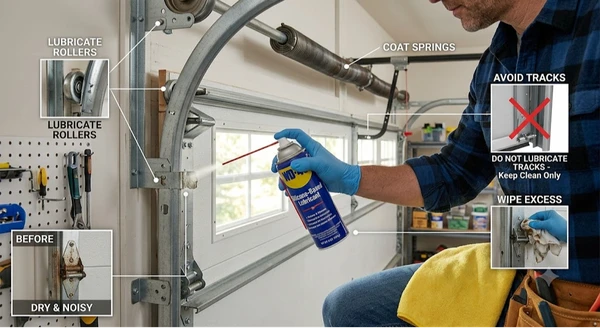
Silicone-based lubricant spray is the right choice for hinges and rollers. Silicone doesn't attract dust the way petroleum-based products do - it repels rather than absorbs particles, which means it stays cleaner longer. It stays fluid across a wide temperature range, which matters for a door that operates in summer heat and winter cold. It doesn't stain steel panels or leave residue that collects grime. The most consistently recommended products in this category are 3-IN-ONE Professional Garage Door Lubricant and CRC Heavy Duty Silicone Lubricant. Both come with precision straw attachments that make application to small components much easier than a wide-spray can.
White lithium grease spray is the right choice for springs, bearing plates, and the opener rail. Heavier than silicone, lithium grease stays in place under the mechanical load of the spring system and under the friction of the opener trolley on the rail. It provides a more robust lubricating film for high-load metal-to-metal contact. The tradeoff is that it's slightly more likely to attract particles than silicone - which is why it belongs on the springs (enclosed in the coil structure) and the overhead rail (where accumulation matters less) rather than on hinges and rollers where contamination directly affects function. WD-40 Specialist White Lithium Grease and Blaster White Lithium Grease are the two most commonly recommended versions of this product.
You don't strictly need both - either product does an adequate job across the whole door if you only want to keep one on hand. But using silicone on hinges/rollers and lithium grease on springs/opener rail is the technically optimal combination and it's what most professional maintenance visits use.
Where to apply it - component by component
This is where most guides go wrong by being too vague. "Lubricate the hinges and rollers" is technically correct and practically insufficient. Here's what each component actually needs.
Hinges - The target is the hinge pin. That's the metal rod running through the center of the hinge barrel where the two panels articulate. You're not lubricating the hinge face or the mounting plates - you're getting lubricant into the rotating joint at the pin. Insert the straw tip of the silicone spray into the gap at the hinge pin end and apply a short burst. You'll see the lubricant work into the barrel gap. Do this on every hinge - a standard double-car door has eight to ten hinges. Wipe any excess from the panel face with a rag.
Rollers - Here's where a common mistake happens: most homeowners spray the outside of the roller wheel. That's the wrong target. The lubricant needs to reach the ball bearings inside the roller hub - the small steel balls that allow the wheel to spin on the axle. Most roller designs have a small gap between the axle stem and the wheel hub where the straw tip of a precision-nozzle spray can deposit lubricant. Apply there, then rotate the wheel by hand to distribute. For nylon rollers, the nylon wheel itself doesn't need lubrication - nylon on steel track runs dry. Only the bearing assembly at the center needs it, and only if the bearings are accessible (exposed or semi-exposed). Fully sealed nylon rollers with enclosed ball bearings don't need user lubrication at all.
Torsion springs - The springs above the door get a coat of white lithium grease along the full length of the coil. Stand slightly to one side (never directly underneath the spring when working on it), hold the can about eight inches from the spring, and make a slow sweeping pass from one end of the coil to the other. The grease works its way between the coils as the spring operates. If you have extension springs running along the sides of the horizontal tracks, the same approach applies - sweep along the spring length from a safe distance.
Bearing plates - The circular plates mounted on each side of the torsion spring shaft. Each has a bearing inside that the shaft rotates through. A short spray into the bearing center of each plate reduces friction on the spring system's operation. Often forgotten; worth including every time.
Opener rail - The metal channel running from the motor unit to the front bracket, where the trolley carriage slides. Apply white lithium grease along the top contact surface of the rail. For chain-drive openers, the chain itself typically doesn't need lubrication - most residential chains come pre-lubricated from the factory and additional lubricant creates a mess that flings off during operation. For screw-drive openers, the manufacturer usually specifies a particular lubricant for the screw threads - check the manual before applying anything.
Lock hardware - If the door has a keyed lock or slide bolt, the keyway and bolt mechanism benefit from a brief spray. This prevents rust and keeps the lock operating smoothly. Easy to forget because it doesn't squeak.
What not to lubricate
The tracks. This gets repeated throughout maintenance guides because people keep doing it. The track interior surface - the channel where the roller rides - should be clean and dry. Lubricant on the track surface collects every grit particle and piece of dust in the garage into a grinding compound. The tracks get cleaned with a dry cloth; they don't get lubricated.
The door panels themselves. The painted or galvanized steel faces don't benefit from lubricant and it creates a surface that collects environmental debris and looks grimy within weeks.
The photo-eye sensor lenses. Lubricant on a sensor lens obscures the infrared beam and creates exactly the problem it appears to be fixing.
How to apply it efficiently - the actual sequence
Unplug the opener before starting. You're going to manually cycle the door, and you don't want it activating.
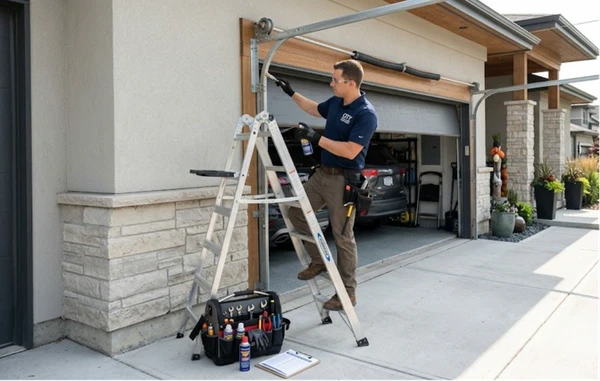
Start with the hinges on the closed door, working from bottom to top. Then move to the springs and bearing plates. Then the opener rail. Apply lubricant to the rollers as you go - this is easier to do as you manually cycle the door, since some rollers are more accessible with the door in different positions.
After lubricating everything, manually cycle the door three to four times - open and closed, slowly. The movement distributes lubricant into the contact surfaces that direct application couldn't reach inside the hinge barrels and roller bearings. This step is what turns a "sprayed it on" job into an effective lubrication job.
Wipe excess from any panel surfaces where drips have landed. Plug the opener back in and run two automatic cycles. The sound difference on a door that was genuinely dry should be immediate - quieter travel, no squeak, smoother operation at the radius section where the door transitions from vertical to horizontal.
When lubrication doesn't fix the squeak
If you've done all of this correctly and the garage door is still squeaking after a few days:
The squeak is coming from a specific location at a specific point in the door's travel - that's a component issue, not a lubrication issue. A roller with a failed bearing squeaks at the same place every cycle even after fresh lubrication. A hinge cracked at the fold continues to creak. A bent track section causes the roller to scrape against the track wall regardless of how well the roller is lubricated.
The squeak resolved immediately after lubrication and came back within a week - either the wrong product was used (one that dissipates quickly), or a component is wearing through lubricant faster than normal because it's already damaged.
Lubrication that holds for three to six months is normal. Lubrication that needs redoing every two to three weeks means something in the system is working abnormally hard.
DoorFixy handles full lubrication service and hardware inspection - including the component assessment that distinguishes a lubrication problem from a hardware problem.
More on the DoorFixy blog - garage door maintenance guides, product recommendations, and practical advice that doesn't waste your time.