January morning, few years back. Twelve degrees outside. I'd had wet snow the day before and I was already running behind when I hit the remote and heard the opener motor strain against a garage door frozen shut to the threshold. Completely bonded. The door was not moving.
I hit the button again. And again. Motor kept running. Door kept not moving.
What I did next was wrong and I knew it was wrong in real time - I stood there and hit that button four more times, waiting for the outcome to change. By the time I accepted that I had a garage door frozen to the ground and not an opener malfunction, the motor had been fighting against it for almost a full minute. Got lucky. Didn't burn anything out.
Here's what actually helps - and why most people make the same first mistake I did.
The first thing: stop pressing the button immediately
Seriously. Before anything else. This is the section that matters most because it's where the expensive part of a frozen garage door situation usually happens.
When you keep pressing the remote on a frozen garage door, the opener motor runs its trolley carriage against a door that physically cannot move. The auto-reverse mechanism on modern openers is designed to detect soft obstructions - a child, a pet, a cardboard box. It is not designed to deal with a door that's been welded to the concrete by a quarter inch of solid ice. Some openers will eventually trip an overload sensor and stop. Others will just keep grinding. The thing that eventually gives is sometimes the drive gear. Sometimes it's the cable. Sometimes it's the bottom door panel itself, which buckles from the upward force being applied against an immovable bottom edge.
A garage door frozen shut that nobody forced costs nothing to fix beyond ten minutes of your time. A frozen door that got forced until something broke costs $200 to $400 in parts and labor, sometimes more.
Reach up and pull the emergency release cord - the red cord hanging from the opener carriage rail. It disconnects the opener from the door entirely. Now you can work on the ice problem without the motor getting involved at all.
What's actually frozen - because it's not always the same thing
Most of the time, a garage door frozen to the ground is exactly that: the rubber weatherstripping seal on the bottom of the door has bonded to the concrete threshold. Snow melt or rain collects at the base of the door, works its way under the bottom seal, and freezes overnight. By morning that seal is effectively glued to the floor. This is what causes probably 85% of frozen garage door calls.
Less common is the door freezing at the sides - where the door panel edges press against the side jamb seals. You get this more in climates with freezing rain, or where the garage door weatherstripping on the sides fits tightly enough to trap water at those contact points. If you push on the door and feel it binding at the sides rather than lifting freely at the bottom, that's the situation.
The one that needs immediate professional attention is a mechanically frozen door - a seized roller, a spring that's contracted so far in the cold that it's binding in the hardware, a cable stiff from ice inside the housing. If you've pulled the emergency release and the door still won't lift when you push up on it manually, and there's no obvious ice contact anywhere along the bottom or sides, stop. That's not a thawing problem. That's a mechanical problem that happens to be presenting in winter. Call someone.
If it's the bottom seal - which it almost certainly is - here's how to actually fix it.
How to thaw a garage door frozen shut: what works and what doesn't
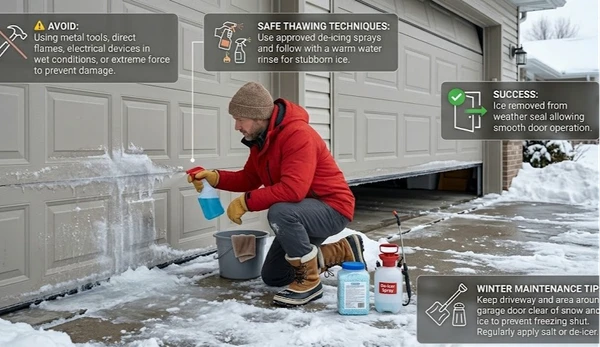
Warm water is the fastest approach for a light to moderate freeze. Not hot. Not boiling - boiling water poured on a frozen garage door threshold can crack the concrete from thermal shock, and the sudden temperature change can warp or crack the rubber bottom seal. Warm water, the kind you'd fill a mixing bowl with at the kitchen sink, poured slowly along the base of the door where the frozen garage door weatherstripping is bonded to the concrete. Let it sit for thirty seconds, add a bit more, then try pushing up on the door with gentle manual pressure. On a light freeze, the bond breaks quickly.
A hair dryer or heat gun works better on a heavier freeze where the ice is thick and warm water isn't getting through it fast enough. Hold it 6 to 8 inches from the bottom seal and move it slowly back and forth along the frozen edge. Keep it moving - holding heat in one spot too long can damage the rubber seal material. Give it two or three minutes, then try the door. A heat gun is faster but more aggressive; a hair dryer is more forgiving if you're not sure about the seal condition.
For a light surface freeze where the bond is thin, a rubber mallet tapped gently along the bottom edge from inside the garage can vibrate the seal loose without any heat at all. You're not hammering the door - you're applying controlled vibration to break the ice contact. If you feel the bond giving after several taps, keep going. If it's genuinely stuck after a minute of this, you need heat or water. Switch methods.
What not to reach for: rock salt, calcium chloride, or any ice-melting chemical product. These work on ice - they also work on your rubber bottom seal, on the galvanized steel door bottom, and on the concrete. Salt accelerates corrosion on every metal component near that threshold: the bottom seal retainer, the door frame, the track hardware at floor level. One winter's worth of salt use to unfreeze a garage door frozen shut can do years' worth of corrosion damage to the components you'll need to replace eventually anyway. Warm water takes three more minutes. Use warm water.
Getting the door open once the ice breaks
When the seal finally releases from the concrete, lift the door manually by gripping it at the center bottom edge. A door with healthy torsion springs should feel much lighter than its actual weight - the spring system is counterbalancing most of those 200-plus pounds. If it feels like you're lifting the entire weight of the door, the springs may be significantly weakened. That's information worth passing to a technician when you call for winter service.
Lift slowly and watch how the door tracks. If you forced the opener against the frozen garage door several times before pulling the release cord, the bottom panel may have a slight buckle, or a roller may have shifted partially out of the track. A door that catches, drags, or tilts as you lift it manually needs to be checked before being returned to automatic operation. Don't run the opener on a door that's not traveling cleanly.
Once the door's open and you've confirmed it's running straight, reconnect the opener. Pull the release cord toward the motor until you hear the click, or just run the opener - on most current models the moving carriage will catch the trolley automatically and re-engage with a audible snap. Run a full automatic cycle and confirm everything sounds and feels normal before you call it done.
What to do tonight so this doesn't happen again tomorrow
If the conditions are the same tomorrow - snow, a warm day, a cold night - the garage door is going to freeze to the ground again. Fix the actual cause, not just tonight's symptom.
Silicone spray on the garage door bottom seal is the simplest preventive measure. A light coat of silicone lubricant on the rubber seal surface creates a barrier that significantly reduces how aggressively it bonds to the concrete in light freeze conditions. It doesn't waterproof the seal or prevent a heavy freeze, but it slows ice formation and makes the morning release much easier. Takes thirty seconds. Should have been done in October. Do it now anyway.
Sweeping the threshold clear after every snowfall is basic but it's the step most people skip because it seems too simple to matter. Snow and slush sitting under the door is the water source that freezes overnight. Remove the snow, and in most cases the freeze doesn't happen. This is obvious. Most people know it. Most people still wake up to a frozen garage door in February because they didn't sweep after Tuesday's storm.
A garage door threshold seal - an adhesive rubber or aluminum strip bonded to the concrete floor that the door closes against - raises the sealing surface off the raw concrete. The rubber-to-rubber or rubber-to-aluminum contact point dries faster than rubber-to-concrete and collects less standing water. For garages that freeze shut repeatedly despite clearing and lubricating, a threshold seal is the upgrade that actually addresses the geometry of why water pools there.
Persistent freezing that comes back every few days regardless of what you do usually has a drainage cause. Water is pooling at the threshold because it's flowing toward the door rather than away from it. The driveway slope, a low point in the concrete, a clogged channel drain at the apron - these are the real problem. Fixing them is a larger project than this article covers, but understanding that repeated garage door freezing is a drainage symptom rather than just a seal problem is the first step toward fixing it permanently rather than treating it every morning.
When thawing the ice doesn't fix it
You've poured warm water, used the heat gun, the ice is clearly gone, the seal is free from the concrete - and the door still won't lift manually after pulling the emergency release. That's not a frozen door anymore. That's a mechanical problem.
Broken torsion spring is the most common culprit - the door will feel impossibly heavy because the counterbalance is gone. You can sometimes see the break if you look at the spring above the door from inside the garage; there'll be a visible gap in the coil. A cable off its drum is another possibility - you may see it hanging loose near the bottom bracket. A seized roller looks like a wheel that won't turn when you try to push the door.
None of these are safe to fix yourself without the right tools and training, especially anything involving the spring system. The spring is under hundreds of pounds of stored tension. Leave it.