A friend of mine bought a house about two years ago. Older place, attached garage, built late 1980s. The home inspector flagged the door between the garage and kitchen in his report - hollow-core, passage handle, no visible fire rating label, no self-closing mechanism - and listed it as a deficiency.
My friend read the word "deficiency" and processed it the way most people process that word in home inspection reports. Non-urgent. Cosmetic. Something to deal with eventually.
He has been living there for two years with the most important fire safety component in his house in a condition that would fail any building code inspection. Not the overhead door - the door from the garage into his kitchen. That one. Which he has never once thought about since the day he moved in.
This is the problem I want to address before anything else, because it's the confusion that sits at the center of almost every conversation about garage door fire ratings. The overhead door - the large panel that opens for your car - and the interior door between the garage and the house are different things with different requirements. They get conflated constantly, and the conflation has real consequences.
Which door the code is actually talking about
When someone searches "garage door fire rating," they're almost always thinking about the big overhead panel. That's not what most residential building codes are regulating.
The International Residential Code - the model code that most U.S. jurisdictions adopt, with local amendments - requires the door separating an attached garage from the living space to be at minimum a 20-minute fire-rated assembly, at least 1-3/8 inches thick in solid wood or solid steel (or honeycomb steel with an equivalent rating), self-closing, and self-latching. That's IRC Section R302.5, and it applies to the door from the garage into the kitchen or hallway. The overhead door is a different question entirely, and for most standard residential situations, it isn't subject to a fire rating requirement under the base code.
The logic is sound once you think about it. A car fire in an attached garage is the scenario everyone worries about. That fire needs a barrier between the garage and the house that holds long enough for people to evacuate. The overhead door faces the outside - it's not the path the fire takes into the house. The interior door is. That's the one the code specifies.
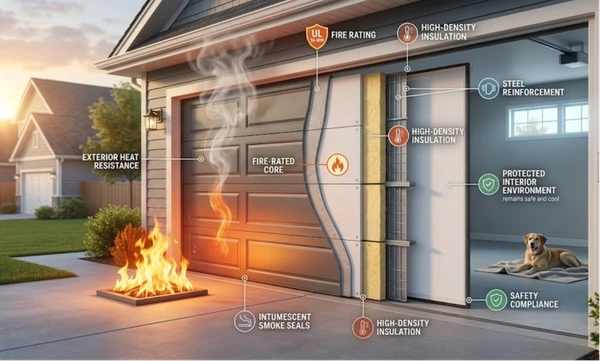
What the overhead door contributes to fire scenarios is gap control and smoke resistance - a well-sealed door with good weatherstripping and no major gaps slows smoke infiltration from outside the house into the garage and vice versa. That matters, but it's a different standard than what the interior door has to meet.
When the overhead door does need a fire rating
The answer isn't identical everywhere, which is part of why this topic generates so much confusion.
Some states layer requirements on top of the base IRC. California is the most well-known example - the state has adopted amendments to the building code that are stricter in several areas than the national baseline. Wildland-Urban Interface zones - the geographic designation that covers areas where residential development meets undeveloped fire-prone land - carry their own set of construction requirements, and those requirements often address the overhead door directly. If you're in a WUI zone in California, Nevada, Oregon, Colorado, or other western states with significant wildfire risk, the rules governing your overhead door may be substantially more stringent than baseline IRC. The California fire map has changed meaningfully in recent years as more areas have been reclassified, so even homeowners who bought several years ago should verify whether their current designation affects their door.
Homes where living space sits directly above the garage are another category. The floor-ceiling assembly between a garage and a habitable space above it carries its own fire resistance requirement, and in some jurisdictions the overhead door is considered part of that assembly's protection. The specific requirement depends on the jurisdictional amendment and how the structure is classified.
Then there's the commercial and mixed-use situation. An overhead door in a garage that's attached to a commercial building, a mixed-use property, or any multi-family structure is regulated under the International Building Code rather than the IRC. Under the IBC, fire-rated overhead doors are required wherever the door opening breaches a fire wall or fire barrier. Ratings in this category range from 45 minutes at the low end to 3 or 4 hours for openings in high fire-resistance-rated assemblies.
HOA governing documents are the wildcard that many homeowners forget to check. Some associations have adopted fire resistance requirements for overhead doors that exceed local building codes - particularly in newer communities and planned developments in fire-risk areas. This information is in the CC&Rs and is worth looking at before assuming the base code is your ceiling.
The cleanest way to get an authoritative answer for your specific property is to call your local building department or fire marshal's office and describe the setup. Not to look it up, not to interpret the code yourself - to call the actual authority and ask. They'll tell you in fifteen minutes what would take you two hours of code research to figure out, and their answer is the one that matters at inspection.
What the rating number actually means
A 20-minute fire-rated door is not a door that survives a fire for 20 minutes. It's a door that was tested to a standardized fire exposure - the ASTM E152 test method or equivalent - and maintained its structural integrity and flame resistance for that duration under those conditions. The conditions are severe, but they're laboratory conditions, not your specific fire scenario.
The practical meaning is about containment and time. A 20-minute rating buys roughly 20 minutes of barrier between the fire in the garage and the rest of the house. That's enough time for most occupants to evacuate if the fire alarm is working and they respond immediately. It's not enough if people are sleeping through it, if there's no alarm, or if the door has been compromised.
Standard residential ratings are 20 minutes and 45 minutes. Commercial goes to 90 minutes, 180 minutes, and 240 minutes. The rating you need in a commercial application is typically three-quarters of the fire resistance rating of the wall the door is installed in - a 1-hour wall requires a 45-minute door, a 2-hour wall requires a 90-minute door. Residential is simpler: 20 minutes is the baseline, and that's what IRC requires for the garage-to-house door.
One thing that catches people off guard: the fire rating belongs to the complete door assembly, not the door panel alone. The door, the frame it's installed in, the hardware, and the seals are all part of the tested assembly. You cannot buy a fire-rated door and install it in a non-rated frame and claim the rating. You cannot add mineral wool or other fire-resistant material to a standard door and have it meet a rating. The assembly has to be factory-tested as a unit, certified by a third-party testing organization, and labeled as such - the label is on the hinge edge of the door and is what inspectors look for. No label means no rating, regardless of what the door was described as.
The self-closing problem that exists in a lot of actual homes
The IRC requirement doesn't just specify fire resistance for the garage-to-house door - it specifies self-closing and self-latching behavior. The door must close and latch on its own when released. This is not optional and it's not decorative.
The reason it's required is that a fire door held open with a doorstop is not a fire door. It's a decorative object with a rating label on the hinge edge. The protection it was tested to provide depends entirely on it being closed.
And yet - self-closing doors are genuinely annoying in a kitchen entry context. You're carrying groceries and you let the door go and it swings back and hits you, or the bag, or the dog. So people prop them open. Not permanently, just when it's convenient. Then the box that was propping it open becomes a permanent fixture because it's always convenient to have it open when you're going in and out.
A fire in an attached garage spreads to the house through the interior door. That's the pattern in almost every residential garage fire fatality or major loss. The door being open, or the self-closer having been disabled, is a factor that shows up repeatedly in fire investigation reports.
There are door stops designed for fire door applications - hold-open devices that release automatically when a fire alarm triggers. They're electromagnetic, they hold the door open during normal use, and they let go the moment the alarm goes off. These are not the rubber wedge from the hardware store. If you want to be able to keep the garage door open for convenience without defeating its protective purpose, this is the hardware that allows it. It costs $50 to $120 and it works.
Smoke does more damage than fire in most residential scenarios
A fire-rated door with a quarter-inch gap at the bottom passes smoke from the moment the fire starts. The rating addresses flame - the door maintains its structural integrity and doesn't let fire through for the rated duration. It says nothing about smoke unless the assembly specifically includes smoke seals.
Smoke is what incapacitates people in residential fires. Direct flame contact is a later-stage problem for most occupants. The scenario where people die in a house fire is typically smoke inhalation before flames reach them, often while they're still asleep and the smoke alarm didn't work or they didn't hear it.
Intumescent seals address this. They're strips of material - typically graphite-based - that sit in channels around the door edges. At normal temperatures they're compressed and allow the door to operate normally. When the temperature rises toward fire conditions, they expand dramatically - the graphite chars and expands to many times its original volume, sealing the gap around the door perimeter. On the bottom of the door, an intumescent door sweep does the same thing.
Some factory fire-rated door assemblies include them. Others don't, and they need to be added as part of the installation. If you have a fire-rated door between your garage and house and you're not sure whether it has intumescent seals, run your finger along the door edge and frame - you're feeling for a soft compressible strip in a channel. If you don't feel it, they're not there, and adding them is a $40 to $80 project with material from any building supply store.
The practical bottom line
For the interior door - the one from the garage into the house - if you have an attached garage and that door is hollow-core, or doesn't swing shut on its own, or has no certification label visible on the hinge edge, it's not meeting code requirements and it's not providing the protection it's supposed to provide. Getting it right costs $400 to $1,300 installed, depending on whether you're replacing the door itself or just upgrading the hardware on an acceptable door. That's not a large number for a safety component this consequential.
For the overhead door - the question depends on where you live and how your property is classified. The base IRC doesn't require it to be fire-rated in a standard residential setup. Local amendments, WUI zone classification, and structure type can change that. The building department call takes fifteen minutes and gives you the actual answer for your actual property.
These are not the same question. Most of the confusion in this topic comes from treating them as if they are.