The power went out at my house during a storm three winters ago. Nothing catastrophic - a line down somewhere in the neighborhood, back on within four hours. But when I went to leave in the morning, the opener didn't respond. No power, no opener.
I knew the red cord was there. I'd seen it a hundred times. What I had never once done was actually pull it. Standing in the garage at 7 AM, running late, was not the ideal moment to figure out my first emergency release experience.
It worked fine. The whole thing took about forty-five seconds and the door opened without drama. But I thought about it afterward - how many people have that cord hanging eighteen inches from their head every time they park the car and have never once thought about what it does, how it works, or what happens if something goes wrong when they pull it.
Here's what I wish I'd known before that morning.
What the cord is actually doing
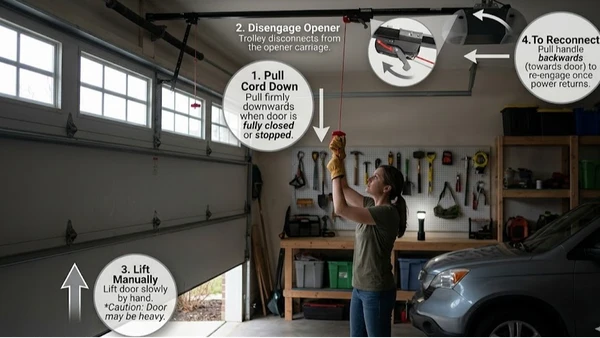
The red cord is attached to a lever on the trolley carriage - the sliding mechanism that runs along the opener rail and connects the opener motor to the door. In normal operation, this trolley is engaged with a carriage on the opener rail; when the motor runs, the carriage moves, the trolley moves with it, and the door moves with the trolley.
Pulling the red cord pivots a spring-loaded latch on the trolley. The latch disengages from the opener carriage. From that point, the trolley is no longer connected to the motor - it can slide freely along the rail in either direction. The door is now disconnected from the opener and can be moved manually.
The click you hear when you pull the cord is the latch releasing. That sound is confirmation that the disconnect worked. If you pull the cord and don't hear or feel the click, pull again with more deliberate downward force. Some levers need to be pulled at a slight angle toward the door rather than straight down - this varies by manufacturer and model.
One thing to check before you pull
The most important single piece of information about using the emergency release safely: check the door position before you pull the cord.
If the door is fully closed, pull away. Everything that follows is routine.
If the door is fully open and held in position by the opener, stop. Think for a moment. The door in the open position is being held partly by the spring system and partly by the opener's mechanical connection. In a healthy door with properly tensioned springs, the springs are doing most of the holding - the door should stay in the open position under spring power alone even without the opener. But if your springs are old, weak, or damaged in any way, the opener is providing some of the force keeping the door up. Disconnect the opener on a door with failing springs and the door may drop suddenly and completely.
This is not a theoretical scenario. It's the situation that causes injuries. The cord is safe to pull on a door with healthy springs. It's potentially unsafe to pull on a door that's open and has compromised springs.
How do you know if your springs are healthy? With the door closed, pull the emergency release, then lift the door manually to about halfway and let go. A properly balanced door with good springs will stay approximately in place - it may drift slightly but shouldn't shoot upward or fall down. If it falls noticeably or drifts rapidly downward, the springs need attention. If it shoots upward, the springs are over-tensioned. Either is a sign to have the springs assessed before relying on manual operation.
If you need to use the emergency release on a door that's currently open and you don't know your spring condition - hold the door while you pull the cord, and don't let go until you've confirmed the door stays in position on its own.
How to manually open the door after disengaging
With the cord pulled and the click confirmed, grip the door handle or the bottom edge of the door in the center. Lift with your legs, not your back. A 200 to 300-pound door with healthy springs should feel much lighter than its actual weight - the springs are providing substantial counterforce, so you're lifting the net weight difference, not the full door weight. This might be 20 to 30 pounds of felt effort. If it feels like 80 pounds, something is wrong.
Lift smoothly and slowly. Guide the door through its travel by hand - it should follow the same track it always does. Once it's in the fully open position, you can let go if the springs hold it. If you're not sure the springs will hold it, don't let go - have someone hold the door while you do what you came to the garage to do.
To close the door manually, grip the handle or bottom edge and pull down. Let it close fully. Don't try to open it partway and leave it - a partially open door with a disengaged opener has nothing holding it in position, and if the springs don't perfectly balance it at that height, it will drift.
Reconnecting the opener after manual use
This is the step people get confused by. After you've manually operated the door, the opener is still disconnected. Using the remote or wall button will run the motor, but the door won't move - the trolley and carriage are no longer linked.
There are two ways to reconnect.
The first way: pull the emergency release cord again, but this time pull it at an angle toward the door (away from the motor), not straight down. This repositions the latch so it's ready to re-engage. Then run the opener - the moving carriage will catch the trolley and re-engage with a click. After that the door operates normally.
The second way works on many modern openers: with the door in the closed position, press the wall button or remote. The opener carriage will travel until it catches the trolley and clicks into engagement, then proceed to move the door. This is the automatic reconnection method and it works on most openers manufactured in the last decade.
If reconnection doesn't seem to be happening - you run the opener and the motor runs but the door still doesn't move - look at the trolley. It should be moving when the carriage passes through it. If the trolley isn't catching, the latch may not be repositioned correctly. Pull the cord again at the angled position toward the door, then try the opener again.
The security concern worth knowing about
The emergency release cord is also the vulnerability that the most common garage door break-in method exploits. A thin wire inserted through the gap at the top corner of the garage door can catch the cord and trip the release from outside - all without any key, any code, any force.
It takes about fifteen seconds for someone who knows how to do it. The door then lifts manually.
The fix is a zip tie through the hole in the release lever, which limits how far the lever travels - far enough to work in a real emergency when you apply proper force, not far enough to trip from a wire hook. Alternatively, a purpose-made release shield physically blocks hook access to the lever.
I've mentioned this elsewhere on this blog and I'll keep mentioning it because it's the most underaddressed residential security vulnerability that costs almost nothing to fix. If you don't have a zip tie on your release lever, that's the thing to do after you finish reading this.
Testing it before you need it
This is the part most homeowners skip. Practicing the emergency release once - on a calm afternoon when nothing is wrong and you have time - is worth the five minutes it takes.
Pull the cord. Listen for the click. Lift the door manually through a full cycle. Check that it holds in the open position. Let it down. Reconnect the opener. Run the opener through a cycle to confirm normal operation.
That's it. Do it once. The next time you need it - power outage, failed motor, jammed opener - you'll know exactly how it feels, exactly what you're listening for, and exactly what to do if the door feels wrong when you try to lift it manually. None of those decisions need to be made under pressure if you've already made them once under no pressure at all.
When the cord itself is damaged
If the red cord is frayed, shortened, or missing entirely - this happens in older openers where the cord was never replaced - don't substitute a random rope or cord and call it done. The cord attaches to a specific lever mechanism, and the right length and attachment method matter for the release to work correctly and for security (a cord that's too long is more accessible to wire-hook attacks; a cord that's too short may not give enough pull travel). If the cord needs replacement, get the correct part for your opener model.
DoorFixy can inspect your emergency release mechanism, replace worn cords and levers, and check your spring balance - the three things that determine whether the red cord works safely when you actually need it.