When my kids were small, I was meticulous about the obvious stuff. Baby gates on the stairs. Cabinet locks on anything with cleaning supplies. Outlet covers everywhere, including the ones behind furniture they couldn't even reach. We had the whole standard childproofing checklist covered.
The garage door didn't cross my mind once.
I didn't think about it until my then-four-year-old pushed the wall button while I was on the other side of the door. She'd watched me do it a hundred times and understood exactly which button made the interesting thing happen. Nothing bad happened - I heard it engaging and called out in time. But it was the first time I thought clearly about what could have happened, and about how casually I'd treated a 300-pound moving machine in a space my kids used constantly.
Garage door injuries to children are more common than most parents realize. The door itself, the mechanical components, the chemicals stored nearby, the pinch points on a door in motion - there's more to think about here than most of us do. Here's what actually matters.
The weight problem nobody visualizes
A standard residential garage door weighs between 150 and 400 pounds depending on the material, size, and insulation. A solid wood carriage door can weigh more. This isn't abstract - it's the weight of a large refrigerator or a small car, moving on a track at several feet per second, with springs and cables that store enough mechanical energy to cause serious harm even when the door isn't actively moving.
Children understand that something is big. They don't intuitively understand what 200 pounds of moving steel does to a human body if it comes down on one. Part of the safety conversation every parent needs to have is making this visceral rather than abstract. Not to frighten them, but to give the hazard appropriate gravity in their minds.
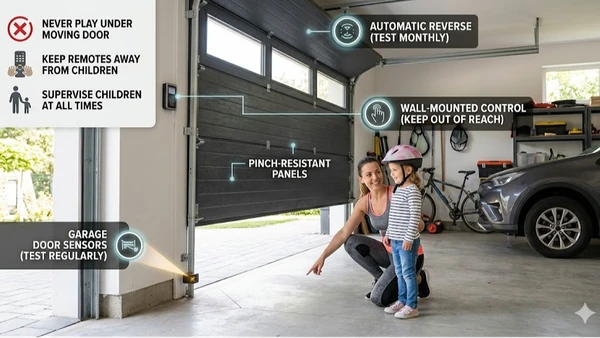
The auto-reverse system - the sensors near the floor that detect obstruction and the pressure-reversal mechanism built into modern openers - exists specifically because of what a closing door does when it meets resistance. That system is good. It's not perfect, and it's not a substitute for children understanding that running under a moving door is not a game.
Sensors and auto-reverse: what you're counting on and what can fail
Every residential garage door opener manufactured after January 1993 is required to have safety sensors - the photo-eye units mounted 4 to 6 inches off the ground on each side of the door opening. They project an infrared beam across the opening. Door hits the beam path, door reverses. That's the system.
What the system doesn't protect against is a child who is already inside the beam's path when the door starts closing - if a small child is crouched in the corner near the wall, below the beam, the sensor may not detect them. The beam is a single line at a fixed height. It's not a field. Anything below that beam, or off to the side against the wall, may not trigger reversal.
Test your sensors at least every few months. Roll a cardboard box into the beam path while the door is closing - the door should stop and reverse immediately. If it doesn't, the sensors are not working and the system your children's safety depends on is not functioning. Fix it before using the door again.
The pressure-reversal mechanism is the backup - when the door physically contacts resistance, it reverses. This mechanism can drift out of adjustment over time. Test it by placing a 2x4 board flat on the ground in the door's path. The door should contact it and reverse. If the door grinds against the board or presses down with sustained force before reversing, the force setting needs adjustment. This is a setting on the opener motor unit and most installers can adjust it quickly.
Remotes and wall buttons: who has access
Kids and garage door remotes is a combination that ends predictably badly, and it happens because the remote looks exactly like a toy - a small plastic device with buttons that make a satisfying mechanical thing happen. The appeal is completely logical from a child's perspective.
Keep remotes out of reach entirely. The visor-clip remote in the car is the one people forget about - children in car seats have access to the visor area more often than parents realize. Move it to the driver's door pocket, or switch to a keychain remote that stays with you and leaves with you.
The wall-mounted button inside the garage is a different problem. Most are mounted at adult height, which is fine for older children but not toddlers. That said, a five-year-old who's seen the button used repeatedly knows exactly what it does and can find a step stool. Consider a wall button with a locking cover - a physical cap over the button that requires an adult hand to flip open. They exist, they're inexpensive, and they add a physical barrier that a young child can't easily defeat.
The keypad on the exterior of the garage also warrants a conversation with older kids about not sharing the code with friends and not using it to sneak in or out. A habit worth building early.
The pinch points that parents don't think about
The door panels on a sectional garage door meet at hinges. When the door is in motion - particularly as it's moving from horizontal to vertical or vice versa - those panel junctions move relative to each other. A small hand or finger placed at the hinge line between panels while the door is moving can be caught in that joint.
Children who are curious about mechanical things - which is most of them - will touch moving parts if given the chance. The hinge area is interesting to look at during operation, and the natural position for a child watching the door is often in a spot where they could easily reach out and touch it.
Rule worth establishing early and repeating: nobody touches the door while it's moving. Not the panels, not the tracks, not the hinges, not the cables. Hands stay away from the door entirely when it's in motion. This rule applies to adults too, which makes it easier to enforce consistently.
The things stored in the garage that matter as much as the door
A safety audit of the garage has to go beyond the door itself. The garage is where most households keep the things that are dangerous enough that they don't want them in the house - and that concentration of hazardous materials in one accessible space creates real risk for children who find their way in.
Pesticides, herbicides, and fertilizers. Paint, paint thinner, and solvents. Automotive fluids - antifreeze is a particular concern because it's sweet-smelling and sweet-tasting to a child who encounters it. Power tools. Sharp implements. Gasoline in containers for the lawnmower.
Lockable storage is the standard recommendation and it's right. A lockable metal cabinet for chemicals that live at floor level is significantly better than putting them on a high shelf - high shelves can be climbed, and the consequences of a container falling from height are different from a container being accessed at floor level. But in practice, most people don't have lockable cabinets and aren't going to buy one tomorrow. The minimum is keeping anything genuinely toxic on the highest shelf that exists and making sure containers are sealed properly. Antifreeze specifically should be treated as a poison in how it's stored and disposed of.
Teaching kids about the garage door - what the conversation actually sounds like
There's a version of the garage door safety conversation that's all rules, no context. Don't press the button. Don't run under the door. Don't touch the springs. These are correct rules, and they're also the kind of rules that curious children push against because they don't understand why.
The more effective conversation gives the reason alongside the rule. The door is very heavy - heavier than our refrigerator. If it came down on you while it was moving, it would hurt you badly. The parts at the edges move in ways that can catch fingers. The coiled springs above the door store enough force to break bones if they're touched or messed with.
Children who understand why a rule exists are better at generalizing it and applying it in situations the rule didn't explicitly cover. A child who knows the door is genuinely dangerous - not in a vague adult-says-so way but in a this-is-what-it-would-actually-do way - makes different decisions in the garage than one who's just been told not to push buttons.
Have this conversation once with context. Revisit it as kids get older and their garage access changes.
The annual check that covers most of this
Once a year - spring works well - test everything:
The cardboard box test on the sensors. The 2x4 test on the pressure reversal. Look at the cables for fraying. Look at the springs for cracks or rust that's progressed to pitting. Check the hinge areas for anything bent or cracking. Run the door through three or four full cycles and listen for any sound that wasn't there last year.
A door that's mechanically sound is a much smaller child safety risk than one that's running on worn hardware. The sensors and the auto-reverse are your backup systems - they work best when the door itself isn't already failing.
DoorFixy offers full safety inspections covering sensors, auto-reverse, hardware condition, and spring status - worth doing once a year, especially if you've never had one done on your current door.
More on the DoorFixy blog - garage door safety, maintenance guides, and practical advice for homeowners.