A friend of mine spent a weekend installing his own garage door. He's mechanically capable - builds furniture, does his own car maintenance, has done most of his home plumbing. He watched every video he could find, ordered the door direct from the manufacturer, and cleared his whole Saturday.
He got the panels hung, the tracks mounted, and the opener wired before he hit the torsion spring. He'd watched the spring winding videos. He'd bought proper winding bars. He stood there looking at it for about ten minutes, thought through what he understood about what was about to happen, and made a call.
He hired someone to finish it.
Later he described what changed his mind: "I understood exactly what the consequences of a mistake were. That's when I decided it wasn't worth the money I was saving."
That's the honest framework for DIY garage door installation in 2026. Some parts are genuinely accessible to a capable homeowner with the right tools and patience. One part is not, and the consequences of getting it wrong are not the kind you recover quickly from.
What the risks actually are - specifically
A garage door torsion spring sits horizontally above the door opening on a steel shaft. It works by being wound to a precise tension - the stored energy in those wound coils is what counterbalances the door's weight, making a 300-pound door feel almost weightless when you lift it. That energy is always there, whether the door is moving or not. A standard torsion spring on a double-car door stores roughly 800 pounds of rotational force when properly tensioned.
When a torsion spring fails unexpectedly - snaps, releases from a winding cone, is unwound incorrectly - that stored energy releases instantly. The spring unwinds violently. Winding bars that weren't seated properly become high-speed projectiles. Spring coils can fracture and fly across the garage. The door drops suddenly because the counterbalance is gone. Any of these can happen in a fraction of a second and leave no time for reaction.
The statistics are not vague here. An estimated 2,000 people per year in the U.S. are injured attempting DIY garage door spring repair or replacement. The injuries documented include broken bones, lacerations, puncture wounds, eye injuries, and worse. The National Safety Council specifically lists garage door spring repair as a task that should not be DIY'd. Emergency room physicians who treat these injuries know the pattern well.
Extension springs - the springs that run along the horizontal tracks on older door systems - are somewhat safer than torsion springs in that they carry less stored energy per unit and fail with less violent consequence. They're still under significant tension and can cause injury. They're still not casual DIY territory.
What IS actually reasonable to do yourself
Here's where the DIY conversation deserves to be honest in both directions. Not everything about DIY garage door replacement is dangerous. A significant portion of the work is accessible to someone with mechanical aptitude, basic tools, and the willingness to work carefully.
Panel installation - hanging the door sections in order, attaching the hinges between panels, and threading the rollers into the track - is physically demanding but not technically complex. The panels are heavy. A double-car door in multiple sections can total 200 to 400 pounds of steel. You need at least one other person. But the work itself - following a sequence, using the right fasteners, confirming alignment as you go - is within the range of someone who does their own home repairs.
Track installation - mounting the vertical track sections to the door frame and the horizontal tracks to the ceiling framing - requires a level, some care with measurements, and solid fastening into structural elements rather than just drywall. Not complicated. Requires attention to getting the spacing right (the gap between the track and the door edge is specific and matters for how the rollers seat). But this is work a careful homeowner can do correctly.
Opener installation - mounting the motor unit, running the rail, wiring the wall button and sensors, programming remotes - is genuinely accessible DIY work. The manufacturers design these for homeowner installation. The instructions are clear. The wiring is low-voltage. The sensor alignment is the part people get wrong most often, but it's correctable.
Bottom weatherstripping, panel hardware, decorative elements - all of this is routine home improvement work. No meaningful safety component.
What separates the accessible work from the dangerous work is a single component: the spring system. Everything else on the door can be done incorrectly and corrected without catastrophic consequence. A misaligned panel can be adjusted. A poorly seated roller can be reseated. A sensor that's off-angle can be realigned. Springs that fail when you're working on them cannot be corrected after the fact.
The cost of professional spring installation alone
Some homeowners ask whether they can do the panel and track work themselves and hire someone just for the springs. The answer is yes, and it's often the most practical approach.
A professional visit specifically for garage door spring installation - coming out to tension and install the springs on a door that's otherwise assembled - runs $150 to $350 depending on spring type, door size, and market. That cost includes the spring itself, the professional labor, and the knowledge that it's being done with the right tools and the right tension calculation for the specific door weight.
This hybrid approach - DIY garage door panel installation handled by the homeowner, spring work handled by a professional - is something most installers will accommodate. Call ahead and explain the situation. Some won't do it; they want to be responsible for the whole job. Others will, particularly if you've documented the door specs and have the spring specs ready.
The hybrid approach works if: the panels are hung correctly and the track is properly aligned and plumb before the technician arrives. If the door isn't ready for springs when the technician gets there, they'll charge for their time regardless.
The tools required and what happens without them
Proper DIY garage door installation tools for the full job:
Two proper steel winding bars - typically 18 inches long, half-inch diameter - specifically sized for the winding cones on your spring. These are not improvised from screwdrivers, hex keys, or anything else that fits approximately. The winding bar needs to seat fully in the winding cone hole. Anything that fits approximately will slip at exactly the wrong moment. This single tool choice is responsible for a significant percentage of spring installation injuries.
C-clamps to lock the door to the tracks before working on springs - this keeps the door from moving while you're tensioning.
A tension calculator or the door manufacturer's spring specification, because the number of quarter-turns of tension required is specific to the door's weight and lift height. Under-tensioning means the door is too heavy for the opener. Over-tensioning means the door shoots up and the opener strains holding it down.
Everything else - drill, socket set, level, measuring tape, ladder - is standard shop equipment.
Without the proper winding bars specifically, do not attempt the spring installation. Not as a caution. As an absolute. The improvised alternative is what's injuring people.
The time investment: what DIY actually takes
This is worth understanding because it affects whether DIY garage door installation is actually saving you what you think it's saving.
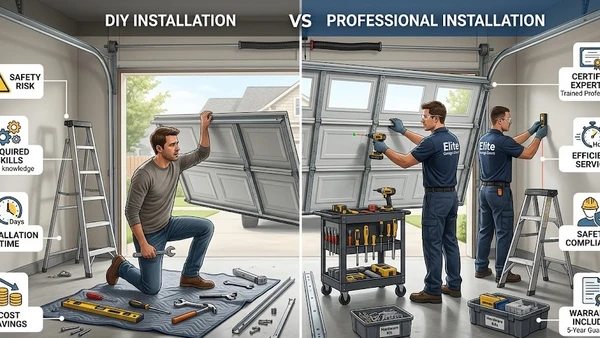
A professional two-person crew completes a standard double-car door installation, including opener, in 4 to 6 hours. They've done it hundreds of times. The sequences are automatic. The tool setups are practiced.
The same job done by a first-time DIY installer typically takes 8 to 14 hours across two days, accounting for watching instructional content, making a hardware store trip when something isn't quite right, troubleshooting alignment that isn't quite correct, and the general slowing-down that comes from doing something for the first time on a job that doesn't allow for going slowly.
Professional installation on a standard door runs $300 to $600 in labor. If your time is worth anything to you, the math on DIY vs professional garage door installation is closer than it initially looks - particularly if you factor in the cost of a spring installation callback anyway.
That said, for homeowners who genuinely want to do the work - who have the time, the mechanical aptitude, and are willing to stop at the spring - DIY panel and track installation is real and saves real money. The question is just whether the savings justify the time and the learning curve on a job where errors in alignment become obvious and annoying to live with.
The verdict, plainly
DIY garage door installation is safe for the panels, tracks, opener, and hardware. These are accessible home improvement tasks for anyone who works carefully and follows the manufacturer's instructions.
DIY garage door spring installation is not recommended for anyone who hasn't been trained in the specific procedure. Not because it's impossibly complex, but because the consequence of a mistake is fast, severe, and not recoverable in the moment.
The sensible middle path: do everything you can do safely, and pay a professional to do the one part that isn't safe to learn on the job.
DoorFixy offers full installation service as well as spring-only installation for homeowners who have handled the panel work themselves - call ahead to discuss what makes sense for your specific situation.
More on the DoorFixy blog - garage door installation guides, safety information, and honest advice for homeowners who want to understand what they're getting into.