Spent some time going through what's actually available this year and what homeowners are finding worth the money. There's a lot of noise in this space - every brand claims to be the most energy efficient, every spec sheet looks impressive. Here's what actually separates the good ones from the ones that just market well.
What to actually look for before picking a door
Before getting into specific picks, here's the framework. A few numbers and terms get thrown around a lot and most buyers don't know what they mean in practice.
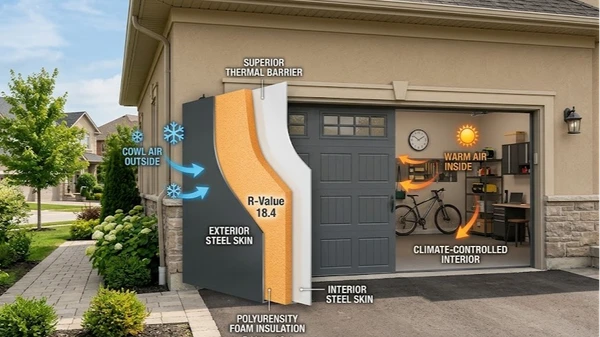
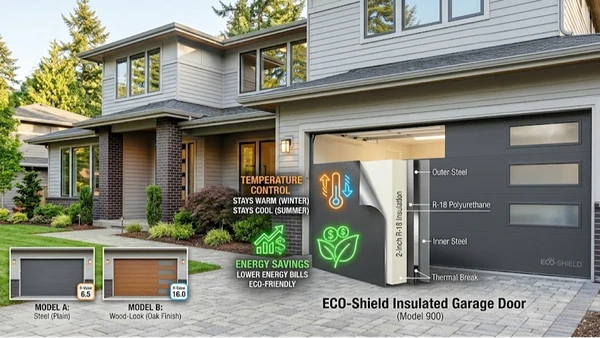
R-value is the insulation rating. Higher = better thermal resistance. But in a garage context, the difference between R-12 and R-18 matters less than marketers suggest because garages have other gaps - around the frame, at the floor, through the ceiling. Don't chase a high R-value at significant extra cost unless you're doing a fully weatherized build.
Construction type matters more than most people realize. Two-layer (steel outside, foam inside) is the budget version. Three-layer (steel outside, foam center, steel inside) is the quality standard. The interior steel layer adds rigidity, dent resistance, and better insulation performance because the foam is fully enclosed rather than exposed to air inside the garage.
Thermal break - some door designs include a non-conductive layer between the steel skins to prevent the cold outer steel from conducting temperature directly to the inner steel. Without a thermal break, a cold steel door transfers that cold to the air inside the garage faster than the insulation alone would suggest.
Perimeter sealing - the R-value of the panel means nothing if the edges aren't sealed. Quality insulated doors include substantial weatherstripping on all four sides. A door with R-18 panels and cheap edge seals will underperform a door with R-12 panels and proper perimeter sealing.
Top picks for 2026
Clopay Gallery Collection Steel - Best Overall Value
Clopay has been making residential garage doors longer than most brands and the Gallery Collection is where they've put their mainstream insulation technology for 2026.
Available in R-6, R-12, and R-18 options within the same line. The three-layer construction on the R-12 and R-18 models uses CFC-free polyurethane foam that's injected into the cavity - not panels pressed in, actually injected so it fills completely and adheres to both steel skins. This matters because pressed-in foam shifts and compresses over years, degrading performance. Injected foam stays put.
The thermal break on the higher-end Gallery models is well-executed. Steel-to-steel temperature transfer is noticeably reduced in cold weather testing compared to doors without it.
Pricing: installed in the $900-1,400 range for a standard single-car door depending on R-value and style options. Mid-range premium for quality that holds up.
Amarr Classica - Best for Appearance Plus Performance
If the door's look matters as much as its thermal performance - which for a lot of homes it does, since the garage door covers a significant portion of the front elevation - the Amarr Classica hits a balance that's hard to match at its price point.
Available in carriage house and traditional raised panel styles. The insulation is polyurethane, three-layer construction, available up to R-17.5. The Classica's weather seal system is one of the better ones in this price range - substantial compression seals on all four sides including a quality bottom seal with good cold-weather flexibility.
What makes the Classica stand out specifically is the consistency of its thermal performance across the full door. Some competitors have well-insulated panels but weak perimeter sealing that undermines the R-value claim in practice. Amarr's edge sealing on the Classica is executed well.
Pricing: $1,000-1,600 installed for single-car depending on style and insulation level.
Wayne Dalton Model 9700 - Best for Extreme Climates
Wayne Dalton designed the 9700 specifically for performance in harsh conditions - both extreme cold and extreme heat. If you're in a climate where temperatures regularly hit negative digits in winter or 110+ in summer, this is where to look.
The 9700 uses a continuous thermal barrier design that addresses the weak point in most insulated doors - the steel section joints between panels. Most insulated doors have a thermal gap at each horizontal section joint. Wayne Dalton's approach on this model minimizes that gap significantly.
R-value runs up to R-20 on the highest specification version. More relevant than the peak R-value is the consistent thermal performance across the whole door surface including the joints - that's where the 9700 actually differentiates.
The door itself is heavier than comparable competitors at the same size due to the construction approach. Spring sizing matters more with this door - have whoever installs it confirm the springs are spec'd for the actual weight.
Pricing: $1,200-1,900 installed for single-car, higher for double. More expensive than the Clopay and Amarr options but the thermal performance in extreme climates justifies it for people in those conditions.
Clopay Coachman Collection - Best Wood-Look Steel
If you want the aesthetic of a wood carriage house door without the maintenance burden and with legitimate insulation, the Coachman is the best execution of this concept available in 2026.
Steel construction with an embossed wood grain finish that holds up well over time - doesn't fade or peel the way painted surfaces on cheaper alternatives do. Polyurethane insulation, three-layer, up to R-20 on higher-spec variants.
The Coachman handles temperature swings better than real wood carriage doors because steel doesn't expand and contract with humidity changes the way wood does. Real wood carriage doors have seal gaps that change seasonally - steel doesn't.
If curb appeal is a significant consideration and you're in a neighborhood where the door style matters visually, the Coachman hits the aesthetic without the tradeoffs of actual wood.
Pricing: $1,300-2,000+ installed for single-car depending on configuration. The wood-look premium is real but for the right home it's worth it.
Amarr Stratford - Best Budget Insulated Door
Not everyone needs a premium door. The Amarr Stratford gives you legitimate insulation - R-9 standard, R-13 available - in a two-layer construction at a price point that makes sense for homes where the garage isn't a primary living or working space.
It's not a three-layer door and it doesn't have the thermal break of the higher-end options. But for a door that primarily needs to be better than a non-insulated door - which is most residential situations - the Stratford delivers real improvement in temperature stability without the premium price.
The perimeter sealing is adequate, not exceptional. The bottom seal is standard vinyl. If you're in a moderate climate and the garage is primarily car storage and occasional use, this performs well enough and lasts well enough.
Pricing: $700-1,000 installed for single-car. The entry point for meaningful insulation without breaking the budget.
The installation matters as much as the door
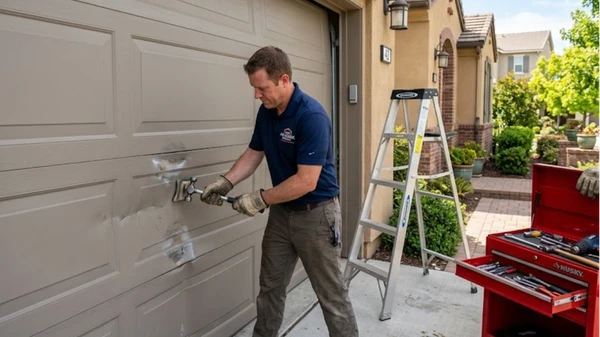
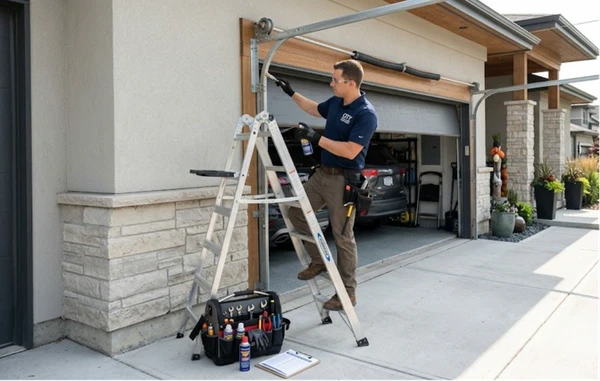
A premium insulated door installed with gaps around the frame and a poor threshold seal will underperform a mid-range door installed properly. This is worth saying clearly because the door choice gets all the attention and the installation quality gets none.
Whoever installs the door should:
Set the spring tension correctly for the door's weight - insulated doors are heavier than non-insulated, springs may need to be adjusted or replaced.
Verify the perimeter sealing makes full contact around all four sides when the door is closed.
Install or recommend a quality threshold seal at the floor - the rubber or vinyl strip that mounts to the concrete and closes the gap between the door bottom and the floor, especially critical on uneven garage floors.
Check that the door panel to frame gaps at the sides are minimal. If there's visible daylight around the frame edge with the door closed, the frame needs to be addressed regardless of the door's R-value.
Quick comparison
Clopay Gallery - best overall value, R-6 to R-18, three-layer, solid brand reputation, $900-1,400 installed.
Amarr Classica - best appearance plus performance balance, up to R-17.5, excellent edge sealing, $1,000-1,600 installed.
Wayne Dalton 9700 - best for extreme climates, up to R-20, unique thermal barrier at panel joints, $1,200-1,900 installed.
Clopay Coachman - best wood-look steel, up to R-20, carriage house aesthetic without real wood problems, $1,300-2,000+ installed.
Amarr Stratford - best budget option, R-9 to R-13, two-layer, honest performance without premium price, $700-1,000 installed.