I know someone in Scottsdale who replaced her garage door three times in eight years. Different brands, similar problems each time. Paint fading in the first summer. Panels warping slightly within two years. A bottom seal that was brittle by the second winter. The third time she called a company that actually asked about her specific conditions - south-facing door, afternoon sun exposure, no shade from trees or overhangs - and recommended something built for that environment instead of a standard residential door with a slightly different color.
She's had that door for four years. No fading. No warp. No seal issues.
This is the gap in how most people shop for garage doors for hot climates. They look at style, price, brand reputation. They don't ask whether the door is engineered for the specific punishment their climate delivers - sustained UV exposure, surface temperatures that can exceed 150°F on a south-facing panel, thermal cycling from hot days to cool nights, and in some regions, humidity that compounds everything.
Here's what actually matters when choosing a heat-resistant garage door in 2026.
Why hot climate garage doors fail differently
The failure modes in hot climates are distinct from cold-climate failures, and understanding them helps explain why certain materials and construction methods matter.
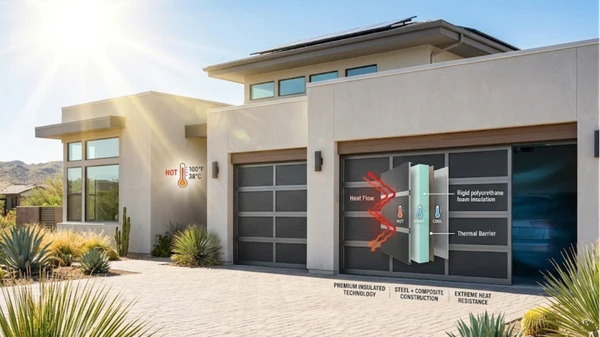
Heat warping is the most obvious one. When a garage door panel is exposed to direct sun and surface temperatures exceed 140 to 150°F - which happens regularly on dark-colored south-facing doors in Arizona, Nevada, and the Texas summer - the differential between the hot exterior skin and the cooler interior causes the panel to bow. An uninsulated single-layer steel door is most vulnerable because there's nothing inside the panel moderating the temperature gradient. A triple-layer insulated garage door resists warping because the foam core bonds the interior and exterior skins together, distributing the thermal stress more evenly.
UV degradation attacks paint finishes, rubber seals, and any vinyl or plastic components. A garage door finish that's rated for standard residential use may show fading within two to three years in a high-UV climate. Specific UV-resistant paint systems and factory baked-on finishes hold significantly better than field-painted surfaces or lower-quality applied finishes.
Thermal expansion and contraction - repeated daily cycling between high daytime heat and cooler nights - stresses the panel joints, the weatherstripping, and the hardware fasteners over time. In Phoenix, the temperature swing from a 110°F afternoon to a 75°F night is 35 degrees of daily thermal cycling. Every fastener and every seal is working against that movement constantly.
Radiant heat transfer into the garage is the energy bill problem. A dark uninsulated steel door facing west can radiate heat into the garage continuously for three to four hours in the afternoon. If the garage is attached to the house, that heat migrates into the living space and increases HVAC load. This is where garage door R-value becomes a direct financial issue, not just a comfort one.
Materials: what works in heat and what doesn't
Insulated steel - the best all-around choice for most hot climates
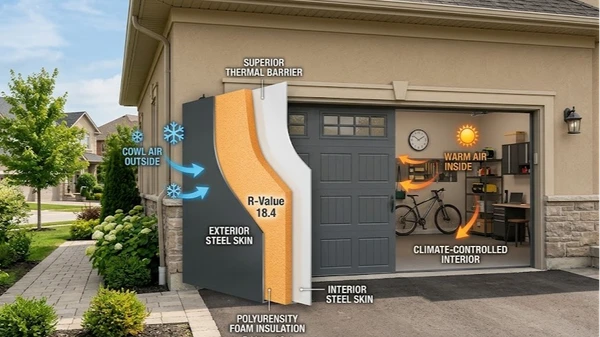
A polyurethane insulated steel garage door with a triple-layer construction (exterior steel skin, injected foam core, interior steel skin) is the benchmark recommendation for hot climates in 2026. The polyurethane foam doesn't just add R-value - it bonds to both skins and creates a composite panel that resists thermal warping better than polystyrene construction or single-layer steel. R-values on quality polyurethane doors run R-12 to R-19, with Clopay's Intellicore system reaching R-20.4.
For hot climates, R-12 to R-16 is the practical target range for attached garages. The diminishing returns above R-16 are real - going from R-13 to R-20 doesn't reduce heat gain proportionally because conduction through the door frame, weatherstripping gaps, and other thermal bridges limits the real-world benefit. R-12 to R-16 in a well-sealed door is where the cost-benefit math works best.
The color choice on a steel door matters more in hot climates than anywhere else. A dark charcoal or black steel door in Phoenix can hit 150 to 160°F surface temperature on a summer afternoon. That heat stresses the insulation layer and increases interior radiant heat gain significantly. Light colors - white, cream, light gray - reflect solar radiation and can be 30 to 50°F cooler at peak sun. If you want a darker color on a hot climate garage door, verify the door uses a factory-applied finish specifically rated for thermal environments and ask about UV-resistant top coats.
Aluminum - the best choice for coastal hot climates
Where heat and humidity combine - coastal Florida, the Gulf Coast, Hawaii - aluminum garage doors make a compelling case. Aluminum is naturally rust-proof, which eliminates the corrosion problem that eventually affects steel doors when their zinc coating is compromised by salt air and humidity. It's lightweight, handles thermal expansion better than steel without the risk of corrosion at expansion joints, and is available in a range of contemporary styles.
The limitation of aluminum for hot climates is that it's a better thermal conductor than steel, meaning it transmits heat more readily without insulation. Insulated aluminum doors - foam-filled panels or polyurethane-core construction - address this, but the R-values available in aluminum generally run lower than in equivalent steel construction. For a south-facing door in a dry desert environment, insulated steel wins on thermal performance. For a beachfront property in humid coastal conditions, aluminum's corrosion resistance makes it the better long-term choice despite the thermal limitation.
Fiberglass and vinyl - for humid tropical climates
South Florida, the Gulf Coast, and anywhere with consistent high humidity and salt air puts steel at a long-term disadvantage regardless of coating quality. Fiberglass and vinyl garage doors for hot climates resist both moisture and UV degradation better than steel in sustained high-humidity environments.
Fiberglass can yellow or become brittle in sustained UV exposure over many years - the quality of the UV stabilizers in the resin determines how long this takes. Premium fiberglass doors with high-quality UV stabilizers and factory gel coat finishes hold up well for 15 to 20 years. Budget fiberglass fades and chalks noticeably faster. Vinyl is more resistant to UV degradation than fiberglass but has lower structural rigidity and doesn't hold paint - you're locked into whatever factory color you choose.
Both options are genuinely low-maintenance compared to steel or wood in a hot-humid climate. No repainting, no rust, no warping. The tradeoff is a narrower style selection and higher upfront cost relative to standard steel.
Wood - only if you're in hot and dry
Wood has no business being a garage door in Florida or along the Gulf Coast. It absorbs moisture, it swells, it warps, it demands refinishing every few years to prevent the finish from separating and the wood from degrading. In a hot-humid climate, wood is a maintenance project that never ends.
In a hot-dry climate - Scottsdale, Las Vegas, Albuquerque - wood is much more viable. The low humidity means minimal moisture cycling. A well-finished solid wood carriage door in the desert can look beautiful for decades with reasonable maintenance. Cedar and redwood have natural oils that resist insect damage and weathering better than softer woods. If you're in a dry climate and the aesthetic matters to you, wood is a legitimate option. Just don't transplant a wood garage door decision from a dry climate to a humid one.
What to actually look for on a spec sheet
When you're comparing heat-resistant garage doors in 2026, these are the specific items worth asking about rather than taking brand reputation at face value:
The R-value - and whether it's the center-of-panel R-value or the whole-door R-value. Some manufacturers quote the insulation performance at the thickest part of the panel. The real-world thermal performance of the whole door is lower because of the frame, end stiles, and seals. Ask which number you're looking at.
Thermal break construction - whether the door frame has a thermal break between the exterior and interior metal components. Without a thermal break, heat conducts directly through the metal frame regardless of how good the panel insulation is. Quality hot-climate doors address this. Lower-priced construction often doesn't.
UV-resistant finish rating - specifically whether the exterior finish is a factory-baked paint system or a field-applied coating, and what the UV resistance specification is. Factory-baked PVDF or polyester paint systems outlast field-applied finishes significantly in high-UV environments.
Weatherstripping type and material - EPDM rubber holds up in sustained heat significantly better than standard vinyl weatherstripping. Ask what the seals are made of before assuming they'll last in your climate.
The R-value and color decision together
In a hot climate, R-value and finish color aren't independent decisions - they interact. A dark-colored door with R-16 insulation may underperform a light-colored door with R-12 insulation in terms of actual heat entering the garage, because solar absorptance on the dark exterior drives surface temperatures that overwhelm the insulation's resistance.
The optimal combination for a hot climate garage door is a light or medium color (light gray, cream, white) paired with R-12 to R-16 polyurethane construction with a thermal-break frame. That combination addresses both the conductive heat transfer (insulation) and the radiant heat gain (color/reflectance) simultaneously.
Going darker on a heat-resistant garage door in a hot climate requires factory-engineered dark finishes specifically designed for those surface temperatures - not the same steel with a dark paint applied. Several manufacturers offer this. Ask specifically before ordering any door in a dark finish for a hot-climate installation.
Quick comparison by climate type
|
Climate type |
Best door material |
Minimum R-value |
Key feature to prioritize |
|
Hot dry desert (AZ, NV, NM) |
Insulated steel or wood |
R-12 to R-16 |
Light color, UV-resistant finish |
|
Hot humid coast (FL, Gulf) |
Aluminum or fiberglass |
R-10 to R-14 |
Corrosion resistance |
|
Hot mixed (TX, SE) |
Insulated steel |
R-13 to R-16 |
Thermal break, EPDM seals |
|
Tropical / salt air |
Aluminum or vinyl |
R-10 minimum |
Rust-proof, moisture resistance |
One question to ask before you finalize anything
Is the door rated for your climate, or rated for standard residential conditions?
That distinction doesn't always appear on a spec sheet or product page, but a knowledgeable dealer can answer it. A door designed and tested in a Midwestern manufacturing environment isn't automatically suited for Phoenix conditions. The materials may be identical, but the performance verification for sustained 115°F ambient temperatures and 150°F surface temperatures is a different standard.
For the homeowner replacing a door that warped, faded, or failed seal after seal in a hot climate: the answer isn't a better version of the same door. It's a door specified for the conditions it's actually going to live in.
DoorFixy can help you find the right heat-resistant garage door for your specific climate, sun exposure, and home - and install it with the right seals and hardware for long-term performance.
More on the DoorFixy blog - garage door buying guides, material comparisons, climate-specific advice, and honest information for homeowners.