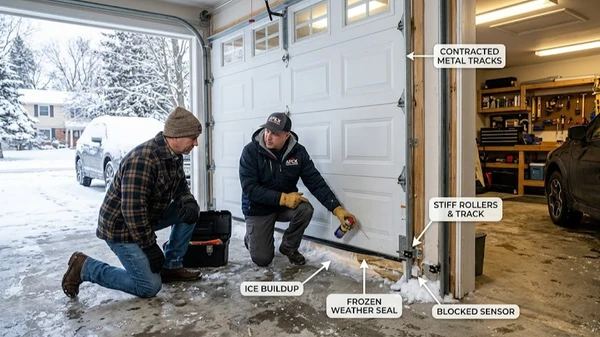
February morning last year. My neighbor was standing in her driveway in a coat, pressing the remote at a garage door that kept traveling about halfway down and then reversing back up. She'd been doing this for ten minutes. The car was still inside. She was late.
Her garage door won't close in cold weather situation wasn't a broken door. It was three things happening at the same time: a frosted sensor lens, lubricant that had thickened to near-solid in the overnight cold, and a bottom seal stiff enough from the temperature that the opener was registering it as an obstruction when the door reached the floor. None of these required a service call. All three were fixable in the driveway in under fifteen minutes.
A garage door not closing in winter is one of the most common cold-weather calls a garage door company gets. The cause is almost never a failed opener. Almost always it's one of a handful of predictable mechanical responses to cold that look like a broken door and aren't.
The sensors are the first place to check - always
When a garage door won't close in cold weather, the photo-eye sensors near the floor are responsible for the problem more often than anything else. Cold does two separate things to sensors that both cause the same symptom: the door starts closing and then reverses, or refuses to close at all.
The first thing cold does is physically shift the sensor brackets. The metal brackets holding the sensors to the door frame contract slightly when temperature drops - we're talking millimeters of movement, but a millimeter is enough to knock the infrared beam out of alignment. The beam from the transmitter on one side stops landing cleanly on the receiver on the other side, and the system reads that as a blocked path. The door won't close because it thinks something is in the way.
The indicator lights tell you if this is your problem. The receiver sensor - usually the one with the green light - should be solid when the beam is connected. If it's blinking or off, the beam is broken. Loosen the mounting bracket slightly, adjust the sensor angle until the light goes solid, and tighten it back down. In cold weather this fix often needs to be redone two or three times across a winter season as the brackets continue contracting and expanding with temperature swings.
The second thing cold does to sensors is frost the lenses. Condensation forms on the small glass or plastic lens face, then freezes. The beam can't pass through an ice-covered lens. The receiver light may look solid (it's detecting ambient light) but the actual infrared signal isn't getting through. Wipe both sensor lenses - transmitter and receiver - with a dry soft cloth. If they've frosted over, clear the ice. This is the simplest fix in the whole list and it works more often than it should.
Thickened lubricant makes the opener think there's an obstruction
Garage door openers have a force limit - a threshold of resistance at which they stop and reverse, because resistance means something might be in the door's path. In warm weather, a properly lubricated door runs smoothly and doesn't approach that threshold. In cold weather, standard lubricants thicken significantly. Petroleum-based products can become near-solid below 32°F. The hinges, rollers, and springs that were moving freely in October are now stiff enough to require noticeably more force from the opener.
The opener interprets that increased friction as an obstruction and reverses. Your garage door keeps reversing in cold weather not because the safety system detected something, but because it's detecting the resistance of its own stiff hardware as if it were an obstacle.
Fix this by applying a cold-weather garage door lubricant - silicone-based spray rated to -40°F works in any residential climate. Apply it to the hinges, rollers, and springs as described in the winterization guide on this blog. Silicone stays fluid at low temperatures where petroleum products solidify. After lubricating, run the door through several manual cycles to distribute the product before reconnecting the opener.
If lubricant alone doesn't fix the reversing problem, the opener's force setting may also need adjustment. Most openers have a down-force adjustment - a dial or screw on the motor unit labeled accordingly - that controls how hard the opener pushes before concluding it's met an obstruction. Increasing this setting by half a turn accounts for the added resistance of cold-weather operation. Don't maximize it - you need headroom for the safety system to function - but a small increase often resolves a garage door that reverses in cold weather without any actual obstruction present.
A stiff bottom seal creates resistance the opener reads as an obstacle
Rubber weatherstripping loses flexibility in cold temperatures - this is called glass transition, the point at which rubber goes from pliable to stiff. A bottom seal that compresses softly against the floor at 60°F becomes noticeably stiffer at 15°F. When the door comes down and that stiff seal meets the concrete, the resistance is higher than the opener expects. Depending on how the force settings are calibrated and how stiff the seal has become, this is sometimes enough to trigger a reversal.
The fix for a garage door reversing at the bottom in winter is usually a combination of two things: applying silicone spray to the bottom seal surface (which keeps the rubber more pliable in cold) and adjusting the opener's down-force setting slightly upward. If the seal is old and has hardened permanently - a seal that's stiff even at room temperature when you flex it by hand - replacement before next winter is worth putting on the list.
Spring tension drops in cold - and that changes everything
Springs lose 10 to 15 percent of their effective tension in extreme cold. The metal contracts, the coil spacing changes slightly, and the counterbalance the spring was providing in warmer weather is reduced. A door that was perfectly balanced in September can be noticeably spring-heavy by December.
When spring tension drops and the door is heavier than the opener expects, two things happen. The opener may reach its force threshold on the way down and reverse. Or the door may travel unevenly, causing a slight bind that also triggers reversal.
A garage door not closing in winter due to weak springs is often misdiagnosed as a sensor or lubricant problem because those are faster and cheaper to check. If you've cleaned the sensors, lubricated everything, and the door still reverses in cold but works fine on warm days - springs are the probable cause. Spring tension adjustment is a professional job. The adjustment itself runs $100 to $150 and is one of the better-value garage door services available because it fixes the root issue rather than working around it.
Ice at the threshold blocking sensor height
Worth its own mention because it's frequently overlooked. Snow that's been walked through, slush tracked in from vehicles, or melt-and-refreeze cycles can build up ice accumulation at the base of the door opening - right at the height where the sensors sit (4 to 6 inches off the ground). That ice mass interrupts the beam the same way a physical obstruction would.
Garage door won't close when it's cold because of ice near the sensors is a simple fix: clear the ice. A flat shovel or ice scraper along the base of the opening, and enough warm water to melt the residual buildup. Then wipe the sensor lenses and recheck whether the indicator lights are solid.
Prevention is easier than the fix - keeping the threshold clear of ice and snow buildup after each storm stops the accumulation that causes this problem. Salt at the threshold isn't recommended for the same reason we covered in the frozen door article: it accelerates corrosion on the hardware near floor level.
Cold remote batteries cause intermittent failure
This one gets overlooked because it feels too simple. Cold drains battery voltage faster than warm, and a remote with batteries that were adequate in November may not be putting out enough signal strength to reliably trigger the opener in January.
Symptom: the remote works sometimes but not consistently. Or it works from close range but not from the end of the driveway. Swap the batteries for fresh ones before assuming anything else is wrong. Takes thirty seconds. Worth ruling out before you spend an afternoon troubleshooting sensors.
When to stop troubleshooting and call someone
If you've checked and cleaned the sensors, lubricated the moving parts, cleared any ice from the threshold, and the garage door still won't close in cold weather - especially if it's intermittent (works fine some mornings, fails on others without obvious reason) - a spring tension issue is almost certainly what you're dealing with. Intermittent cold-weather failure that resolves itself by afternoon when the temperature rises a few degrees is essentially diagnostic of spring tension that's borderline in cold but adequate in slightly warmer conditions.
Broken springs - a full break rather than just tension loss - make the door feel impossibly heavy when you try to lift it manually after pulling the emergency release. You can sometimes see the break in the coil from inside the garage. That's a service call, not a DIY adjustment.
DoorFixy handles cold-weather garage door diagnostics, sensor realignment, spring adjustment, and full winterization - including same-day calls for the mornings that can't wait.