My garage door started making a noise about two years ago that I can only describe as sounding like a shopping cart with one bad wheel being pushed across a parking lot. Loud, intermittent grinding. Enough to wake the dog. Enough to make my wife ask about it in the tone of voice that means it's no longer just annoying, it's a problem.
I called someone out expecting springs or a bent track. He pulled one of the rollers out, showed it to me - steel, original to the house, about fourteen years old, rust showing on the bearings - and said it was a simple upgrade. New nylon rollers. Forty-five minutes.
The door has been nearly silent since. I spent a decade unnecessarily tolerating that noise.
That's the thing about garage door rollers - they're small, invisible while the door is working, and completely ignored until they start failing. At that point most people assume something expensive is broken. Usually it's not.
What a roller actually is
Worth understanding the basics before comparing materials, because the roller is more than just a wheel.
A garage door roller has three main components. The wheel - the part that rolls inside the track. The stem - the metal shaft that fits into the door hinge. And the ball bearings - tiny steel balls inside the wheel hub that allow it to spin smoothly around the stem.
The ball bearings are the most important part of that assembly, and the part most people don't know to look at when buying replacements. A roller with more ball bearings runs smoother and quieter. A roller with sealed ball bearings - meaning the bearing housing is protected from dust and moisture - lasts dramatically longer than one where the bearings are exposed.
This matters because the distinction between nylon and steel rollers isn't just the wheel material. You can get a cheap nylon roller with no ball bearings that's barely better than a plastic toy. You can get a high-quality steel roller with sealed bearings that outperforms it completely. When people compare nylon vs. steel, they're often not comparing equivalent quality tiers. The honest comparison requires specifying what kind of each.
Steel rollers: what you're probably working with right now
Steel rollers are what most homes come with from the builder. They've been used in garage doors since the very beginning of the overhead door industry - more than a hundred years - which should tell you they work well enough to have stuck around.
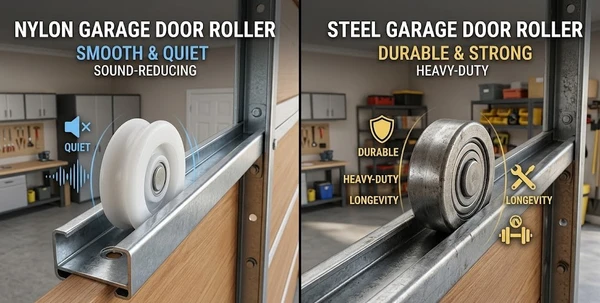
The case for steel is straightforward. They're strong, they handle heavy doors well, and entry-level steel rollers with 7 to 10 ball bearings are inexpensive - usually $3 to $6 per roller.
The case against is also straightforward: metal on metal is loud. A steel wheel rolling inside a steel track creates vibration and noise that you feel through the door and hear in adjacent rooms. If your garage is attached to your house and you have a bedroom anywhere near that wall, you know this already. The noise is worse early in the morning, worse in cold weather when metal contracts, and gets progressively worse as the bearings wear.
The bigger long-term issue is rust. Steel rollers have a rust-resistant coating that eventually fails - scratches, wears through, or just ages out. Once the coating goes, moisture gets to the bearing assembly. In humid climates, coastal areas, or anywhere with hard winters where road salt ends up tracked into the garage, this happens faster than you'd want. A rusted bearing doesn't just get noisier - it can eventually seize up, and a seized roller inside a track causes uneven door movement that puts stress on the whole system.
With decent maintenance, steel rollers with 7 to 10 bearings last about five to seven years under regular residential use. The better ones with 10 to 13 bearings, kept lubricated and inspected annually, can push past ten years.
Nylon rollers: the upgrade most people don't know about
Nylon rollers use the same steel stem as steel rollers - that part doesn't change. The wheel itself is made from injection-molded nylon, which is what changes everything about the operating character of the door.
Nylon against steel track is a fundamentally different sound than steel against steel. It's not just quieter - it's qualitatively different. Less grinding, less vibration transmission, smoother across track joints. If you've ever noticed that some garage doors seem to glide and others seem to clunk and shudder their way up, rollers are usually the difference.
The durability case is where it gets interesting. A premium nylon roller with sealed ball bearings and 11 to 13 bearings carries cycle ratings of 50,000 to 100,000 cycles. If you use your garage door four times a day - which is about average for a household - that's roughly 1,500 cycles per year. A 50,000-cycle roller lasts over thirty years at that usage rate. That's not a misprint.
Even at more moderate quality levels, nylon rollers with 10 sealed bearings typically last ten to fifteen years. Compare that to five to seven for comparable steel rollers and the math isn't close.
Nylon doesn't rust. That's the other thing. Moisture, humidity, road salt tracked in from the driveway - none of it affects the wheel material itself. The stem is still steel and can rust, but the bearing housing is protected inside the nylon wheel and sealed from the environment. This is the biggest practical advantage in climates where steel rollers corrode.
The downside: nylon costs more. Premium nylon rollers with sealed bearings run about $8 to $15 each for residential quality. A full set of ten rollers - the typical count for a double-car garage door - runs $80 to $150 for quality nylon versus $30 to $60 for comparable steel. The upfront difference is real. The total cost of ownership over ten or fifteen years is not.
One thing that trips people up: cheap nylon vs. premium nylon
Not all nylon rollers are equal and it's easy to buy the wrong ones.
The builder-grade black plastic rollers that come on many new-construction homes are often mistaken for nylon. They're not. They're low-density plastic with no ball bearings, and they're the worst rollers available. They last two to three years and fail noisily. If your garage door came with what look like black plastic wheels, those are almost certainly worth replacing sooner rather than later.
Actual nylon rollers - the kind worth buying - are typically white or gray, feel substantial in the hand, and have ball bearings you can feel when you spin the wheel. If you're buying them at a hardware store or online, look for these indicators:
Ball bearing count - 10 to 13 for residential. Under 7 is not worth buying.
Sealed vs. unsealed - "Sealed bearings" or "sealed ball bearings" in the product description means the bearing housing is protected. If it doesn't say sealed, it isn't.
Stem length - Standard residential stem is 4 inches. If your door uses double hinges on heavier sections, you might need a 7-inch stem. Check before ordering.
Roller diameter - Most residential doors use 2-inch rollers. This is almost always correct but worth confirming if you have an older or commercial-grade door.
Which actually lasts longer?
Direct answer: premium nylon with sealed bearings outlasts steel under almost all residential conditions. The combination of higher cycle ratings, corrosion resistance, and reduced mechanical stress on the track and hinge hardware makes nylon the longer-lasting choice for the typical homeowner.
Steel has its advantages. For very heavy doors - solid wood carriage doors, commercial-grade panels - the higher load capacity of steel rollers can be relevant. For homeowners who are renting or planning to move within a few years, the lower upfront cost of decent steel rollers might make more sense than investing in premium nylon.
For everyone else? The upgrade to nylon with sealed bearings is the single best value maintenance upgrade most garage doors never get. The parts cost less than a dinner out. The installation is straightforward. And the difference in how the door operates - quieter, smoother, less strain on the opener - is immediate and noticeable.
When to replace rollers regardless of material
Watch for these signs and don't wait:
Grinding or screeching sounds during operation - bearings are wearing out. Lubrication might mask it temporarily but won't fix it.
Shuddering or uneven movement - one or more rollers may have failed completely and the door is dragging.
Rollers sitting crookedly in the track - visible tilt means the bearing is shot and the stem is wobbling.
Visible rust on the wheel or bearing - especially with steel rollers in humid environments.
One important safety note: you can safely replace most rollers yourself by removing one hinge at a time with the door in the down position. Do not touch the bottom roller bracket. That bracket is where the lift cable attaches, and it's under extreme spring tension. Leave the bottom brackets to a professional.