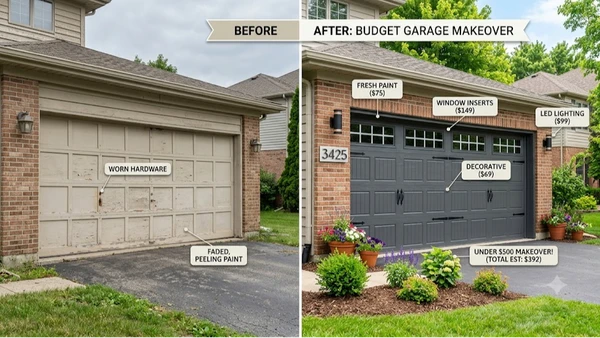
A friend of mine was convinced she needed a new garage door. The old one - a plain builder-grade steel door from about 2005 - looked tired, the color had faded to a flat, chalky gray, and the hardware was the same forgettable silver it had been since installation. The door itself was structurally fine. The springs were good. Everything worked. It just looked like an afterthought.
She spent $340 over a long weekend. Fresh paint in a warm black, new matte black strap hinges and handles, and a set of colonial window inserts she found at the hardware store. No professional help. No new door.
Her neighbor asked if she'd replaced the entire door.
That's what a well-executed budget garage door makeover can do. The difference between before and after has less to do with spending and more to do with choosing the right interventions and executing them cleanly. Here's the breakdown of what works, roughly in order of impact per dollar.
Paint: the highest-impact low-cost upgrade
Nothing changes how a garage door looks more dramatically per dollar than paint. A door in the wrong color or a color that's faded, chalked, or chipped pulls down the entire front of the house. A freshly painted door in a deliberate, well-chosen color reads as intentional and updated even when everything else about the house is the same.
The cost is real but low. Exterior acrylic latex paint for a double-car door uses about a gallon to a gallon and a half - call it $35 to $65 for the paint depending on quality. Add primer ($20 to $30 for a quart if you need it) and the materials are under $100.
The prep is where most DIY garage door paint projects succeed or fail. Skip it and the paint peels within a season. Do it correctly and a quality acrylic exterior paint job on a steel door holds for five to seven years. The prep sequence: wash thoroughly (a dirty surface is why most paint fails early), sand lightly to break the gloss (a scuff pass with 150-grit on the whole door), spot-prime any rust or bare metal, then prime the whole door if you're going from a light to dark color or the existing paint is in rough shape. Two thin coats of the finish color, applied top to bottom.
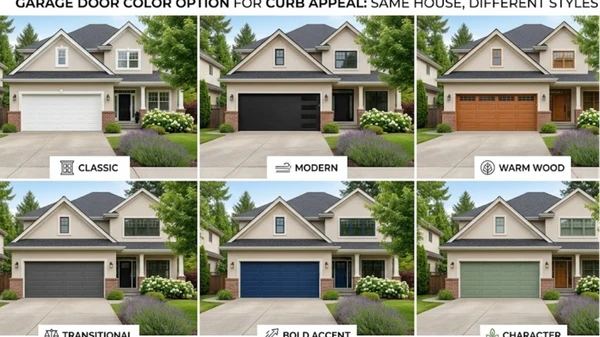
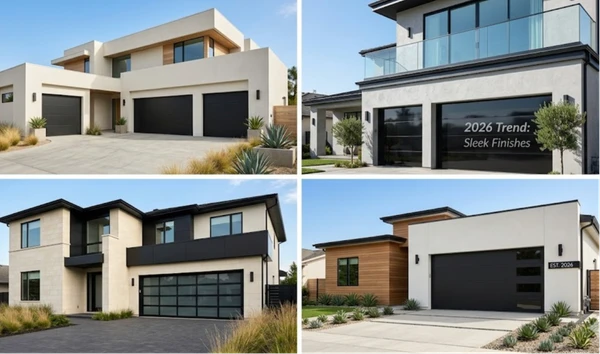
What color? In 2026, the combinations getting the most positive response across a range of home styles are: matte black or deep charcoal on white or light siding, warm white on brick, deep green or navy on natural wood or light gray siding. The guiding principle: match the new door color to the window frames, front door hardware, or shutters to create a coherent dark-accent language across the facade. A door color that relates to something else on the house looks designed. A door color that exists in isolation looks accidental.
A word on application method: a foam roller in the 3/8-inch nap range gives a smooth, non-stippled finish on flat steel panels. A brush for the recessed sections and edges. Work top to bottom so drips hit unpainted sections you'll cover next. The difference between a rolled finish and a brushed finish on a steel door is visible up close - the roller produces a cleaner result on the flat surfaces.
Decorative hardware: what turns a plain door into a carriage door
Decorative garage door hardware - specifically strap hinges and handles - is the upgrade most people don't know exists until they see it. It's also the one that generates the most neighbor comments.
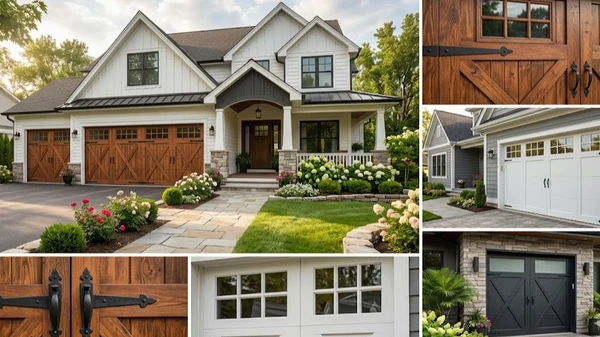
Faux strap hinges are black metal hinge pieces with mounting holes that attach magnetically or with screws directly to the door face. They're not functional - the door doesn't swing on them - but from the street they create the visual impression of a carriage door with traditional hardware. Paired with a center handle or ring pull on each section of the door, the effect is a complete carriage-house look on what was a blank steel panel.
The cost varies by material and quality. Magnetic versions - which stick to steel doors without any drilling - run $30 to $80 for a full set for a double-car door. Screw-mounted versions require drilling but are more permanent and tend to stay in position through weather changes better; they run $50 to $120. Heavy cast iron versions are at the premium end of the non-replacement hardware market and look the most convincing at close distance.
The finish matters almost as much as the style. Matte black is the most versatile and current choice in 2026 and works against any door color. Oil-rubbed bronze is warmer and suits doors with cedar or wood-tone elements. Avoid chrome or polished nickel - both read as bathroom hardware on a garage door, which is exactly the impression you don't want.
For the hardware to read as authentic from the street, the scale needs to be right. Strap hinges that are too small look like decorations. The vertical straps should run at least two-thirds of the panel width. Check photos of actual carriage doors and match the proportions - hardware that's undersized defeats the effect.
Window inserts: the upgrade that adds structure and light
A garage door without windows is a blank panel. Windows - even a single row of them across the top section - give the door vertical scale, break up the flatness, and let natural light into the garage.
Decorative window inserts fit into existing window openings that are already cut in the door. If your door has windows, the inserts are the decorative pieces that create the divided-light or arched appearance inside the existing frame. Swapping them out requires no tools - most snap in and out with hand pressure.
If your door doesn't have windows, adding them requires cutting the opening (a jigsaw, careful measurement, and a few hours on a Saturday) and installing a full window kit with frame and glass. The kits are door-specific - Clopay, Wayne Dalton, and Amarr each make window kits designed for their panel profiles - and most run $50 to $150 per window installed.
Style choices: colonial grilles (a rectangular grid of panes) suit traditional and craftsman homes and are the most versatile option. Arched or cathedral windows work on Spanish colonial and Mediterranean-influenced homes. Clean rectangular panes with no grille suit contemporary and modern homes where any divided light looks fussy. Prairie-style windows suit craftsman and mid-century homes.
The decision to add windows is also a decision about privacy and security. Clear glass lets light in both directions - anyone walking by can see what's inside. Frosted glass diffuses the light without the transparency. Tinted glass reduces solar heat gain and limits visibility. For garages where the contents are valuable and visible from the street, frosted or tinted glass is the practical choice.
Trim and frame refresh: the framing that makes everything else look better
This is the upgrade that professionals notice and homeowners don't think about.
The door trim - the frame molding around the opening on the exterior - contributes significantly to how finished the door looks. Trim that's cracked, painted over in a color that no longer matches, rotted at the bottom corners, or simply missing the second pass of caulk is visually rough even if the door itself is in good condition.
Garage door trim refresh involves scraping loose paint, caulking any gaps between the trim and the siding or the trim and the brick mold, and repainting. If the trim is wood and has soft spots from water damage, those sections need to come out and be replaced before painting. PVC trim board is worth considering as a replacement material - it doesn't rot, doesn't need repainting on the same schedule as wood, and looks identical to wood painted trim from any normal viewing distance.
Paint the trim in a color that complements the new door color. White or cream trim against a dark door is a classic combination that reads clearly from the street. Trim that matches the door color closely blurs the visual edge between the door and the frame, which reduces the crispness of the whole composition.
While you're working on the trim, the exterior light fixtures flanking the door are worth looking at. Light fixtures that have weathered, discolored, or are a finish that no longer matches the new hardware are a detail that pulls against everything else you've improved. Replacing a pair of flanking wall sconces runs $40 to $100 for midrange fixtures and takes an hour. The match between the fixture finish and the door hardware finish - both matte black, both oil-rubbed bronze - creates the coherence that makes an exterior look like it was designed rather than accumulated.
What to do about the driveway and threshold
The area directly in front of the door contributes to how the door reads in context. A cracked, oil-stained, or dated driveway apron doesn't cancel out a painted and hardware-upgraded door, but it limits how much the door upgrade lifts the overall picture.
Pressure washing the driveway surface before the door work is the minimum - it's a $50 rental or a professional job and it removes the accumulated grime that makes concrete look older than it is. A can of concrete cleaner handles oil stains if washing alone doesn't.
If the threshold - the transition at the base of the door where the driveway meets the garage - is rough, stained, or has concrete spalling, a concrete resurfacer applied to the apron area costs $25 to $40 in materials and significantly improves the appearance of the zone immediately in front of the door.
Landscaping in planters or window boxes flanking the garage doesn't directly improve the door, but it provides visual context that makes the door look more intentional. A garage door in the center of a composed, planted, maintained exterior reads differently than the same door sitting in a concrete desert.
When a makeover makes sense vs. when you need a new door
The honest question to ask before investing in a garage door makeover: is the door itself the problem or is it the door's presentation?
If the panels are structurally sound - no significant warping, no panel edges pulling apart, no sections that have buckled or cracked from impact - and the door travels smoothly on good hardware with springs in decent condition, a makeover addresses the appearance problem without the cost of replacement.
If the panels have significant damage, if the door is an uninsulated single-layer steel door in a climate where insulation matters, if the style is fundamentally wrong for the house and no hardware overlay is going to fix that, or if the mechanical components (springs, rollers, opener) are at end of life anyway - replacement may be the better investment, particularly given the ROI data on garage door replacement home value.
The point where a full makeover budget approaches the cost of a basic new door is around $800 to $1,200. If you're spending that to save an old door that would still need a new door in a few years, the math stops working in the makeover's favor.
But for a structurally sound door that just looks tired? The combination of paint, hardware, and windows - executed well - can produce a result that genuinely surprises people. My friend's neighbor asked if she'd replaced the entire door. She hadn't. She'd just made the right choices with $340 and a long weekend.
DoorFixy can help you figure out whether a makeover or a replacement makes more sense for your specific door - and handles either direction well.
More on the DoorFixy blog - garage door style guides, buying advice, ROI data, and practical upgrades for homeowners who want more from their garage door.