Every year I look at the Remodeling Magazine Cost vs. Value Report with a degree of healthy skepticism. It's a useful dataset - they survey real estate professionals in nearly 20 markets and ask how much specific remodeling projects add to a home's resale value. But it's a national average, and I've seen enough regional real estate to know that national averages aren't universal experiences.
With that caveat stated upfront: the garage door replacement ROI numbers from the 2025 report are genuinely striking. And they've been striking for several consecutive years, which is different from one good year.
Here's what the data actually shows and how to think about it for your situation.
The headline numbers - and where they come from
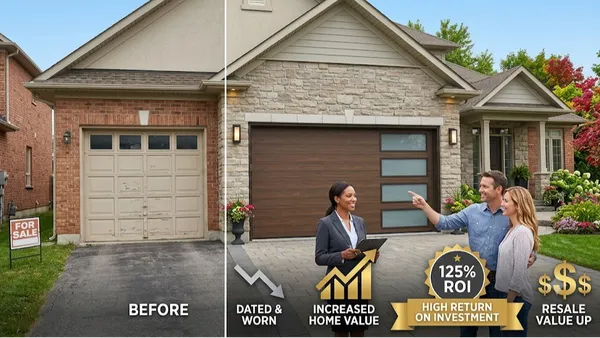
According to the 2025 Cost vs. Value Report published by Zonda (which produces the report under the Remodeling Magazine brand), garage door replacement returned an average of 268% at resale. The average project cost was approximately $4,672. The average value added at resale was over $12,500.
That 268% figure represents the second consecutive year garage door replacement held the number one spot in the entire report - outperforming every other remodeling project tracked. It's also a significant jump from prior years: 193.9% in 2024, and 102.7% in 2023.
The 2026 report, which reflects data from a different sample period, shows a somewhat lower figure of approximately 194% - still the top-ranked project, still significantly above every interior remodel tracked, and still well above the next-highest exterior project.
Worth noting: the report measures resale value relative to project cost, not absolute dollar gain. A 268% ROI on a $4,672 project means buyers paid roughly $12,500 more for the home than they would have without the upgrade - a genuine and verifiable number as far as real estate professionals in the surveyed markets could assess it. But these are professional estimates of buyer perception, not guaranteed appraisal increments. The methodology matters for reading the number correctly.
Why the ROI is so high - the actual mechanics
The garage door home value increase isn't mysterious. It comes from a combination of factors that the report captures and that anyone who's done real estate transactions recognizes.
Leverage from low base cost. A garage door replacement is inexpensive relative to most exterior home improvements. A kitchen remodel that adds $50,000 of perceived value still shows a mediocre ROI if it cost $90,000. A garage door that adds $12,500 of perceived value and cost $4,700 to replace shows spectacular ROI because the base is small and the perceived value gain is large relative to it.
Visual leverage from exterior scale. The garage door covers 20 to 40% of the front-facing facade on most residential homes. That's a disproportionately large portion of what a buyer sees from the street. A worn, outdated, or mismatched garage door drags down the perceived quality of the entire exterior in a way that no similarly-priced interior upgrade can match from the outside. Replacing it with something current and well-matched to the home's style changes the buyer's initial perception before they've stepped out of their car.
Broad appeal vs. subjective taste. Kitchen and bathroom remodels carry subjective risk - a homeowner who loves a particular cabinet style or tile pattern may have chosen something that the buyer doesn't love, which means the investment doesn't fully translate to perceived value. Garage doors have lower aesthetic risk. A well-matched, quality door in an appropriate style is broadly appealing in a way that a custom kitchen isn't. The investment translates more cleanly to buyer perception.
Signal of maintenance. A new or recently-replaced garage door signals to buyers that the property has been maintained. An old, dented, or faded door signals the opposite - and that signal radiates. Buyers who see a neglected exterior start looking for other signs of deferred maintenance, and their offers reflect the uncertainty that creates.
What the 268% number doesn't tell you
<cite index="22-1">The Cost vs. Value Report uses national averages</cite>, and the variation between markets is significant. A garage door replacement ROI in a hot coastal real estate market where buyers are competing for properties and curb appeal is intensely scrutinized looks different from the same project in a flat rural market where buyers are less influenced by exterior aesthetics. The national average is a useful directional signal, not a guarantee.
It also matters what you're replacing and with what. A basic builder-grade steel door replaced with another basic builder-grade steel door generates less buyer perception improvement than an aging, dented single-layer door replaced with an attractive insulated carriage-style door that matches the home's architecture. The survey captures a range of projects and averages them. Your specific replacement's ROI depends on where you're starting from and where you're going.
The numbers also don't distinguish between timing. A new garage door home value impact right before a sale - when buyers will form their first impression of a recently-updated door - likely exceeds the impact of a replacement done several years before the sale, when the door has had time to accumulate minor wear and become less obviously new.
The non-resale value that doesn't show up in ROI calculations
The Cost vs. Value Report measures resale impact. It doesn't measure the value of living with the improvement before selling.
Energy savings from replacing an uninsulated door with an insulated one (R-12 or higher) on an attached garage are real. The DOE estimates that 25% of home energy loss occurs through the garage - not all of that is the door, but the door contributes meaningfully. An insulated door on an attached garage reduces the HVAC load on the shared wall and, in many climates, produces measurable energy savings over the years of ownership.
Reduced maintenance is another non-resale benefit. A new quality door replaces aging hardware, worn springs, and deteriorating seals with fresh components. The first several years of ownership with a new door are typically maintenance-light compared to the last several years with an old one. Fewer emergency calls, fewer parts replacements, less inconvenience.
Security and daily function matter too. A new door with rolling-code technology and smart opener integration is more secure than a decade-old fixed-code system. A door that opens and closes reliably and quietly every morning is a different daily experience than one that strains, squeaks, and occasionally requires a second button press.
These are real. They don't show up in the ROI percentage, but they affect the total value proposition of the investment.
What makes sense for your situation
The resale-value case for a new garage door is strongest in three specific scenarios.
You're planning to sell within two years. The closer the installation is to the listing date, the more the visual improvement registers with buyers and the less time the door has had to show wear. If you're actively preparing for a sale, this is one of the clearest-ROI exterior upgrades available.
Your existing door is obviously dated, damaged, or mismatched. A door with visible dents, fading paint that shows chalking when you run a finger across it, or a style that was considered outdated before the current decade - these drag down buyer perception more than buyers can articulate but more than sellers can afford to ignore. The upgrade from this starting point to a current, well-matched door is where the maximum perceived value gain happens.
The door is visually prominent on the facade. A house where the garage dominates the front elevation - three-car garages, homes where the garage is centered and forward - gets more benefit from a door upgrade than a home where the garage is side-entered or visually subordinate.
Where the math is softer: you replaced the door recently and it still looks good, the garage is a detached structure that isn't part of the facade calculation, or you're in a market where buyers are competing on price and square footage rather than finishes.
The comparison that puts it in perspective
The minor kitchen remodel - new cabinet fronts, updated countertops, fresh hardware, mid-range appliances - recouped about 96% of its cost in the 2025 report. That's considered a strong interior ROI. The major upscale kitchen remodel recouped about 40%. A bathroom addition recouped about 30%.
A garage door replacement at 268% isn't just the best project in the exterior category. It's dramatically ahead of the best interior remodel available. The gap between them is the argument for the investment, stated more clearly than any summary paragraph can manage.
DoorFixy can help you pick the right door for your home, budget, and timeline - including whether a replacement makes sense now or whether maintenance and hardware updates on the current door are the right short-term call.