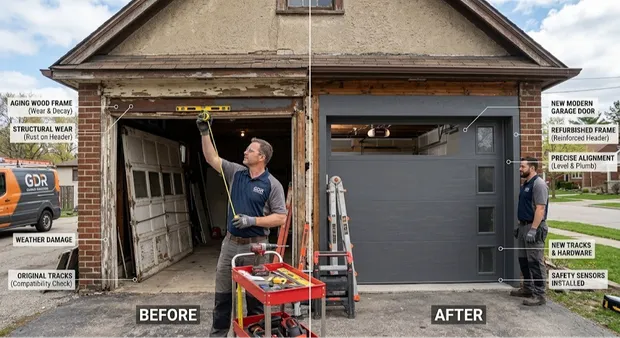
When the installer pulled up to my parents' house last spring for their door replacement, the first thing he did wasn't look at the new door sitting in the truck. He walked straight to the garage, took a pocket knife out, and pressed the tip into the wood trim on the left side of the frame. The knife sank in about a quarter inch before he stopped pushing.
"That's soft," he said. He probed a few more spots. "The wood's been wet. This side needs to come out."
My parents had no idea. The door had been opening and closing fine. Nothing visible from the outside suggested anything was wrong with the frame. But the moisture had been working on the framing behind the trim for a long time, and if they'd hung a 200-pound door on that side without addressing it, the frame would have gradually failed under the load.
Installing a new garage door on an old frame is possible - in many cases it's the right call. But the frame has to be assessed before you make that decision, not assumed to be fine.
What the frame actually does - and why it matters
The garage door frame isn't decorative. It's the structural interface between the door system and the house. The vertical tracks anchor to it. The header bracket holds the spring hardware against it. The weatherstripping seals against it. The opener's front mount bracket ties into it. Every load the door and its hardware generates - and a sectional door with spring tension generates significant load - transfers to the frame and from there to the surrounding wall structure.
A garage door frame in good condition distributes all of that correctly. A frame with rot, pest damage, or structural compromise doesn't distribute anything - it just slowly fails while the hardware works against it, and the signs show up as alignment problems, track drift, and eventually a door that won't close correctly.
This is why the frame assessment comes before the door selection discussion for any experienced installer. The frame either supports the job or it doesn't, and finding out after the door is hung is a worse situation than finding out before.
The four things that determine whether your old frame can be reused
Structural integrity is the first and most important factor. The wood framing around the garage opening - the vertical king studs on each side and the header across the top - needs to be solid. Press on it. Look for soft spots, visible rot, or discoloration that suggests long-term moisture contact. Tap along the frame; a hollow sound where you expect solid wood means the interior has been compromised. Pest damage - termite galleries, carpenter ant tunneling - can be visible as surface galleries or only apparent when you probe.
Minor surface weathering on the trim is cosmetic. Soft wood that takes a nail or knife blade easily means the structural fibers are compromised and the framing has lost its ability to hold fasteners securely. A lag bolt that bites into solid wood will hold for decades. The same bolt in soft rotted wood will gradually pull out under load.
Dimensional match is the second factor. The new door has to fit the existing opening. This sounds obvious until you're dealing with an older home where the opening was built to a non-standard dimension, or where decades of settling have shifted the opening slightly out of square. Standard garage door frame dimensions for a double-car opening are typically 16 feet wide and 7 feet tall. Anything meaningfully different from standard may require either a custom-ordered door or structural modification to the opening.
Measure the opening width and height at multiple points - at the floor, in the middle, at the top. If the numbers vary by more than half an inch, the opening has shifted and the new door will need shimming or the frame will need correction. A door hung in an opening that isn't square will never seal or travel correctly.
Headroom and side room are the third consideration. The space between the top of the opening and the ceiling determines whether the spring hardware and horizontal track can be installed without modification. Standard torsion spring installation needs at least 10 to 12 inches of headroom. Add an opener and you need more. An older home with low ceilings in the garage may not have standard headroom, and the existing frame configuration may have been built around low-headroom hardware that's no longer available.
Compatibility with the new door's hardware is the fourth factor. This is where old frames sometimes fail even when the wood is fine. The existing header bracket may be in the wrong position for the new door's spring shaft location. The existing track mounting holes may not line up with the new tracks. These issues aren't always discovered until installation begins, which is why an experienced installer looks at the frame before quoting, not just the door.
What about the tracks - can those be reused too?
Separate question from the frame, and worth addressing directly because a lot of homeowners try to save money by keeping the existing tracks.
The short answer: almost always no, and it matters more than most people expect.
Garage door tracks are engineered for specific door weights, heights, and panel profiles. A track system designed for a 7-foot, 130-pound steel door is not the same as one designed for an 8-foot, 220-pound insulated door. The track gauge, the radius curve, the roller channel width - all of these are matched to the door spec. Using the wrong tracks with a new door creates friction, accelerated roller wear, misalignment, and in worst cases, a door that comes off the track because the rollers don't seat correctly.
Reusing old garage door tracks with a new door also voids most manufacturer warranties. The warranty covers the door when installed with the specified hardware. The tracks are part of that specification. Installing the door on non-specified tracks transfers any resulting damage to out-of-pocket territory.
The only reasonable exception: replacing a door with an identical model, same size and weight, where the existing tracks are in good condition, properly aligned, and confirmed by the manufacturer to be compatible. This requires explicit confirmation, not just approximate similarity. If the installer isn't certain, replace the tracks.
When frame replacement is necessary - not optional
Several situations require replacing the garage door frame, not just the door:
If the wood is soft enough to take a blade or probe without resistance, the structural fibers are gone. No amount of surface treatment restores structural integrity to rot-damaged framing. It comes out, gets replaced with fresh pressure-treated lumber, and then the installation proceeds.
If the opening is visibly out of square - one vertical side higher than the other, the header visibly tilted - the framing has shifted. Shimming can compensate for minor variations, but significant deviation means the frame has moved relative to the surrounding structure, which requires assessment of the underlying cause before hanging a new door on it.
If you're changing door size. Increasing garage door opening size - going from a single 9-foot door to a double 16-foot door, or raising the height from 7 feet to 8 feet - requires structural work regardless of the existing frame's condition. The opening has to be reframed to accommodate the new size, the header may need to be replaced with one rated for the wider span, and this work typically requires a building permit.
If there's been water damage to the header specifically. The header carries the load across the top of the opening; it's under more stress than the side framing. A compromised header is a structural concern that goes beyond cosmetic replacement.
Changing door style and what it means for the frame
Switching from one type of door to another is where frame compatibility gets more nuanced.
A sectional door - the standard panel-by-panel type - has specific frame requirements for the vertical and horizontal tracks. A carriage-style door that swings out has different requirements entirely, including clearance on each side of the opening for the door arc. Converting from a sectional to a swing-out, or adding a new door type where a different type previously existed, usually requires frame modification.
Replacing like-for-like - same door type, same size, same or similar weight - is where the existing frame has the best chance of being reused without modification. The hardware locations are typically the same, the track mounting points are in the expected positions, and the installer is working with a frame that was designed for the door type going in.
What the frame assessment involves - and who should do it
Any professional garage door company will assess the frame as part of a replacement quote. They're looking at:
The wood for soft spots, rot, moisture staining, and pest damage. The opening dimensions at multiple heights and widths. The headroom above the opening and the side room on each side. The existing hardware and whether it conflicts with or can accommodate the new installation. The electrical situation - whether there's a functioning outlet where the opener motor will mount.
If the installer doesn't mention the frame condition during the quote, ask. The condition of the existing garage door frame is the single largest variable in whether a straightforward replacement stays straightforward or requires additional work.
DoorFixy provides frame assessment as part of every installation quote - so you know before the crew shows up what the frame situation is, what it means for the installation, and whether any repairs are needed before the door goes in.