There's a moment in real estate that happens before anyone walks through a front door. The buyer pulls up, looks at the house for thirty seconds from the car, and forms an impression that the rest of the showing either confirms or fights against. Agents know this. Sellers who've watched a listing sit for weeks while comparable houses move know this too.
The garage door is one of the most dominant elements in that thirty-second read. On most residential homes, it covers between 20 and 40% of the visible front elevation. It's not an accent feature - it's a primary surface. A door that reads as tired, dated, or mismatched doesn't just look bad on its own terms; it tells a story about the house that buyers carry with them from car to doorbell.
The good news is that this is one of the more actionable problems in home improvement. Garage door curb appeal upgrades range from $30 to $5,000, they're reversible or upgradeable, and they produce results that are visible from the street - which is exactly where you need them to land.
Here's what actually works, organized by scale and impact.
The upgrade with the highest visual return per dollar: color
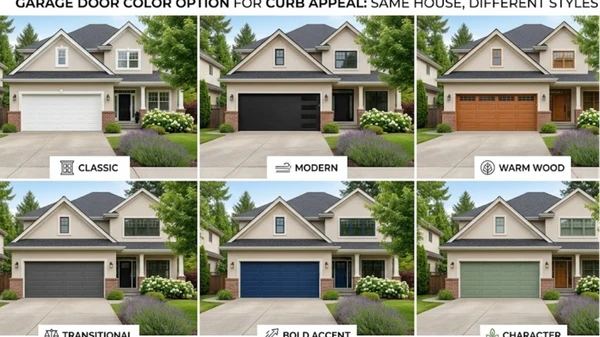
Nothing changes how a garage door curb appeal reads from the street as quickly or as dramatically as a deliberate, well-executed color change. A faded, chalky, or wrong-color door undermines the entire facade composition. A freshly painted door in a color that relates to the window frames, the front door, and the trim can make a home look actively designed rather than just maintained.
The full painting process - wash, sand, prime, two coats - costs under $150 in materials and a long Saturday of work. That ROI ratio is essentially impossible to beat with any other home improvement on any scale.
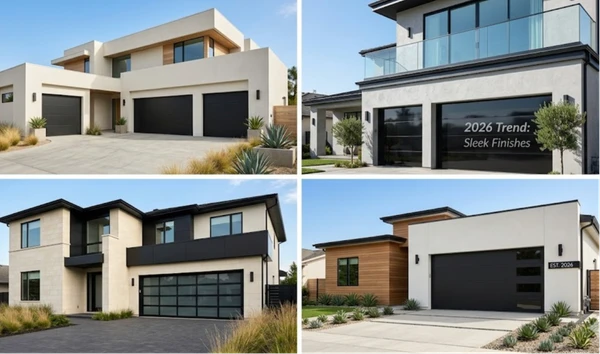
The colors doing the most work for curb appeal in 2026: matte black or deep charcoal against light-colored siding (white, cream, light gray), warm black on brick, deep navy or forest green on natural wood siding or light gray homes, and warm white on Craftsman or traditional homes where anything bolder would read as a disruption rather than an accent.
What all of these have in common: they relate to something else on the house. The dark door matches the window frames, or the black door matches the front door hardware, or the white door matches the trim. When the garage door color is part of a coherent exterior color language rather than a standalone choice, the result reads as intention rather than accident. Intention is what reads well from the street.
The two application mistakes that kill what would otherwise be a good paint job: not sanding before painting (without mechanical bite for the paint to grip, even good paint peels within a season), and using interior latex or the wrong product for the substrate. Steel garage doors need 100% exterior acrylic latex. Apply it in two thin coats with a foam roller on the flat sections and a brush in the recessed areas.
Decorative hardware: from blank panel to carriage door
If the painting job is the biggest value-per-dollar curb appeal upgrade, adding decorative hardware is the most dramatically transformative one in terms of the door's design character.
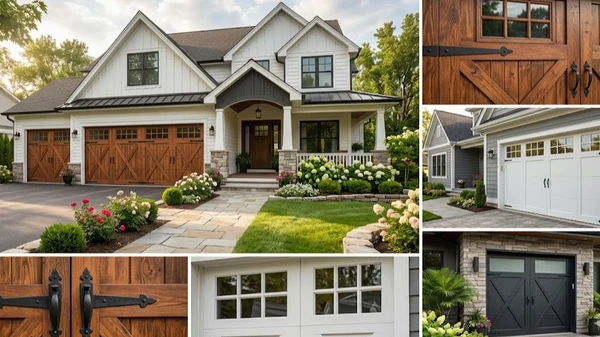
A plain raised-panel steel door with nothing on it is a blank, generic surface. The same door with a set of matte black strap hinges and a center handle looks like a carriage house door. From the street - which is the only view that matters for curb appeal - the effect is convincing enough that neighbors ask whether you replaced the door.
Decorative garage door hardware in the form of strap hinges attaches to the door face and is available in two configurations: magnetic (which sticks to steel doors without drilling) and screw-mounted (which requires drilling through the panel). Magnetic versions run $30 to $80 for a full set for a double-car door and are easy to reposition or remove. Screw-mounted versions are more permanent and tend to hold their position better through weather cycles; they run $50 to $120.
The scale has to be right for the effect to work. Strap hinges that are too small look like decorations rather than hardware. The vertical straps should run at least two-thirds of the panel height - look at photos of actual carriage doors and match the proportions. Paired with a center ring pull or bar handle on each door section, the composition reads clearly as carriage-style from the street.
The hardware finish needs to coordinate with the rest of the door and facade hardware. Matte black is the most versatile choice in 2026 - it works against dark and light door colors and matches the window frame and front door hardware on most current homes. Oil-rubbed bronze is warmer and suits doors with cedar or wood-tone elements nearby.
Window inserts: structure, proportion, light
A row of windows across the top section of a garage door does several things simultaneously. It breaks up the visual mass of a large panel. It creates vertical interest and proportion - a door that has windows reads as finished in a way that a door without them doesn't. It lets natural light into the garage. And it creates a design connection between the garage door and the windows on the rest of the house.
Garage door window inserts that fit existing cutouts in the door snap in without any tools. They come in colonial, arched, prairie, and rectangular styles. The style choice should be driven by what's already on the house: colonial window grilles on the garage door against a home with prairie windows on the main facade creates visual discord that people feel without necessarily identifying. Match the garage windows to the style and proportion of the windows nearby.
If the door doesn't have cutouts, adding windows requires cutting the opening with a jigsaw and installing a full window kit with frame and glass. The kits are door-specific - most major brands (Clopay, Wayne Dalton, Amarr) make kits for their panel profiles - and run $50 to $150 per window. A row of six windows across the top section of a double-car door, installed over a weekend, makes a significant and permanent improvement to the door's visual character.
The glass choice affects privacy and solar gain. Clear glass lets in the most light and looks the most open. Frosted or seeded glass diffuses light and reduces visibility into the garage. Tinted glass reduces solar gain (meaningful in hot climates where a south or west-facing door accumulates heat). In garages where the contents are visible from the street, frosted or tinted glass is the practical choice.
A style upgrade when the door itself is the right candidate
Sometimes the underlying door structure is fine but the panel style is working against the house. A flat flush panel on a Craftsman home, a raised panel on a contemporary home, or an outdated raised panel profile on a home where everything else has been updated to a more current aesthetic - these are situations where the door style creates friction with the overall composition.
Upgrading garage door style without replacing the door is limited - you can't repress the steel panel profile once it's manufactured. The options are hardware and paint to recontextualize the existing panel (effective for most traditional styles), window inserts to add detail, or full door replacement when the style mismatch is fundamental.
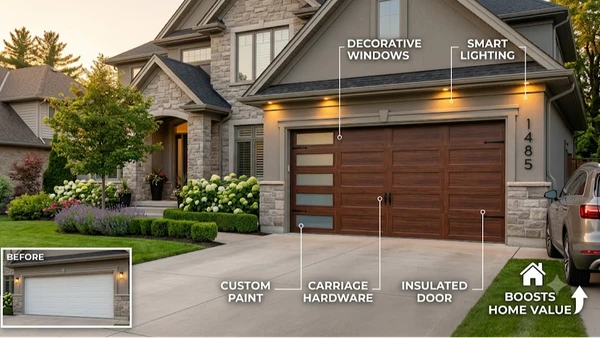
The combination that produces the most dramatic before-and-after result within a moderate budget: paint the existing door in a deliberate color, add carriage-style strap hinges and handles, and install a row of colonial or rectangular windows across the top section. The effect changes the design language of the door completely without replacing the structure. Cost: $200 to $500 in materials, one to two full days of work.
A new door when the existing one is the limiting factor
There's a point at which upgrading the existing door produces diminishing returns. A door that's significantly dented, has warped or buckled panels, is uninsulated single-layer steel that's visibly flexing under the opener, or is a style that's fundamentally incompatible with the house's architecture - this is when replacement is the right garage door curb appeal upgrade rather than enhancement of what's there.
The 2025 Cost vs. Value Report recorded an average 268% ROI on garage door replacement nationally - <cite index="2-1">the #1 ranked home improvement project for the second consecutive year</cite>. The mechanism is straightforward: a garage door covers a large, prominent exterior surface, the replacement cost is relatively low, and buyers respond to curb appeal before they respond to anything inside the house.
For a homeowner replacing a door for curb appeal, the choices that matter most are:
Style alignment with the house - a carriage-house door on a Craftsman bungalow, a flush contemporary panel on a mid-century modern home, a traditional raised panel on a colonial. A door that reads as belonging to the house is more valuable than a door that looks good in isolation.
Color in context - how the new door color relates to the rest of the facade. The considerations are the same as for a paint upgrade, but chosen at purchase rather than after the fact.
Window presence - a new door with windows reads differently than the same door without them. For most home styles except contemporary, adding windows at the time of purchase is the right call.
Insulation - R-12 to R-16 polyurethane insulated construction on an attached garage. Beyond the thermal benefit, the insulated construction panel has more depth and shadow definition than a single-layer panel, which photographs better and reads more substantial from the street.
The surroundings that make the upgrade land
The garage door is one element in a composition. Its curb appeal impact is maximized when the surroundings support it.
Exterior lighting - a pair of wall sconces flanking the door in a finish that matches the new door hardware finishes the composition. A dark door with matte black hardware and matte black sconces reads as a designed system. The same door with mismatched brass fixtures reads as an incomplete upgrade.
Driveway apron condition - the concrete immediately in front of the door. Cracks, stains, and spalling distract from the door above them. Pressure washing clears accumulated grime. Concrete resurfacer handles surface spalling. A clean, maintained apron is the floor of the composition.
Trim condition - the frame molding around the garage door opening. Trim that's peeling, discolored, or slightly out from the wall creates visual noise right at the edge of the door. Fresh caulk, fresh paint in a color that complements the door, and any rotted sections replaced before painting turns the trim from a distraction to a clean frame.
None of these make the door itself more appealing. But they determine whether the door's visual impact is fully realized or undercut by what surrounds it.
The one question that focuses the decision
What's the limiting factor on this door?
If it's color - paint it. If it's plain steel with no character - add hardware and windows. If it's a style that works against the house - consider full replacement. If it's an insulated performance issue on an attached garage in a climate where that matters - replacement with insulated construction pays back in energy costs and comfort.
The best garage door upgrade for curb appeal is the one that addresses the actual limiting factor, not the one that adds the most things. A freshly painted door with the right hardware often beats a new door that's the wrong style. Knowing which problem you're solving drives the right decision.